
Items related to Descartes' Error : Emotion, Reason, and the Human...
Synopsis
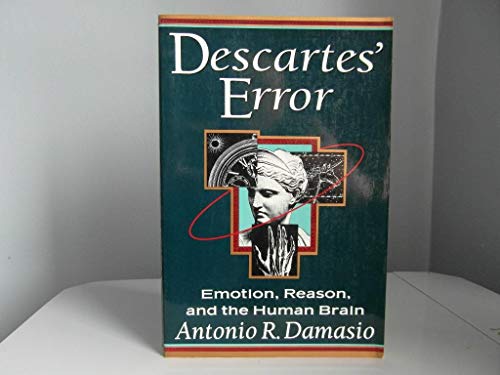
Linking the process of rational decision making to emotions, an award-winning scientist who has done extensive research with brain-damaged patients notes the dependence of thought processes on feelings and the body's survival-oriented regulators. 50,000 first printing.
"synopsis" may belong to another edition of this title.
About the Author
Antonio R. Damasio, M.D., Ph.D., is the M. W. Van Allen Professor of Neurology and head of the department of neurology at the University of Iowa College of Medicine, Iowa City. He is also adjunct professor at the Salk Institute for Biological Studies, La Jolla, California.
Reviews
In an important, gracefully written exploration of the neurochemical basis of mind, neurologist Damasio rejects the Cartesian notion of the human mind as a thinking organ more or less separate from bodily processes. Emotions and feelings, he argues, are essential to reasoning and decision-making. The human brain, he further contends, has a specialized region in the frontal lobes for making personal and social decisions, and this region works in concert with deeper brain centers that store emotional memories. To support this controversial claim, Damasio draws on his work with brain-injured patients at the University of Iowa College of Medicine, and also cites the case of Phineas Gage, a Vermont railway foreman who lost his ethical faculties after an explosion in 1848 drove a metal rod through his skull. Damasio's exciting investigation challenges the fashionable metaphor of the mind as a software program. Interested readers are also referred to Richard Restak's The Modular Brain (Nonfiction Forecasts, June 13). Illustrations. 50,000 first printing; QPB alternate; Library of Science selection.
Copyright 1994 Reed Business Information, Inc.
Few neuroscientists today would defend Cartesian dualism--the idea that mind and body are separate--but Damasio takes one more leap: Not only are philosophers wrong to separate brain and body, but psychology's separation of reason from emotion is also wrong. Most neuroscientists agree that what we call the mind reflects the functions of the nervous system--in short, crudely speaking, the body. Modern science, however, has transferred the old mind- body split into a brain-body dichotomy in which the brain occupies a hierarchically privileged place. But Damasio (Neurology/Univ. of Iowa College of Medicine) democratizes the relationship between brain and body; he posits a powerful interdependence in which our physical experience of the world around us is central to the creation of our sense of self, and colors our behavior. His persuasive argument begins with Phineas Gage, a 19th-century railway worker who suffered brain damage when an iron rod shot through his head like a missile, destroying his left eye and parts of his frontal lobes. The result was not a loss of speech or memory but profound personality and emotional changes and an inability to make rational judgments about the present and future. Damasio and his wife, Hanna, have studied patients with similar frontal-lobe damage and similar effects: IQ, memory, and language are intact, but there is a lack of feeling and an inability to put current events in context and make future judgments. These points are eloquently expressed, along with the anatomical/physiological evidence linking the frontal cortices with sensory-motor areas and emotional networks that feed forward and backward from the body surface and internal organs. Damasio is the first to admit that he cannot prove all he says. In the meantime, one can read with pleasure and share the excitement of a neuroscientist who sees that in the union of the many parts of the human brain lies its strength. (Quality Paperback Book Club alternate selection; Library of Science main selection) -- Copyright ©1994, Kirkus Associates, LP. All rights reserved.
The idea that the mind exists as a distinct entity from the body has profoundly influenced Western culture since Descartes proclaimed, "I think, therefore I am." Damasio, head of neurology at the University of Iowa and a prominent researcher on human brain function, challenges this premise in a fascinating and well-reasoned argument on the central role that emotion and feelings play in human rationality. According to Damasio, the same brain structures regulate both human biology and behavior and are indispensable to normal cognitive processes. Damasio demonstrates how patients (his own as well as the 19th-century railroad worker Nicholas Gage) with prefrontal cortical damage can no longer generate the emotions necessary for effective decision-making. A gifted scientist and writer, Damasio combines an Oliver Sack-like reportage with the presentation of complex, theoretical issues in neurobiology. Recommended for wide purchase.
Laurie Bartolini, Legislative Research, Springfield, Ill.
Copyright 1994 Reed Business Information, Inc.
Pioneering scientist Damasio's international reputation is based on his explorations into the neurology of vision, memory, and language. His influence will extend far beyond the parameters of the scientific community with this marvelously lucid and engaging presentation of his innovative ideas about the interconnectedness of mind and body. Damasio begins with some dramatic case histories of people who have survived brain damage without severe physical impairment only to experience bizarre degradations of personality and thought processes. He explains these puzzling maladies by analyzing the various systems at work in the brain, from those associated with life support to the highest echelon of cognition. After discussing how emotions and feelings are expressed by the bodypounding heart, trembling hands, blushingDamasio launches into one of his main themes: how essential emotions are to our ability to reason and make decisions. As he illuminates numerous ways the body and the mind work together to process stimuli, draw upon memory, and fuel thought and judgment, Damasio convinces us that the self is a perpetually recreated neurobiological state. Descartes' error, then, was his belief that the mind and body are separate entities. On the contrary, Damasio tells us, their continual collaboration is the key to consciousness and individuality. Donna Seaman
"About this title" may belong to another edition of this title.
Search results for Descartes' Error : Emotion, Reason, and the Human...

Stock Image
DESCARTES' ERROR Emotion, Reason, and the Human Brain
Seller: ThriftBooks-Reno, Reno, NV, U.S.A.
Seller rating 5 out of 5 stars

Hardcover. Condition: Fair. No Jacket. Readable copy. Pages may have considerable notes/highlighting. ~ ThriftBooks: Read More, Spend Less. Seller Inventory # G0399138943I5N00
Stock Image
DESCARTES' ERROR Emotion, Reason, and the Human Brain
Seller: ThriftBooks-Reno, Reno, NV, U.S.A.
Seller rating 5 out of 5 stars
Hardcover. Condition: Good. No Jacket. Former library book; Pages can have notes/highlighting. Spine may show signs of wear. ~ ThriftBooks: Read More, Spend Less. Seller Inventory # G0399138943I3N10
Stock Image
DESCARTES' ERROR Emotion, Reason, and the Human Brain
Seller: ThriftBooks-Reno, Reno, NV, U.S.A.
Seller rating 5 out of 5 stars
Hardcover. Condition: Fair. No Jacket. Missing dust jacket; Readable copy. Pages may have considerable notes/highlighting. ~ ThriftBooks: Read More, Spend Less. Seller Inventory # G0399138943I5N01
Stock Image
DESCARTES' ERROR Emotion, Reason, and the Human Brain
Seller: ThriftBooks-Dallas, Dallas, TX, U.S.A.
Seller rating 5 out of 5 stars
Hardcover. Condition: Very Good. No Jacket. May have limited writing in cover pages. Pages are unmarked. ~ ThriftBooks: Read More, Spend Less. Seller Inventory # G0399138943I4N00
Stock Image
DESCARTES' ERROR Emotion, Reason, and the Human Brain
Seller: ThriftBooks-Atlanta, AUSTELL, GA, U.S.A.
Seller rating 5 out of 5 stars
Hardcover. Condition: Good. No Jacket. Former library book; Pages can have notes/highlighting. Spine may show signs of wear. ~ ThriftBooks: Read More, Spend Less. Seller Inventory # G0399138943I3N10
Stock Image
DESCARTES' ERROR Emotion, Reason, and the Human Brain
Seller: ThriftBooks-Dallas, Dallas, TX, U.S.A.
Seller rating 5 out of 5 stars
Hardcover. Condition: Good. No Jacket. Former library book; Pages can have notes/highlighting. Spine may show signs of wear. ~ ThriftBooks: Read More, Spend Less. Seller Inventory # G0399138943I3N10
Stock Image
DESCARTES' ERROR Emotion, Reason, and the Human Brain
Seller: ThriftBooks-Atlanta, AUSTELL, GA, U.S.A.
Seller rating 5 out of 5 stars
Hardcover. Condition: Good. No Jacket. Pages can have notes/highlighting. Spine may show signs of wear. ~ ThriftBooks: Read More, Spend Less. Seller Inventory # G0399138943I3N00
Stock Image
DESCARTES' ERROR Emotion, Reason, and the Human Brain
Seller: ThriftBooks-Atlanta, AUSTELL, GA, U.S.A.
Seller rating 5 out of 5 stars
Hardcover. Condition: Fair. No Jacket. Readable copy. Pages may have considerable notes/highlighting. ~ ThriftBooks: Read More, Spend Less. Seller Inventory # G0399138943I5N00
Stock Image
DESCARTES' ERROR Emotion, Reason, and the Human Brain
Seller: ThriftBooks-Dallas, Dallas, TX, U.S.A.
Seller rating 5 out of 5 stars
Hardcover. Condition: Fair. No Jacket. Readable copy. Pages may have considerable notes/highlighting. ~ ThriftBooks: Read More, Spend Less. Seller Inventory # G0399138943I5N00
Stock Image
DESCARTES' ERROR Emotion, Reason, and the Human Brain
Seller: ThriftBooks-Phoenix, Phoenix, AZ, U.S.A.
Seller rating 5 out of 5 stars
Hardcover. Condition: Very Good. No Jacket. May have limited writing in cover pages. Pages are unmarked. ~ ThriftBooks: Read More, Spend Less. Seller Inventory # G0399138943I4N00