
Items related to Every Man a Tiger
Synopsis
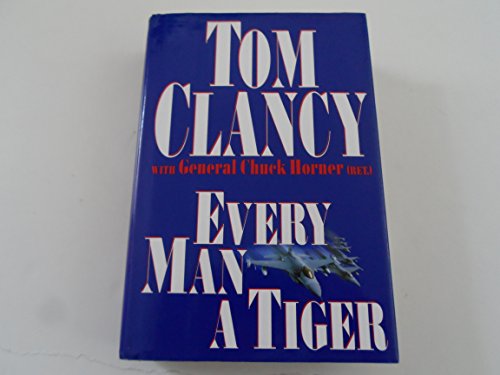
Combining military history and biography, a profile of General Chuck Horner, commander of the allied air forces during the Persian Gulf War, discusses the tactics involved, as well as the changing nature of our Air Force. 400,000 first printing. BOMC Main.
"synopsis" may belong to another edition of this title.
About the Author
Tom Clancy was the author of eighteen #1 New York Times-bestselling novels. His first effort, The Hunt for Red October, sold briskly as a result of rave reviews, then catapulted onto the bestseller list after President Ronald Reagan pronounced it ���the perfect yarn.��� Clancy was the undisputed master at blending exceptional realism and authenticity, intricate plotting, and razor-sharp suspense. He died in October 2013.
���
Reviews
Clancy's second study in high command of the U.S. armed forces (after Into the Storm, written with Army general Fred Franks) focuses on Air Force general Chuck Horner, the fighter pilot who was overall air commander for Desert Shield/Desert Storm. This book is less about the Gulf War than about the making of a modern fighter general and the remaking of a modern air force. Horner was part of a new Air Force generation that rejected the Strategic Air Command model of "predictability, order and control" in favor of a holistic approach to air power and air command. A firm believer in central control of air assets, Horner also regarded traditional distinctions between "strategic" and "tactical" air as no longer relevant. What mattered was the appropriate situational use of air power in an integrated war plan. The main text demonstrates Horner's success in implementing his concepts over Iraq. Though the narrative offers no startling insights or revelations, the authors make the important contribution of presenting command friction as a natural consequence of interaction among senior officers with high intelligence and strong wills. The implication is clear: to succeed in an unpredictable international environment, America's armed forces will need tigers at their head. Tigers are dangerous. They challenge each other. They take issue with higher wisdom and higher authority. And, according to the authors, they can be replaced by safely neutered house cats only at the country's peril. 500,000 first printing; $500,000 ad/promo; BOMC main selection; author tour.
Copyright 1999 Reed Business Information, Inc.
Bestselling novelist and nonfiction military author Clancy (A Guided Tour of an Aircraft Carrier, 1999, etc.) partners with Horner, a Vietnam fighter pilot who rose to general and commander of the Desert Storm air offensive, to narrate the Gulf War from the top commanders vantage point. The duo portray an air-warrior culture shaped by the perennial possibility of death, whether in the exacting training or in combat. Horner describes the strange rules of engagement dictated to the military in Vietnam from LBJ's far-off Washington, where politicians often bypassed the advice of military leaders in a policy of ``Graduated Pressure'' that prolonged the war and caused casualties to mount. Clancy credits young Vietnam-era officers like Colin Powell, Norman Schwarzkopf, and Horner with correcting the mistakes of that war by reforming the Army and Air Force while building the greatest, most effective armed forces in history. The result was a quick victory with few casualties over Iraq's huge army. Readers get a detailed description of the air offensive and the victory in Kuwait and Iraq of a successful coalition of Arab, European, and American ground troops. There are snapshots of Schwarzkopf (the short fused, perfectionist Commander-in-Chief, who could not bear the agony of losing any of his beloved ground troops), Powell, President Bush, Secretary Cheney, and the Arab high commanders. Horner discusses the philosophy of command and finds that the war was necessary to stop the stealing of vital oil supplies and the murder, rape, and torture inflicted by Iraqi troops on the people of Kuwait. Despite the bravery of soldiers in a just cause, war is still a hateful course of action and should be used as a policy of last resort, Horner declares. An absorbing, detailed, and useful study of soldiers under stress and deadly events that tested their courage, determination and efficiency. (First printing of 500,000, Book-of-the-Month Club main selection, $500,000 ad/promo) -- Copyright ©1999, Kirkus Associates, LP. All rights reserved.
Clancy takes a look at war with the commander of U.S. allied air assets during Desert Shield and Desert Storm.
Copyright 1999 Reed Business Information, Inc.
"About this title" may belong to another edition of this title.
Search results for Every Man a Tiger

Stock Image
Every Man a Tiger
Seller: World of Books (was SecondSale), Montgomery, IL, U.S.A.
Seller rating 5 out of 5 stars

Condition: Acceptable. Item in good condition. Textbooks may not include supplemental items i.e. CDs, access codes etc. Seller Inventory # 00067463206
Stock Image
Every Man a Tiger
Seller: World of Books (was SecondSale), Montgomery, IL, U.S.A.
Seller rating 5 out of 5 stars
Hardback. Condition: Good. Seller Inventory # 00066941710
Seller Image
Every Man a Tiger
Seller: 3Brothers Bookstore, Egg harbor township, NJ, U.S.A.
Seller rating 5 out of 5 stars
Condition: very_good. Cover may have light wear, pages in very good condition and binding is sturdy; may have other light shelf wear or creases. May have notes or highlighting. Seller Inventory # EVV.0399144935.VG
Seller Image
Every Man a Tiger
Seller: Zoom Books Company, Lynden, WA, U.S.A.
Seller rating 5 out of 5 stars
Condition: like_new. Seller Inventory # ZBV.0399144935.LN
Seller Image
Every Man a Tiger
Seller: Zoom Books Company, Lynden, WA, U.S.A.
Seller rating 5 out of 5 stars
Condition: very_good. Book is in very good condition and may include minimal underlining highlighting. The book can also include "From the library of" labels. May not contain miscellaneous items toys, dvds, etc. . We offer 100% money back guarantee and 24 7 customer service. Seller Inventory # ZBV.0399144935.VG
Seller Image
Every Man a Tiger
Seller: Zoom Books East, Glendale Heights, IL, U.S.A.
Seller rating 5 out of 5 stars
Condition: very_good. Book is in very good condition and may include minimal underlining highlighting. The book can also include "From the library of" labels. May not contain miscellaneous items toys, dvds, etc. . We offer 100% money back guarantee and 24 7 customer service. Seller Inventory # ZEV.0399144935.VG
Seller Image
Every Man a Tiger
Seller: Used Book Company, Egg Harbor Township, NJ, U.S.A.
Seller rating 5 out of 5 stars
Condition: Good. Shows moderate signs of wear and previous use. Can include notes/highlighting. A portion of your purchase benefits nonprofits! - Note: Edition & format may differ from what is shown in stock photo & item details. May not include supplementary material (toys, access code, dvds, etc). Seller Inventory # 584ZSU0013O8_ns
Seller Image
Every Man a Tiger
Seller: Used Book Company, Egg Harbor Township, NJ, U.S.A.
Seller rating 5 out of 5 stars
Condition: Very Good. Former library copy. Shows minimal signs of wear and previous use. Can include minimal notes/highlighting. A portion of your purchase benefits nonprofits! - Note: Edition & format may differ from what is shown in stock photo & item details. May not include supplementary material (toys, access code, dvds, etc). Seller Inventory # 584UZG000K4C_ns
Seller Image
Every Man a Tiger
Seller: Used Book Company, Egg Harbor Township, NJ, U.S.A.
Seller rating 5 out of 5 stars
Condition: As New. Shows very minimal signs of wear and previous use. A portion of your purchase benefits nonprofits! - Note: Edition & format may differ from what is shown in stock photo & item details. May not include supplementary material (toys, access code, dvds, etc). Seller Inventory # 584ZST000584_ns
Stock Image
Every Man a Tiger
Seller: Your Online Bookstore, Houston, TX, U.S.A.
Seller rating 5 out of 5 stars
hardcover. Condition: Fair. Seller Inventory # 0399144935-4-28115335