
Items related to Battle Ready
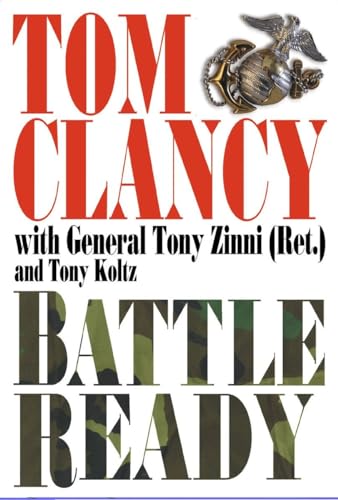
Synopsis
In his first three Commanders books, Tom Clancy teamed with Generals Fred Franks, Jr., Chuck Horner, and Carl Stiner to provide masterful blends of history, biography, you-are-there narrative, insight into the practice of leadership, and plain, old-fashioned storytelling. Battle Ready is all of that-and it is also something more.
Marine General Tony Zinni was known as the "Warrior Diplomat" during his nearly forty years of service. As a soldier, his credentials were impeccable, whether leading troops in Vietnam, commanding hair-raising rescue operations in Somalia, or-as Commander in Chief of CENTCOM-directing strikes against Iraq and Al Qaeda. But it was as a peacemaker that he made just as great a mark-conducting dangerous troubleshooting missions all over Africa, Asia, and Europe; and then serving as Secretary of State Colin Powell's special envoy to the Middle East, before disagreements over the 2003 Iraq War and its probable aftermath caused him to resign.
Battle Ready follows the evolution of both General Zinni and the Marine Corps, from the cauldron of Vietnam through the operational revolution of the seventies and eighties, to the new realities of the post-Cold War, post-9/11 military-a military with a radically different job and radically different tools for accomplishing it. It is an eye-opening book-a front-row seat to a man, an institution, and a way of both war and peace that together make this an instant classic of military history.
"synopsis" may belong to another edition of this title.
About the Author
Tom Clancy is the author of thirteen novels, most recently The Teeth of the Tiger, and the Commanders books Into the Storm, Every Man a Tiger, and Shadow Warriors.
General Tony Zinni (Ret.) was Commander in Chief of CENTCOM from 1997 to 2000, and from November 2002 to March 2003 was Colin Powell's special envoy to the Middle East. He has also led special missions to such nations as Turkey, Pakistan, Kenya, Russia, Yemen, Indonesia, and the Philippines-a role he continues today.
Reviews
"In the lead-up to the Iraq War and its later conduct, I saw at a minimum, true dereliction, negligence, and irresponsibility, at worse, lying, incompetence and corruption." So says former U.S. Central Command commander in chief Zinni, who retired in September 2000 and has been outspoken ever since regarding the uses and abuses of the U.S. military. This book is the latest of Clancy's nonfiction Commanders series, which has previously featured collaborations with Gen. Fred Franks Jr. of the army, Gen. Chuck Horner of the air force and Gen. Carl Stiner, formerly U.S. Special Operations commander. As in those books, Clancy gives adequate background on his subject and his subject's context, then quotes him liberally, consigning tens of pages at a time to Zinni's italicized first-person reflections. Beginning the book with the 1998 CentCom-coordinated attack on Saddam Hussein (the unfortunately named Operation Desert Fox), Clancy and Zinni next move through 150 or so pages of Zinni's service as a Philadelphia-born (in 1947) Marine infantry officer during Vietnam and his racially charged Headquarters and Service stint on Okinawa in the early '70s. The book then flashes forward to the end of the Cold War and steams along from there, with details on Zinni's European command service, including 1990 meetings with a recently de-Sovietized Russian army and support operations during the Persian Gulf War. Zinni joined CentCom just in time for the Somalia debacle, and he is candid about its failings. Over the next years, Zinni traveled widely in parts of the world that were obscure to the U.S. then (Pakistan, Central Asia), but are central now, and played cat-and-mouse with Saddam regarding weapons inspections all through the late '90s. But it is Zinni's 24-page closing statement, "The Calling," that will sell the book to nonbuff civilians, summing up his service and the ways in which he feels his generation's legacy is in jeopardy.
Copyright © Reed Business Information, a division of Reed Elsevier Inc. All rights reserved.
This is the fourth book in Clancy's nonfiction Commanders series; all have been cowritten with generals. This one chronicles the 40-year career of the now-retired Zinni, which includes two tours in Vietnam, two years as an instructor at the Basic School in the U.S., and his role as head of the U.S. Central Command. He also served in posts in Okinawa, Vieques Island, Germany, Turkey, and Somalia. Zinni reflects on the Vietnam War, saying, "Today we are seeing a stream of apologetic books by the policymakers and military leaders of that era--as though saying mea culpa enough will absolve them of the terrible responsibility they bear." On Operation Desert Storm, he says, "The only reason [that campaign] worked was because we managed to go up against the only jerk on the planet who was stupid enough to challenge us to refight World War II." On the Iraq war, he insists, "False rationales presented as justification, a flawed strategy, lack of planning, the unnecessary distraction from real threats, and the unbearable strain dumped on our overstretched military, all of these caused me to speak out." He warns that military conflict has changed in the twenty-first century and we have been reluctant to recognize it or to acknowledge it. Whether or not readers agree with Zinni, this is a book that demands our attention. George Cohen
Copyright © American Library Association. All rights reserved
Excerpt. © Reprinted by permission. All rights reserved.
CHAPTER ONE
Desert Fox
THE TOMAHAWKS WERE SPINNING up in their tubes.
It was November 12, 1998. U.S. Marine General Tony Zinni, the commander in chief of United States Central Command (CENTCOM), was standing in his command room overlooking the command center at CENTCOM's Tampa, Florida, headquarters, leading the preparations for what promised to be the most devastating attack on Iraq since the 1991 Gulf War.
The spacious command center was fitted out with desks, phones, computers, maps, and large and small screens showing updates and the positions of aircraft and ships. In addition to the usual office-type furnishings, the windowed room had secure phones and video communications with Zinni's superiors and his commanders in the field. It was Zinni's battle position-the bridge of his ship.
At the end of the First Gulf War, Iraq had agreed to the UN-supervised destruction of its weapons of mass destruction (WMD) and the programs to develop and build them. That agreement had been a lie. The Saddam Hussein regime had never intended to give up its WMD program, and for the next seven years it had conducted a running battle with UNSCOM, the UN inspection operation in Iraq, to protect its programs in any way possible . . . by hiding them, moving them around, lying, stonewalling, delay, and noncooperation.
The two essential issues covered by the UN mandate were compliance and accountability. That is, the inspectors had to ask and get satisfactory answers to these questions: "Are the Iraqis in compliance with the UN requirement to destroy their WMD and completely dismantle their WMD programs? And are they satisfactorily accounting for the programs and WMD they claim to have destroyed?" The absence of Iraqi cooperation on both of these issues led UNSCOM to make the obvious assumption that the Iraqis were hiding something-either that the weapons still existed or that the Iraqis at least wanted to maintain their capability to make them. UNSCOM had to look hard at the worst case.*
When UNSCOM had persisted in carrying out the UN mandate, the Iraqis had raised the stakes-by making it ever harder for UNSCOM to do its job. There had been greater and greater threats and intimidation, lies, obstruction, and hostility . . . allied with a diplomatic assault aimed at splitting off powerful states friendly to Iraq (principally France, Russia, and China) from the rest of the Security Council and using their support to sabotage the disarmament effort.
With each Iraqi escalation came a counterthreat from the United States: "If UNSCOM is forced to leave Iraq with their work unfinished, the U.S. will hit Iraq and hit it hard." The threat caught the Iraqis' attention. As each escalation neared its climax, and the inspectors started to pull out of the country, the Saddam Hussein regime blinked, backed down, and let them return-though each time with fewer teeth.
But now it looked like the Iraqis were not going to blink. The day before, November 11, the UN inspection teams had left once again, apparently for good. As they left, President Clinton had given Zinni the signal to go. The twenty-four-hour launch clock had started.
Zinni knew the moment was approaching for the cruise missile launch-the moment of truth. These weren't airplanes. Once the Tomahawks were in the air, they could not be recalled.
Before him was an open line to the White House, where the Joint Chiefs of Staff (JCS) vice-chairman, Air Force General Joe Ralston, was sitting. Before him, too, was another line to his Navy component commander, Vice Admiral Willy Moore, in Bahrain. Moore was in constant communications with the eight ships that would launch the initial cruise missile salvo. The clock ticked on.
The twenty-four hours passed. Zinni had told the President that the strike could be stopped at any moment up to six hours before the bombs were scheduled to hit. That was the drop-dead time for a no-go decision. As it happened, he had built in fifteen minutes of fudge time as a safety margin.
But the no-go deadline had passed. And so had Zinni's fifteen minutes of fudge time.
He took a deep breath-and then the line from the White House lit up: Saddam was backing down again. He'd agreed to UNSCOM's demands.
General Ralston's voice came down the wire: "It's a no-go. Don't shoot," he told Zinni. "Do we have any time left? Is it okay?"
Zinni honestly didn't know. All he could do was grab the phone and call Willy Moore. . . .
FOR ZINNI, this story had begun fifteen months before, on August 13, 1997, when he'd been appointed the sixth CINC (commander in chief) of CENTCOM.*
As commander, Zinni watched over a vast region including most of the Middle East, East Africa, and Southwest and Central Asia. His challenges were legion: the delicate, complex relationships with his regional allies; the rising threat of terrorism, led by the not yet world-famous Osama bin Laden; the growing proliferation of weapons of mass destruction; the chronic problems of failed or incapable states, civil wars, border disputes, and criminal activities such as drug trafficking and smuggling; and the difficult task of containing the two regional hegemons, Iran and Iraq.
Though he would have preferred a balanced approach to all the regional issues rather than having to concentrate his energies and CENTCOM's capabilities on America's obsession with Saddam Hussein, by far Zinni's biggest challenge proved to be enforcing the UN-imposed post-Gulf War sanctions on Saddam's regime. In his view, Saddam could be contained and marginalized; making him the issue only gave him more clout and distracted the U.S. from more important regional issues, such as the Israeli-Palestinian peace process, Iran, terrorism, and the building of security relationships.
Not long after he became CINC, he proposed a six-point strategic program to William Cohen, President Clinton's Secretary of Defense, aimed at this more balanced approach. After a polite hearing with Cohen and a session with the Senate Majority and Minority Leaders and the Speaker of the House, Zinni was told to stay out of policy and to stick to execution. "Yes, sir," he said-always a good Marine.
Meanwhile, the magnitude of the Iraq problem was once again brought home only five days after he took command, at an extended meeting at CENTCOM headquarters with Ambassador Richard Butler, the new head of UNSCOM. CENTCOM provided support for UNSCOM with UN-supervised U-2 flights over Iraq.
Zinni was already familiar with these missions. Before his appointment as commander, he had, as General Peay's deputy, coordinated the CENTCOM support missions with Butler's predecessor, Rolf Ekeus.
On the face of it, UNSCOM's mandate was straightforward. UN Resolution 687, which set up UNSCOM (and which Iraq had accepted and agreed to support), had directed Iraq to "destroy, remove, or render harmless" its WMD and any missiles with a range greater than 150 kilometers. This process was to have three stages: Iraq would declare its WMD and missiles, UNSCOM would verify the declaration as accurate, and then together UNSCOM and the Iraqis would destroy them.
The Iraqis had given Ekeus a hard time; but his problems were nothing compared with the obstacles they were already putting in the way of his successor. Iraqi efforts to conceal their WMD programs-their "hideous charade," in Butler's words-were to have dramatic consequences for Tony Zinni.
THOUGH TONY ZINNI did not look like a recruiting poster, he was instantly recognizable as a Marine. He was slightly under medium height, solidly built, barrel-chested, with dark hair cut in the jarhead Marine fashion-very short with shaved back and sides. His look was normally intent, thoughtful, direct, and friendly; laughter came easily to him; and he had the social openness, warmth, and common touch that came from long exposure to all kinds and varieties of people. Hardened by a lifetime of military service-and most especially by Vietnam, which had radically changed him-tough decisions didn't faze him.
Before becoming the head of UNSCOM, Richard Butler had been the Australian ambassador to the UN, with considerable expertise in arms control and WMD issues. Like Zinni, he came out of a working-class urban Catholic background (Zinni grew up in Philadelphia, Butler in Sydney); and, like Zinni, he was a burly, physically imposing man, friendly, direct, outspoken, and tough.
Not surprisingly, the two men connected easily. Both men listened well and were not reluctant to express their views.
Butler's first words to Zinni made it clear that he would not play favorites. He'd call the pitches as he saw them. But a successful outcome to the inspections was all up to the Iraqis. If they opened up and came clean with their missiles and WMD, he would give them a clean bill of health, and they'd get their reward-the lifting of the draconian sanctions imposed as a consequence of their invasion of Kuwait in 1990.
So far they had shown zero inclination to come clean-anything but-while crying crocodile tears over their fellow Iraqis, who were enduring the terrible sanctions imposed by the American Satan. (Saddam's henchmen, meanwhile, lived royally in palaces.)
When it came down to the naked truth, Saddam's regime was far more interested in keeping their WMD and missile programs than in lifting the sanctions. Yet if they could get the sanctions removed while keeping their WMD, all the better.
Butler had no illusions about the other players in this high-stakes game, either: he was well aware that the Americans had their own agenda-not to mention the UN bureaucracy, the French, the Russians, the Chinese, and everyone else with a stake in what went on inside the nation with the world's second-largest proven oil reserves . . . a nation whose government was arguably the most repressive since Stalin's USSR.
The Iraqis, well aware of these agendas, played everyone off against each other, trying various gambits aimed at ending or at least weakening UNSCOM-from conning Butler, to putting a wedge in the Security Council, to appealing to the Secretary-General for a diplomatic solution (meani...
"About this title" may belong to another edition of this title.
Search results for Battle Ready

Stock Image
Battle Ready
Seller: World of Books (was SecondSale), Montgomery, IL, U.S.A.
Seller rating 5 out of 5 stars

Hardback. Condition: Good. In his first three Commanders books, Tom Clancy teamed with Generals Fred Franks, Jr., Chuck Horner, and Carl Stiner to provide masterful blends of history, biography, you-are-there narrative, insight into the practice of leadership, and plain, old-fashioned storytelling. Battle Ready is all of that-and it is also something more. Marine General Tony Zinni was known as the Warrior Diplomat during his nearly forty years of service. As a soldier, his credentials were impeccable, whether leading troops in Vietnam, commanding hair-raising rescue operations in Somalia, or-as Commander in Chief of CENTCOM-directing strikes against Iraq and Al Qaeda. But it was as a peacemaker that he made just as great a mark-conducting dangerous troubleshooting missions all over Africa, Asia, and Europe; and then serving as Secretary of State Colin Powell's special envoy to the Middle East, before disagreements over the 2003 Iraq War and its probable aftermath caused him to resign. Battle Ready follows the evolution of both General Zinni and the Marine Corps, from the cauldron of Vietnam through the operational revolution of the seventies and eighties, to the new realities of the post-Cold War, post-9/11 military-a military with a radically different job and radically different tools for accomplishing it. It is an eye-opening book-a front-row seat to a man, an institution, and a way of both war and peace that together make this an instant classic of military history. Seller Inventory # 00027701851
Seller Image
Battle Ready
Seller: 3Brothers Bookstore, Egg harbor township, NJ, U.S.A.
Seller rating 5 out of 5 stars
Condition: good. Books may contain some notes and highlighting. Supplements such as Access Codes, Cd's Dust Jackets, etc. are not guaranteed with used book purchases. Seller Inventory # EVV.0399151761.G
Seller Image
Battle Ready
Seller: Zoom Books East, Glendale Heights, IL, U.S.A.
Seller rating 5 out of 5 stars
Condition: very_good. Book is in very good condition and may include minimal underlining highlighting. The book can also include "From the library of" labels. May not contain miscellaneous items toys, dvds, etc. . We offer 100% money back guarantee and 24 7 customer service. Seller Inventory # ZEV.0399151761.VG
Stock Image
Battle Ready
Seller: Your Online Bookstore, Houston, TX, U.S.A.
Seller rating 5 out of 5 stars
hardcover. Condition: As New. Seller Inventory # 0399151761-1-37590591
Seller Image
Battle Ready
Seller: 3Brothers Bookstore, Egg harbor township, NJ, U.S.A.
Seller rating 5 out of 5 stars
Condition: very_good. Cover may have light wear, pages in very good condition and binding is sturdy; may have other light shelf wear or creases. May have notes or highlighting. Seller Inventory # EVV.0399151761.VG
Stock Image
Battle Ready (Study in Command)
Seller: More Than Words, Waltham, MA, U.S.A.
Seller rating 5 out of 5 stars
Condition: Good. A sound copy with only light wear. Overall a solid copy at a great price! Seller Inventory # BOS-Q-14i-01442
Seller Image
Battle Ready
Seller: Greenworld Books, Arlington, TX, U.S.A.
Seller rating 5 out of 5 stars
Condition: good. Fast Free Shipping â" Good condition. It may show normal signs of use, such as light writing, highlighting, or library markings, but all pages are intact and the book is fully readable. A solid, complete copy that's ready to enjoy. Seller Inventory # GWV.0399151761.G
Seller Image
Battle Ready
Seller: Greenworld Books, Arlington, TX, U.S.A.
Seller rating 5 out of 5 stars
Condition: very_good. Fast Free Shipping â" Very Good condition book with a firm cover and clean pages. Shows normal use and some light wear or limited notes markings. A solid, nice copy to enjoy. Seller Inventory # GWV.0399151761.VG
Stock Image
Battle Ready
Seller: Evergreen Goodwill, Seattle, WA, U.S.A.
Seller rating 5 out of 5 stars
hardcover. Condition: Good. Seller Inventory # mon0000588867
Stock Image
Battle Ready (Study in Command)
Seller: Once Upon A Time Books, Siloam Springs, AR, U.S.A.
Seller rating 4 out of 5 stars

Hardcover. Condition: Good. This is a used book in good condition and may show some signs of use or wear . This is a used book in good condition and may show some signs of use or wear . Seller Inventory # mon0003554169