
Items related to A Short Rhetoric for Leaving the Family
Synopsis
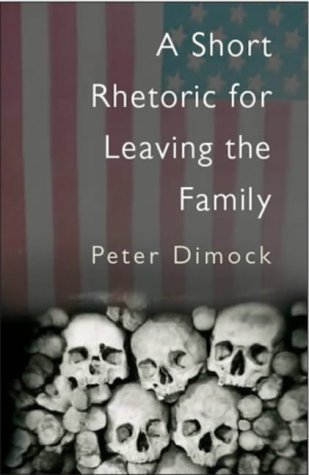
Hundreds of novels have explored the war in Vietnam. This is the first to explore the world of the architects of that war, and it cuts terribly close to home. Dimock brilliantly exposes the pained heart of a single family and offers a vision of what their way of life still costs us all. His book raises with startling freshness ancient yet urgent questions about relations between image, word, and act.
"synopsis" may belong to another edition of this title.
About the Author
Peter Dimock has long worked in publishing-at Random House, and as senior executive editor for history and political science at Columbia University Press, where he worked with authors including Angela Davis, Eric Hobsbawm, Toni Morrison, and Amartya Sen. His first novel, "A Short Rhetoric for Leaving the Family", was published by Dalkey Archive Press in 1998.
From Kirkus Reviews
An excruciating debut novel that portraysin terms taken directly from Cicero's rules of rhetorica dysfunctional American family haunted by the Vietnam War. Jarlath Lanham is one of those old-family boys always eager to tell you, in the most conceited manner possible, just how impressively dreadful his family is. Usually such characters go on and on about incest, child abuse, or other sexual deviancies. For Jarlath, however, politics is the name of the game. His father, you see, was a ``Special Assistant'' to the White House during the 1960s, responsible for plotting and guiding the course of the war in Southeast Asia, and his brother A.G. was an Army officer whose unit was accused of war crimes in Vietnam. Jarlath possesses photographic evidence of A.G.'s guilt, and his refusal to surrender it to his father has made him a family pariah: they charged him with endangering the welfare of his young nephews and committed him to a mental institution, but now (some 15 years later) hes writing a letter to his nephews explaining his actions and exposing the corruption of the Lanhams. The problem? Hes as intent on ingraining the classical order of rhetoric on his nephews minds as he is on exposing the truth about his father and brother, and his letter quickly degenerates into rant (If you want to hold in memory a large number of things and make them available for speech [and Im assuming you do], it is important to equip yourself with a large number of backgrounds, so that in them you can set a large number of images). Perhaps rhetoric is meant as a guiding metaphor, but it soon swallows the story whole in its own rhetoric, which is far less measured than Cicero's. For a taste of the bizarre, this isn't a bad start, but the weirdness fits poorly with the soap-opera plot and deadly earnest tone. -- Copyright ©1998, Kirkus Associates, LP. All rights reserved.
"About this title" may belong to another edition of this title.
Search results for A Short Rhetoric for Leaving the Family

Stock Image
A Short Rhetoric for Leaving the Family
Seller: Open Books, Chicago, IL, U.S.A.
Seller rating 5 out of 5 stars

hardcover. Condition: Very Good. Open Books is a nonprofit social venture that provides literacy experiences for thousands of readers each year through inspiring programs and creative capitalization of books. Seller Inventory # mon0000685918
Stock Image
A Short Rhetoric for Leaving the Family
Seller: Better World Books Ltd, Dunfermline, United Kingdom
Seller rating 5 out of 5 stars
Condition: Good. Former library copy. Pages intact with minimal writing/highlighting. The binding may be loose and creased. Dust jackets/supplements are not included. Includes library markings. Stock photo provided. Product includes identifying sticker. Better World Books: Buy Books. Do Good. Seller Inventory # 67770673-20
Buy Used
US$ 13.03
US$ 6.64 shipping
Ships from United Kingdom to U.S.A.
Ships from United Kingdom to U.S.A.
Quantity: 1 available
Stock Image
A Short Rhetoric for Leaving the Family (a first printing)
Published by
Methuen Publishing Ltd,uk, 2004
ISBN 10: 0413774147
ISBN 13: 9780413774149
Used
Hardcover
First Edition
Seller: S.Carter, NEWPORT, United Kingdom
Seller rating 4 out of 5 stars

Hardcover. Condition: Near Fine. Dust Jacket Condition: Near Fine. 1st Edition. uk1st.edition,.1st.printing.near fien hardback in near fien dustwrapper. 15/14.Language: eng Language: eng 0.0 Language: eng Language: eng. Seller Inventory # 14...fjkcxici
Buy Used
US$ 6.83
US$ 26.67 shipping
Ships from United Kingdom to U.S.A.
Ships from United Kingdom to U.S.A.
Quantity: 2 available