
Items related to Overruling Democracy
Synopsis
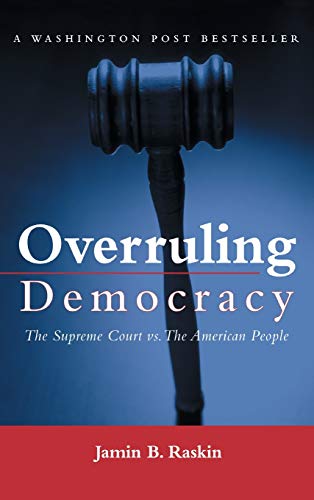
The Supreme Court has recently issued decisions announcing that citizens have neither a constitutional right to vote, nor the right to an education. Conservative judges have continually disavowed claims to any rights not specifically mentioned in the Constitution. In "Overruling Democracy, " celebrated law professor Jamin B. Raskin, argues that we need to develop a whole new set of rights, through amendments or court decisions, that revitalize and protect the democracy of everyday life. Detailing specific cases through interesting narratives, "Overruling Democracy" describes the transgressions of the Supreme Court against the Constitution and the people - and the faulty reasoning behind them -- and lays out the plan for the best way to back a more democratic system.
"synopsis" may belong to another edition of this title.
About the Author
Jamin B. Raskin is Professor of Law at American University in Washington D.C. His articles have appeared in Slate, The Washington Monthly, The American Prospect, TheNation, The Washington Post, The Los Angeles Times and many other newspapers, journals and magazines.
Reviews
Constitutional scholar Raskin uses the Bush versus Gore decision declaring Bush president as a reflection of both the continuing momentum of a rightward swing and the antidemocratic thrust of the U.S. Supreme Court. The use of the equal protection clause of the Constitution, designed to protect the newly freed slaves, as a basis for protecting Bush is symbolic of the inverse practices of the Supreme Court. States' rights, strict constructionism, original intent--these theories associated with the rightist ideologies fell under the political need to ensure that the "right" president was elected. This rightward shift is the consequence of a successful strategy to appoint conservative judges to the federal bench and has resulted in the denial of constitutional rights to an education and to public debate and a narrowing of privacy rights. Raskin argues that conservative jurists have taken an activist posture against popular democracy. In addition to challenging the propriety of this conservative judicial activism, Raskin articulates a plan for counterbalancing that activism. A worthy read. Vernon Ford
Copyright © American Library Association. All rights reserved
"About this title" may belong to another edition of this title.
Search results for Overruling Democracy

Stock Image
Overruling Democracy
Seller: BooksRun, Philadelphia, PA, U.S.A.
Seller rating 5 out of 5 stars

Hardcover. Condition: Very Good. 1. With dust jacket. It's a well-cared-for item that has seen limited use. The item may show minor signs of wear. All the text is legible, with all pages included. It may have slight markings and/or highlighting. Seller Inventory # 0415934397-11-1-29
Seller Image
Overruling Democracy
Seller: -OnTimeBooks-, Phoenix, AZ, U.S.A.
Seller rating 5 out of 5 stars
Condition: good. A copy that has been read, remains in good condition. All pages are intact, and the cover is intact. The spine and cover show signs of wear. Pages can include notes and highlighting and show signs of wear, and the copy can include "From the library of" labels or previous owner inscriptions. 100% GUARANTEE! Shipped with delivery confirmation, if you're not satisfied with purchase please return item! Ships via media mail. Seller Inventory # OTV.0415934397.G
Seller Image
Overruling Democracy
Seller: Greenworld Books, Arlington, TX, U.S.A.
Seller rating 5 out of 5 stars
Condition: very_good. Fast Free Shipping â" Very Good condition book with a firm cover and clean pages. Shows normal use and some light wear or limited notes markings. A solid, nice copy to enjoy. Seller Inventory # GWV.0415934397.VG
Stock Image
Overruling Democracy : The Supreme Court Versus the American People
Published by
Taylor & Francis Group, 2003
ISBN 10: 0415934397
ISBN 13: 9780415934398
Used
Hardcover
First Edition
Seller: Better World Books, Mishawaka, IN, U.S.A.
Seller rating 5 out of 5 stars
Condition: Good. 1st Edition. Former library copy. Pages intact with minimal writing/highlighting. The binding may be loose and creased. Dust jackets/supplements are not included. Includes library markings. Stock photo provided. Product includes identifying sticker. Better World Books: Buy Books. Do Good. Seller Inventory # 2323175-20
Stock Image
Overruling Democracy : The Supreme Court Versus the American People
Published by
Taylor & Francis Group, 2003
ISBN 10: 0415934397
ISBN 13: 9780415934398
Used
Hardcover
First Edition
Seller: Better World Books: West, Reno, NV, U.S.A.
Seller rating 5 out of 5 stars
Condition: Good. 1st Edition. Former library copy. Pages intact with minimal writing/highlighting. The binding may be loose and creased. Dust jackets/supplements are not included. Includes library markings. Stock photo provided. Product includes identifying sticker. Better World Books: Buy Books. Do Good. Seller Inventory # 2323175-20
Stock Image
Overruling Democracy: The Supreme Court Vs. the American People
Seller: ThriftBooks-Atlanta, AUSTELL, GA, U.S.A.
Seller rating 5 out of 5 stars
Hardcover. Condition: Good. No Jacket. Missing dust jacket; Pages can have notes/highlighting. Spine may show signs of wear. ~ ThriftBooks: Read More, Spend Less. Seller Inventory # G0415934397I3N01
Stock Image
Overruling Democracy: The Supreme Court Vs. the American People
Seller: ThriftBooks-Atlanta, AUSTELL, GA, U.S.A.
Seller rating 5 out of 5 stars
Hardcover. Condition: Very Good. No Jacket. Missing dust jacket; May have limited writing in cover pages. Pages are unmarked. ~ ThriftBooks: Read More, Spend Less. Seller Inventory # G0415934397I4N01
Stock Image
Overruling Democracy: The Supreme Court Vs. the American People
Seller: ThriftBooks-Dallas, Dallas, TX, U.S.A.
Seller rating 5 out of 5 stars
Hardcover. Condition: Good. No Jacket. Former library book; Pages can have notes/highlighting. Spine may show signs of wear. ~ ThriftBooks: Read More, Spend Less. Seller Inventory # G0415934397I3N10
Stock Image
Overruling Democracy: The Supreme Court versus The American People
Seller: Wonder Book, Frederick, MD, U.S.A.
Seller rating 5 out of 5 stars
Condition: Very Good. Very Good condition. Good dust jacket. A copy that may have a few cosmetic defects. May also contain light spine creasing or a few markings such as an owner's name, short gifter's inscription or light stamp. Seller Inventory # P15I-01146
Stock Image
Overruling Democracy The Supreme Court vs the American People
Seller: Friends of the Multnomah County Library, Portland, OR, U.S.A.
Seller rating 5 out of 5 stars
Hardcover. Condition: Good. Dust Jacket Condition: Fair. Dust jacket bumped and has several open tears along edges. Book tightly bound with clean pages. Seller Inventory # 62457