
Items related to The Science of Vampires
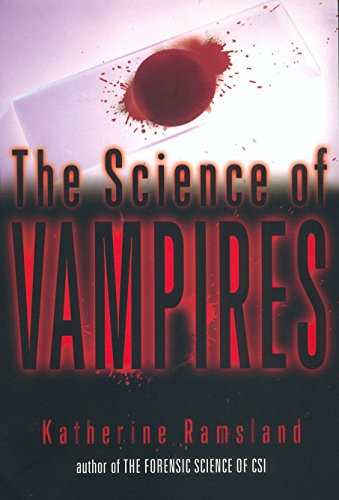
Synopsis
· Are any vampire myths based on fact?
· Bloodsucking villain to guilt-ridden loner—what has inspired the redemption of the vampire in fiction and film?
· What is Vampire Personality Disorder? What causes a physical addiction to another person’s blood?
· Are there any boundaries in the polysexual world of vampires?
· How could a vampire hide in today’s world of advanced forensic science?
· What is the psychopathology of the vampire?
· What happens in the brain of a vampire’s victim?
Si...
"synopsis" may belong to another edition of this title.
About the Author
Katherine Ramsland began her career as a writer with Prism of the Night: A Biography of Anne Rice, and has since published 59 books, including the bestselling The Vampire Companion: The Official Guide to Anne Rice’s The Vampire Chronicles. She holds graduate degrees in forensic psychology, clinical psychology, criminal justice, and philosophy. She teaches forensic psychology and criminal justice at DeSales University.
Reviews
Biographer of Anne Rice and Dean Koontz, Ramsland (The Forensic Science of CSI) ranges over everything from quantum mechanics to feng shui in explaining the evolution of "a mostly fictional creature." Because every vampire television series, novel and role-playing game has created variations on exactly what a vampire is, Ramsland admittedly runs into some difficulty applying science to these "shapeshifters," making for some slippery discussions. For example, Ramsland reviews crime scene procedures or ponders such questions as whether vampires have a full range of bodily fluids with equal earnestness. In her quest for real-life vampires, she studies blood-drinking club goers who identify with the mysterious monsters but are not actual murderers, but also relates tales about serial killers such as Ted Bundy because they exhibit vampiric traits such as remorselessness and lust for destruction. The discussion of contemporary vampirism and its relationship to "goth" and bondage subcultures is informative, though the explanation of "psychic vampires" (those who manipulate others and feed off of their mental anguish) is less so. While this is not a scholarly book aimed at the scientific community, and it may not surprise Dracula devotees, it serves as a useful compendium of folklore and popular culture for those with a casual interest in vampires, a group whose membership regularly rises during the Halloween season.
Copyright 2002 Reed Business Information, Inc.
"About this title" may belong to another edition of this title.
Search results for The Science of Vampires

Stock Image
The Science of Vampires
Published by
Penguin Publishing Group, 2002
ISBN 10: 0425186164
ISBN 13: 9780425186169
Used
Softcover
Seller: World of Books (was SecondSale), Montgomery, IL, U.S.A.
Seller rating 5 out of 5 stars

Condition: Acceptable. Item in acceptable condition! Textbooks may not include supplemental items i.e. CDs, access codes etc. Seller Inventory # 00096346544
Stock Image
The Science of Vampires
Seller: BooksRun, Philadelphia, PA, U.S.A.
Seller rating 5 out of 5 stars
Paperback. Condition: Very Good. 1. It's a well-cared-for item that has seen limited use. The item may show minor signs of wear. All the text is legible, with all pages included. It may have slight markings and/or highlighting. Seller Inventory # 0425186164-11-1
Stock Image
The Science of Vampires
Published by
Penguin Publishing Group, 2002
ISBN 10: 0425186164
ISBN 13: 9780425186169
Used
paperback
Seller: Evergreen Goodwill, Seattle, WA, U.S.A.
Seller rating 5 out of 5 stars
paperback. Condition: Good. Seller Inventory # mon0000809797
Stock Image
The Science of Vampires
Published by
Penguin Publishing Group, 2002
ISBN 10: 0425186164
ISBN 13: 9780425186169
Used
Softcover
First Edition
Seller: Better World Books, Mishawaka, IN, U.S.A.
Seller rating 5 out of 5 stars
Condition: Very Good. 1st Edition. Former library copy. Pages intact with possible writing/highlighting. Binding strong with minor wear. Dust jackets/supplements may not be included. Includes library markings. Stock photo provided. Product includes identifying sticker. Better World Books: Buy Books. Do Good. Seller Inventory # 12347358-6
Stock Image
The Science of Vampires
Published by
Penguin Publishing Group, 2002
ISBN 10: 0425186164
ISBN 13: 9780425186169
Used
Softcover
First Edition
Seller: Better World Books, Mishawaka, IN, U.S.A.
Seller rating 5 out of 5 stars
Condition: Good. 1st Edition. Pages intact with minimal writing/highlighting. The binding may be loose and creased. Dust jackets/supplements are not included. Stock photo provided. Product includes identifying sticker. Better World Books: Buy Books. Do Good. Seller Inventory # 3265721-6
Stock Image
The Science of Vampires
Published by
Penguin Publishing Group, 2002
ISBN 10: 0425186164
ISBN 13: 9780425186169
Used
Softcover
First Edition
Seller: Better World Books, Mishawaka, IN, U.S.A.
Seller rating 5 out of 5 stars
Condition: Very Good. 1st Edition. Pages intact with possible writing/highlighting. Binding strong with minor wear. Dust jackets/supplements may not be included. Stock photo provided. Product includes identifying sticker. Better World Books: Buy Books. Do Good. Seller Inventory # 4694701-6
Stock Image
The Science of Vampires
Seller: HPB-Diamond, Dallas, TX, U.S.A.
Seller rating 5 out of 5 stars
Paperback. Condition: Very Good. Connecting readers with great books since 1972! Used books may not include companion materials, and may have some shelf wear or limited writing. We ship orders daily and Customer Service is our top priority! Seller Inventory # S_434670231
Stock Image
The Science of Vampires
Published by
Penguin Publishing Group, 2002
ISBN 10: 0425186164
ISBN 13: 9780425186169
Used
paperback
Seller: HPB-Ruby, Dallas, TX, U.S.A.
Seller rating 5 out of 5 stars
paperback. Condition: Very Good. Connecting readers with great books since 1972! Used books may not include companion materials, and may have some shelf wear or limited writing. We ship orders daily and Customer Service is our top priority! Seller Inventory # S_463345563
Stock Image
The Science of Vampires
Seller: HPB Inc., Dallas, TX, U.S.A.
Seller rating 5 out of 5 stars
paperback. Condition: Very Good. Connecting readers with great books since 1972! Used books may not include companion materials, and may have some shelf wear or limited writing. We ship orders daily and Customer Service is our top priority! Seller Inventory # S_475021769
Stock Image
The Science of Vampires
Seller: World of Books Inc, Montgomery, IL, U.S.A.
Seller rating 4 out of 5 stars

Paperback. Condition: Fair. · Are any vampire myths based on fact?· Bloodsucking villain to guilt-ridden loner?what has inspired the redemption of the vampire in fiction and film?· What is Vampire Personality Disorder? What causes a physical addiction to another person?s blood?· Are there any boundaries in the polysexual world of vampires?· How could a vampire hide in today?s world of advanced forensic science?· What is the psychopathology of the vampire?· What happens in the brain of a vampire?s victim? Si. Seller Inventory # CIN0425186164A