
Items related to Fontamara
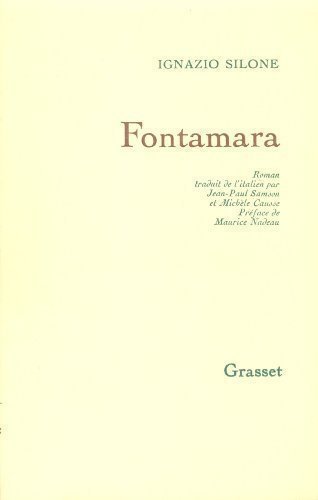
Synopsis
It is Silone's first novel and is among his most famous works. It received worldwide acclaim and sold more than a million and a half copies in twenty-seven languages. It was first published in German translation in Zurich, Switzerland in 1933, and was published in English by Penguin Books in September 1934. Fontamara is derived from the Italian 'Fonte Amara' (Bitter Stream.) Appearing on the eve of the Spanish Civil War, and published just a few months after Hitler came to power, when the world was beginning to take sides for or against fascism, the novel had a galvanising effect on public opinion. Fontamara 'became the very symbol of resistance' and ‘is widely agreed to have played a major role as a document of anti-Fascist propaganda outside Italy in the late 1930s,' as it criticises the deceitful and immoral nature of the Fascist party and its followers.
Fontamara is a fictional small rural village in Marsica in the Abruzzo region. The people (the Fontamaresi) are poor and the village is very remote to the extent that the citizens are unaware of world events such as the rise of Fascism. There is a tremendous gap between the ‘’cafoni’’ (peasants) who populate ‘’Fontamara’’ and those who live in the city. The Fontamaresi work the Earth to survive, turn to emigration as a means of economic improvement and are ignorant to events happening outside of their town. They are cut off from the rest of Italy and thus unaffected by modernity and new technology. The Impresario is a stark contrast to the Fontamaresi, who have laboured for centuries to little avail, as he quickly became the richest man in the region and embodies the power, authority and immorality of the Fascists. The Fontamaresi are exploited due to their naïvety and ignorance, the women are raped by the squadristi (a group of Fascists), Berardo Viola makes the ultimate sacrifice to allow the continued distribution of clandestine texts to spread the word about socialism and encourage rebellion against Fascism and at the end the majority of the population are killed at the hands of the Government.
"synopsis" may belong to another edition of this title.
Language Notes
Text: English, Italian (translation)
"About this title" may belong to another edition of this title.
Search results for Fontamara

Seller Image
Meridian Classic: Fontamara
Seller: Bookbot, Prague, Czech Republic
Seller rating 5 out of 5 stars

Softcover. Condition: Fair. Anmerkungen / beschriftet / Stempel; Verschmutzung; Leichte Verformung / umgeknickte Seiten; Leichte Verschmutzung / Farbtonveränderung; Starke Gebrauchsspuren. Silone's first novel, published in German in 1933 and in English in 1934, garnered worldwide acclaim, selling over a million and a half copies in twenty-seven languages. Set against the backdrop of the impending Spanish Civil War and shortly after Hitler's rise to power, the narrative had a profound impact on public opinion, becoming a symbol of resistance and a significant anti-Fascist document in the late 1930s. The story unfolds in the fictional rural village of Fontamara, located in the Abruzzo region, where the impoverished inhabitants, the Fontamaresi, are largely unaware of global events, including the rise of Fascism. They live in stark contrast to the wealthy Impresario, who represents the power and immorality of the Fascist regime. The Fontamaresi, disconnected from modernity and technology, struggle for survival through agriculture and emigration, while remaining vulnerable to exploitation. Their ignorance leads to tragic consequences, including violence against women by Fascist squads. Berardo Viola emerges as a key figure, sacrificing himself to disseminate socialist ideas and incite rebellion. Ultimately, the government's brutal actions result in the deaths of many villagers, highlighting the dire consequences of their naivety and the oppressive political climate. Seller Inventory # 2e7e53f7-a60e-4d87-a7db-5dea26d77388
Buy Used
US$ 15.75
US$ 24.11 shipping
Ships from Czech Republic to U.S.A.
Ships from Czech Republic to U.S.A.
Quantity: 1 available
Stock Image
Meridian Classic: Fontamara Ignazio Silone
Seller: BUCHSERVICE / ANTIQUARIAT Lars Lutzer, Wahlstedt, Germany
Seller rating 5 out of 5 stars
Condition: gut. 1981. Meridian Classic: Fontamara In englischer Sprache. pages. Seller Inventory # BN439088
Buy Used
US$ 236.50
US$ 45.89 shipping
Ships from Germany to U.S.A.
Ships from Germany to U.S.A.
Quantity: 1 available