
Items related to All That We Can Be: Black Leadership And Racial Integration...
Synopsis
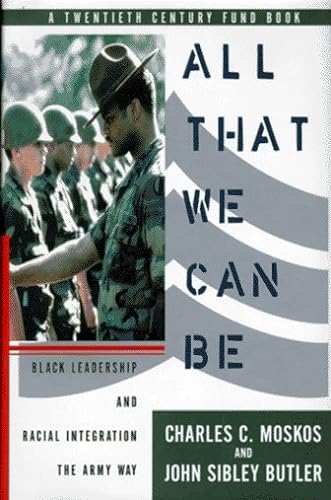
The foremost autorities on race relations in the armed forces recount the previously untold success story of how the U.S. Army became the most integrated institution in America. Charles C. Moskos and John Sibley Butler observe that the Army is the only place in America where blacks routinely boss around whites, and in this book they lay out the path by which the Army has promoted excellence across racial lines, while also showing how this military model can be adapted to fit the needs of civilian society. The Army way offers hope for our nation in a troubled time, and by following its example, Americans of all races can truly be all that we can be.
"synopsis" may belong to another edition of this title.
About the Author
Charles C. Moskos is a professor of sociology at Northwestern University.
Reviews
A down-to-earth briefing from a team of sociologists on the US Army's achievements in affording equal opportunity to all comers, suggesting what other American institutions might learn from it. Before assessing the details of what they call a success story with caveats, sociologists Moskos (Northwestern Univ.) and Butler (Univ. of Texas) provide a once-over-lightly survey of the African- American experience in the US military, from the colonial era to the present. Getting down to business, the authors offer by-the- numbers summaries on the incidence of African-Americans in the enlisted, NCO, and commissioned ranks (one in nine members of the Army's officers corps is black). Liberal complaints about cannon fodder to the contrary, there's no evidence that blacks are overrepresented in front-line units, which suffer the greatest casualties under fire. Moskos and Butler characterize the Army as a race-savvy, not race-blind, service that pragmatically subordinates trendy peripheral concerns (ethnic diversity, multiculturalism) to its primary goal of combat readiness. The authors go on to argue that ``the Army does not patronize or infantilize blacks by implying that they need special standards in order to succeed.'' Instead of lowering its standards, they point out, the Army elevates veterans as well as recruits with a wealth of instructional courses and programs. Among the lessons to be learned from the accomplishments of the Army and its black soldiers, they cite the need to focus on opportunity and to link affirmative-action efforts to supply- rather than demand-side exigencies or aspirations. In a concluding chapter, the authors call for a national service corps to offset the loss of opportunities caused by downsizing of the US military. An important, eye-opening study that delivers fresh, matter- of-fact perspectives on a divisive issue in need of more reason and less rhetoric. -- Copyright ©1996, Kirkus Associates, LP. All rights reserved.
YA. A highly readable book that will surely attract YAs interested in the military, especially African Americans. The authors state that there are more African Americans in the military than in any other organization in this country, and, much more importantly, that nowhere else in the U.S. are as many whites supervised by blacks. They explain why the military, particularly the Army, has advanced so much further in race relations than other mass institutions. They make the point that "the Army does not lower its standards in order to assure an acceptable racial mix"?it takes young people who enter the recruitment office regardless of race so long as they meet the physical, mental, and moral standards. In the services, moreover, "[a]ffirmative action exists, but without timetables or quotas governing promotions." The authors end their work with lessons civilians might learn from the military. There is nothing similar to this solidly researched and well-documented book in or out of print. A sound addition to any collection.?Alan Gropman, Industrial College of the Armed Forces, Washington, D.C.
Copyright 1997 Reed Business Information, Inc.
The authors?a white sociologist and a black one, both former draftees?offer a solid analysis of how the army became the best-integrated institution in this country. "The Army is not race-blind, it is race-savvy," they declare; its nods to multiculturalism, according to Moskos and Butler, are subordinated to an overriding goal of combat-readiness, while its affirmative-action programs do not lower standards for blacks but train them to meet army standards. Moreover, they say, because of racial mixing, many white soldiers have become attuned to black culture (music, religion, etc.), even as black soldiers have adapted to the service's "white" history. The authors also note that black political leaders, many of them clergy, lack empathy for the many blacks in military service. Among their conclusions: an emphasis on banning racist expression (as on campuses) is far less vital than expanding black opportunity; affirmative action must be linked to pools of qualified candidates, and should be geared to blacks (who suffer the greatest stigma), not other minorities. They argue that the only way to replicate the equalizing effect of the military is to institute national civilian service for youth, which could bring together people of diverse backgrounds, serve as a "bridging program" for the disadvantaged and offer post-service education benefits. It's an intriguing proposal, but a politically volatile one that some may consider ominous.
Copyright 1996 Reed Business Information, Inc.
Fifty years ago, President Truman desegregated the armed forces. Today, according to two former army personnel, the army is integrated to the point of being Afro-Americanized. Due to the adaptability of African Americans and the army's willingness to award achievement, black soldiers are finding advancement opportunities not available to them elsewhere. The authors elaborate on this thesis in six chapters of analysis, data, and commentary. In Chapter 7, they suggest 12 guidelines for using the army's lesson to overcome racism in American society. The book has a great deal in common with Colin Powell's My American Journey (LJ 11/15/95) and would be a fine supplement to that text. Recommended for public libraries.?Frances O. Sandiford, Green Haven Correctional Facility Lib., Stormville, N.Y.
Copyright 1996 Reed Business Information, Inc.
In a slim but superior volume, two leading sociologists of the American military describe the army's successful racial integration during the last 20 years, a success resulting from commitment to the original definition of affirmative action, which in practice led to integration's moving steadily through the ranks. In a hierarchical organization such as the army, the higher levels are the model for the lower--and they have enforcement powers. So it has gone in the army, in which the noncommissioned officer corps is now 40 percent African American. Moskos and Butler favorably contrast the army with civilian institutions, although not in detail sufficient to allow for complete comparisons. Still, their effort has the virtue--rare in sociological works--of being exceedingly readable, enough so that it stands a chance of winning the wide audience, particularly among business executives, that it richly deserves. Roland Green
"About this title" may belong to another edition of this title.
Search results for All That We Can Be: Black Leadership And Racial Integration...

Stock Image
All That We Can Be: Black Leadership And Racial Integration The Army Way
Seller: More Than Words, Waltham, MA, U.S.A.
Seller rating 5 out of 5 stars

Condition: Very Good. . . All orders guaranteed and ship within 24 hours. Before placing your order for please contact us for confirmation on the book's binding. Check out our other listings to add to your order for discounted shipping. Seller Inventory # WAL-L-3h-002361
Stock Image
All That We Can be: Black Leadership and Racial Integration the Army Way
Seller: World of Books (was SecondSale), Montgomery, IL, U.S.A.
Seller rating 5 out of 5 stars
Hardback. Condition: Very Good. In a fascinating study of how the Army became the premier model for developing black leadership in a racially integrated setting, Moskos and Butler show how this system works and how it can be applied throughout American society. The foremost autorities on race relations in the armed forces recount the previously untold success story of how the U.S. Army became the most integrated institution in America. Charles C. Moskos and John Sibley Butler observe that the Army is the only place in America where blacks routinely boss around whites, and in this book they lay out the path by which the Army has promoted excellence across racial lines, while also showing how this military model can be adapted to fit the needs of civilian society. The Army way offers hope for our nation in a troubled time, and by following its example, Americans of all races can truly be all that we can be. Seller Inventory # 00098400089
Stock Image
All That We Can be: Black Leadership and Racial Integration the Army Way
Seller: World of Books (was SecondSale), Montgomery, IL, U.S.A.
Seller rating 5 out of 5 stars
Hardback. Condition: Good. In a fascinating study of how the Army became the premier model for developing black leadership in a racially integrated setting, Moskos and Butler show how this system works and how it can be applied throughout American society. The foremost autorities on race relations in the armed forces recount the previously untold success story of how the U.S. Army became the most integrated institution in America. Charles C. Moskos and John Sibley Butler observe that the Army is the only place in America where blacks routinely boss around whites, and in this book they lay out the path by which the Army has promoted excellence across racial lines, while also showing how this military model can be adapted to fit the needs of civilian society. The Army way offers hope for our nation in a troubled time, and by following its example, Americans of all races can truly be all that we can be. Seller Inventory # 00097997098
Stock Image
All That We Can Be: Black Leadership And Racial Integration The Army Way
Seller: Half Price Books Inc., Dallas, TX, U.S.A.
Seller rating 5 out of 5 stars
hardcover. Condition: Very Good. Connecting readers with great books since 1972! Used books may not include companion materials, and may have some shelf wear or limited writing. We ship orders daily and Customer Service is our top priority! Seller Inventory # S_435728183
Stock Image
All That We Can Be : Black Leadership and Racial Integration the Army Way
Published by
Basic Books, 1996
ISBN 10: 0465001084
ISBN 13: 9780465001088
Used
Hardcover
First Edition
Seller: Better World Books, Mishawaka, IN, U.S.A.
Seller rating 5 out of 5 stars
Condition: Very Good. 1st ed. Former library copy. Pages intact with possible writing/highlighting. Binding strong with minor wear. Dust jackets/supplements may not be included. Includes library markings. Stock photo provided. Product includes identifying sticker. Better World Books: Buy Books. Do Good. Seller Inventory # 572719-6
Stock Image
All That We Can Be : Black Leadership and Racial Integration the Army Way
Published by
Basic Books, 1996
ISBN 10: 0465001084
ISBN 13: 9780465001088
Used
Hardcover
First Edition
Seller: Better World Books, Mishawaka, IN, U.S.A.
Seller rating 5 out of 5 stars
Condition: Very Good. 1st ed. Pages intact with possible writing/highlighting. Binding strong with minor wear. Dust jackets/supplements may not be included. Stock photo provided. Product includes identifying sticker. Better World Books: Buy Books. Do Good. Seller Inventory # 572718-6
Stock Image
All That We Can be: Black Leadership and Racial Integration the Army Way
Seller: World of Books Inc, Montgomery, IL, U.S.A.
Seller rating 4 out of 5 stars

Hardback. Condition: Very Good. In a fascinating study of how the Army became the premier model for developing black leadership in a racially integrated setting, Moskos and Butler show how this system works and how it can be applied throughout American society. The foremost autorities on race relations in the armed forces recount the previously untold success story of how the U.S. Army became the most integrated institution in America. Charles C. Moskos and John Sibley Butler observe that the Army is the only place in America where blacks routinely boss around whites, and in this book they lay out the path by which the Army has promoted excellence across racial lines, while also showing how this military model can be adapted to fit the needs of civilian society. The Army way offers hope for our nation in a troubled time, and by following its example, Americans of all races can truly be all that we can be. Seller Inventory # CIN0465001084VG
Stock Image
All That We Can be: Black Leadership and Racial Integration the Army Way
Seller: World of Books Inc, Montgomery, IL, U.S.A.
Seller rating 4 out of 5 stars
Hardback. Condition: Good. In a fascinating study of how the Army became the premier model for developing black leadership in a racially integrated setting, Moskos and Butler show how this system works and how it can be applied throughout American society. The foremost autorities on race relations in the armed forces recount the previously untold success story of how the U.S. Army became the most integrated institution in America. Charles C. Moskos and John Sibley Butler observe that the Army is the only place in America where blacks routinely boss around whites, and in this book they lay out the path by which the Army has promoted excellence across racial lines, while also showing how this military model can be adapted to fit the needs of civilian society. The Army way offers hope for our nation in a troubled time, and by following its example, Americans of all races can truly be all that we can be. Seller Inventory # CIN0465001084G
Stock Image
All That We Can Be: Black Leadership and Racial Integration the Army Way
Published by
Basic Books, New York, 1996
ISBN 10: 0465001084
ISBN 13: 9780465001088
Used
Hardcover
First Edition
Seller: Great Expectations Rare Books, Staten Island, NYC, NY, U.S.A.
Seller rating 5 out of 5 stars
Cloth Spine Over Boards. Condition: Very Fine. Dust Jacket Condition: Very Good. First Edition. Hardcover in non price-clipped dust-jacket. 198pp., Index. First edition, first printing. No previous ownership marks. Book is in very fine condition, dust-jacket Very good. Size: 8vo - over 7¾" - 9¾" tall. Seller Inventory # 006468
Stock Image
All That We Can Be: Black Leadership and Racial Integration the Army Way
Published by
Basic Books, New York, New York, U.S.A., 1996
ISBN 10: 0465001084
ISBN 13: 9780465001088
Used
Hardcover
First Edition
Seller: Adagio Books, Longmont, CO, U.S.A.
Seller rating 5 out of 5 stars
Hardcover. Condition: Very Good. Dust Jacket Condition: Very Good. First Edition. In very good, clean condition. Reveals how the Army created a smoothly functioning integrated system, how it works, and how this military model can be adapted to fit the needs of civilian society. Seller Inventory # 1652-3