
Items related to The Math Gene: How Mathematical Thinking Evolved And...
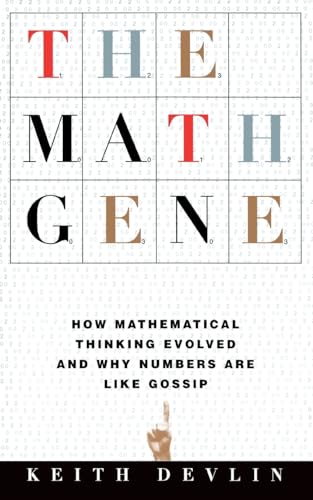
Synopsis
If people are endowed with a "number instinct" similar to the "language instinct" -- as recent research suggests -- then why can't everyone do math? In The Math Gene, mathematician and popular writer Keith Devlin attacks both sides of this question. Devlin offers a breathtakingly new theory of language development that describes how language evolved in two stages and how its main purpose was not communication. Devlin goes on to show that the ability to think mathematically arose out of the same symbol-manipulating ability that was so crucial to the very first emergence of true language. Why, then, can't we do math as well as we speak? The answer, says Devlin, is that we can and do -- we just don't recognize when we're using mathematical reasoning.
"synopsis" may belong to another edition of this title.
About the Author
Keith Devlin is a Senior Researcher and Executive Director at Stanford's Center for the Study of Language and Information, a Consulting Professor in the Department of Mathematics, and a co-founder of the Stanford Media X research network. National Public Radio's "Math Guy," he is the author of over twenty-five books. He lives in Stanford, California.
"About this title" may belong to another edition of this title.
Search results for The Math Gene: How Mathematical Thinking Evolved And...

Stock Image
The Math Gene: How Mathematical Thinking Evolved And Why Numbers Are Like Gossip
Seller: World of Books (was SecondSale), Montgomery, IL, U.S.A.
Seller rating 5 out of 5 stars

Paperback. Condition: Good. Why is math so hard? And why, despite this difficulty, are some people so good at it? If there's some inborn capacity for mathematical thinking,which there must be, otherwise no one could do it ,why can't we all do it well? Keith Devlin has answers to all these difficult questions, and in giving them shows us how mathematical ability evolved, why it's a part of language ability, and how we can make better use of this innate talent.He also offers a breathtakingly new theory of language development,that language evolved in two stages, and its main purpose was not communication,to show that the ability to think mathematically arose out of the same symbol-manipulating ability that was so crucial to the emergence of true language. Why, then, can't we do math as well as we can speak? The answer, says Devlin, is that we can and do,we just don't recognize when we're using mathematical reasoning. Seller Inventory # CIN0465016197G
Stock Image
The Math Gene: How Mathematical Thinking Evolved And Why Numbers Are Like Gossip
Seller: World of Books (was SecondSale), Montgomery, IL, U.S.A.
Seller rating 5 out of 5 stars
Paperback. Condition: Fair. Why is math so hard? And why, despite this difficulty, are some people so good at it? If there's some inborn capacity for mathematical thinking,which there must be, otherwise no one could do it ,why can't we all do it well? Keith Devlin has answers to all these difficult questions, and in giving them shows us how mathematical ability evolved, why it's a part of language ability, and how we can make better use of this innate talent.He also offers a breathtakingly new theory of language development,that language evolved in two stages, and its main purpose was not communication,to show that the ability to think mathematically arose out of the same symbol-manipulating ability that was so crucial to the emergence of true language. Why, then, can't we do math as well as we can speak? The answer, says Devlin, is that we can and do,we just don't recognize when we're using mathematical reasoning. Seller Inventory # 00097362875
Stock Image
The Math Gene: How Mathematical Thinking Evolved And Why Numbers Are Like Gossip
Seller: World of Books (was SecondSale), Montgomery, IL, U.S.A.
Seller rating 5 out of 5 stars
Paperback. Condition: Very Good. Why is math so hard? And why, despite this difficulty, are some people so good at it? If there's some inborn capacity for mathematical thinking,which there must be, otherwise no one could do it ,why can't we all do it well? Keith Devlin has answers to all these difficult questions, and in giving them shows us how mathematical ability evolved, why it's a part of language ability, and how we can make better use of this innate talent.He also offers a breathtakingly new theory of language development,that language evolved in two stages, and its main purpose was not communication,to show that the ability to think mathematically arose out of the same symbol-manipulating ability that was so crucial to the emergence of true language. Why, then, can't we do math as well as we can speak? The answer, says Devlin, is that we can and do,we just don't recognize when we're using mathematical reasoning. Seller Inventory # 00103723557
Stock Image
The Math Gene: How Mathematical Thinking Evolved And Why Numbers Are Like Gossip
Seller: Gulf Coast Books, Cypress, TX, U.S.A.
Seller rating 5 out of 5 stars
paperback. Condition: Fair. Seller Inventory # 0465016197-4-34415861
Seller Image
The Math Gene: How Mathematical Thinking Evolved And Why Numbers Are Like Gossip
Seller: Zoom Books East, Glendale Heights, IL, U.S.A.
Seller rating 5 out of 5 stars
Condition: very_good. Book is in very good condition and may include minimal underlining highlighting. The book can also include "From the library of" labels. May not contain miscellaneous items toys, dvds, etc. . We offer 100% money back guarantee and 24 7 customer service. Seller Inventory # ZEV.0465016197.VG
Stock Image
The Math Gene: How Mathematical Thinking Evolved And Why Numbers Are Like Gossip
Published by
Basic Books (edition Reprint), 2001
ISBN 10: 0465016197
ISBN 13: 9780465016198
Used
Paperback
Seller: BooksRun, Philadelphia, PA, U.S.A.
Seller rating 5 out of 5 stars
Paperback. Condition: Fair. Reprint. The item might be beaten up but readable. May contain markings or highlighting, as well as stains, bent corners, or any other major defect, but the text is not obscured in any way. Seller Inventory # 0465016197-7-1
Seller Image
The Math Gene: How Mathematical Thinking Evolved And Why Numbers Are Like Gossip
Seller: Greenworld Books, Arlington, TX, U.S.A.
Seller rating 5 out of 5 stars
Condition: very_good. Fast Free Shipping â" Very Good condition book with a firm cover and clean pages. Shows normal use and some light wear or limited notes markings. A solid, nice copy to enjoy. Seller Inventory # GWV.0465016197.VG
Stock Image
The Math Gene: How Mathematical Thinking Evolved And Why Numbers Are Like Gossip
Seller: World of Books Inc, Montgomery, IL, U.S.A.
Seller rating 4 out of 5 stars

Paperback. Condition: Very Good. Why is math so hard? And why, despite this difficulty, are some people so good at it? If there's some inborn capacity for mathematical thinking,which there must be, otherwise no one could do it ,why can't we all do it well? Keith Devlin has answers to all these difficult questions, and in giving them shows us how mathematical ability evolved, why it's a part of language ability, and how we can make better use of this innate talent.He also offers a breathtakingly new theory of language development,that language evolved in two stages, and its main purpose was not communication,to show that the ability to think mathematically arose out of the same symbol-manipulating ability that was so crucial to the emergence of true language. Why, then, can't we do math as well as we can speak? The answer, says Devlin, is that we can and do,we just don't recognize when we're using mathematical reasoning. Seller Inventory # CIN0465016197VG
Stock Image
The Math Gene: How Mathematical Thinking Evolved And Why Numbers Are Like Gossip
Seller: World of Books Inc, Montgomery, IL, U.S.A.
Seller rating 4 out of 5 stars
Paperback. Condition: Fair. Why is math so hard? And why, despite this difficulty, are some people so good at it? If there's some inborn capacity for mathematical thinking,which there must be, otherwise no one could do it ,why can't we all do it well? Keith Devlin has answers to all these difficult questions, and in giving them shows us how mathematical ability evolved, why it's a part of language ability, and how we can make better use of this innate talent.He also offers a breathtakingly new theory of language development,that language evolved in two stages, and its main purpose was not communication,to show that the ability to think mathematically arose out of the same symbol-manipulating ability that was so crucial to the emergence of true language. Why, then, can't we do math as well as we can speak? The answer, says Devlin, is that we can and do,we just don't recognize when we're using mathematical reasoning. Seller Inventory # CIN0465016197A
Stock Image
The Math Gene: How Mathematical Thinking Evolved And Why Numbers Are Like Gossip
Seller: World of Books Inc, Montgomery, IL, U.S.A.
Seller rating 4 out of 5 stars
Paperback. Condition: Good. Why is math so hard? And why, despite this difficulty, are some people so good at it? If there's some inborn capacity for mathematical thinking,which there must be, otherwise no one could do it ,why can't we all do it well? Keith Devlin has answers to all these difficult questions, and in giving them shows us how mathematical ability evolved, why it's a part of language ability, and how we can make better use of this innate talent.He also offers a breathtakingly new theory of language development,that language evolved in two stages, and its main purpose was not communication,to show that the ability to think mathematically arose out of the same symbol-manipulating ability that was so crucial to the emergence of true language. Why, then, can't we do math as well as we can speak? The answer, says Devlin, is that we can and do,we just don't recognize when we're using mathematical reasoning. Seller Inventory # CIN0465016197G