
Synopsis
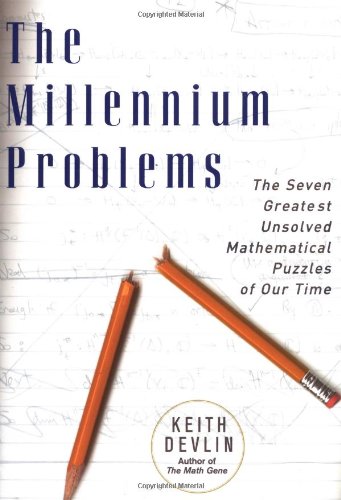
In 2000, the Clay Foundation of Cambridge, Massachusetts, announced a historic competition: whoever could solve any of seven extraordinarily difficult mathematical problems, and have the solution acknowledged as correct by the experts, would receive 1 million in prize money. There was some precedent for doing this: in 1900 David Hilbert, one of the greatest mathematicians of his day, proposed twenty-three problems, now known as the Hilbert Problems, that set much of the agenda for mathematics in the twentieth century. The Millennium Problems are likely to acquire similar stature, and their solution (or lack of one) is likely to play a strong role in determining the course of mathematics in the current century. Keith Devlin, renowned expositor of mathematics, tells here what the seven problems are, how they came about, and what they mean for math and science.These problems are the brass rings held out to today's mathematicians, glittering and just out of reach. In the hands of Keith Devlin, "the Math Guy" from NPR's "Weekend Edition," each Millennium Problem becomes a fascinating window onto the deepest and toughest questions in the field. For mathematicians, physicists, engineers, and everyone else with an interest in mathematics' cutting edge, The Millennium Problems is the definitive account of a subject that will have a very long shelf life.
"synopsis" may belong to another edition of this title.
About the Author
Keith Devlin is the Executive Director of the Center for the Study of Language and Information at Stanford University. He lives in Palo Alto, California.
Reviews
Adult/High School-In May, 2000, the Clay Mathematics Institute posted a million-dollar prize to anyone able to solve any of what it considered the seven most important mathematical problems of the 21st century. They were chosen not for theoretical beauty alone, but because many of them deal with concepts in fields like physics, computer science, and engineering, and exist because practitioners in those fields are already using theoretical or practical design solutions that have not been mathematically proven. Devlin, "The Math Guy" from NPR's Weekend Edition, does a good job explaining the background of the problems and why theoretical mathematics as a discipline should matter to a general audience. Each problem has a chapter of its own and is given a treatment that, where applicable, extends back to the ancient Greeks. A passing knowledge of mathematics is important for taking in Devlin's work but a major in the subject is not, and this book should satisfy anyone looking for a layman's guide to modern theoretical mathematics. Or hoping to win a million dollars.
Sheryl Fowler, Chantilly Regional Library, VA
Copyright 2003 Reed Business Information, Inc.
The noble idea that advanced mathematics can be made comprehensible to laypeople is tested in this sometimes engaging but ultimately unsatisfying effort. Mathematician and NPR commentator Devlin (The Math Gene) bravely asserts that only "a good high-school knowledge of mathematics" is needed to understand these seven unsolved problems (each with a million-dollar price on its head from the Clay Mathematics Institute), but in truth a Ph.D. would find these thickets of equations daunting. Devlin does a good job with introductory material; his treatment of topology, elementary calculus and simple theorems about prime numbers, for example, are lucid and often fun. But when he works his way up to the eponymous problems he confronts the fact that they are too abstract, too encrusted with jargon, and just too hard. He finally throws in the towel on the Birch and Sinnerton-Dyer Conjecture ("Don't feel bad if you find yourself getting lost... the level of abstraction is simply too great for the nonexpert"), while the chapter on the Hodge Conjecture is so baffling that the second page finds him morosely conceding that "the wise strategy might be to give up." Nor does Devlin make a compelling case for the real-world importance of many of these problems, rarely going beyond vague assurances that solving them "would almost certainly involve new ideas that will... have other uses." Sadly, this quixotic book ends up proving that high-level mathematics is beyond the reach of all but the experts.
Copyright 2002 Reed Business Information, Inc.
Pledged by a wealthy amateur math enthusiast, $1 million per problem awaits whoever can solve the seven problems mathematician Devlin describes in this work. A similar proposition, minus the money, was made in 1900 by the German mathematician David Hilbert, who listed two dozen math mysteries he hoped would be dispelled in the coming century. All but one were, and that one, called the Riemann hypothesis, carries over to the new set of conundrums. The Riemann hypothesis is comprehensible to an advanced high-school math student, thanks to Devlin's clarity as well as his experience in popular exposition as the author of books such as The Math Gene (2000) and NPR's explainer of all things mathematical. As to the rest of the conjectures, Devlin directly states that no one without a doctorate could understand them, let alone crack them. But as a skilled guide pointing out the shape of the problems, and the practical implications of their solutions, Devlin's intriguing book will appeal to the lay reader curious about the abstract frontiers of math. Gilbert Taylor
Copyright © American Library Association. All rights reserved
"About this title" may belong to another edition of this title.
Other Popular Editions of the Same Title

Search results for The Millennium Problems 1

Stock Image
The Millennium Problems 1
Seller: Your Online Bookstore, Houston, TX, U.S.A.
Seller rating 5 out of 5 stars

hardcover. Condition: Good. Seller Inventory # 0465017290-3-32861790
Stock Image
The Millennium Problems
Seller: World of Books (was SecondSale), Montgomery, IL, U.S.A.
Seller rating 5 out of 5 stars
Condition: Good. Good condition ex-library book with usual library markings and stickers. Seller Inventory # 00096710069
Seller Image
The Millennium Problems 1
Seller: Greenworld Books, Arlington, TX, U.S.A.
Seller rating 5 out of 5 stars
Condition: good. Fast Free Shipping â" Good condition. It may show normal signs of use, such as light writing, highlighting, or library markings, but all pages are intact and the book is fully readable. A solid, complete copy that's ready to enjoy. Seller Inventory # GWV.0465017290.G
Stock Image
The Millennium Problems 1
Published by
Basic Books (edition American First), 2002
ISBN 10: 0465017290
ISBN 13: 9780465017294
Used
Hardcover
Seller: BooksRun, Philadelphia, PA, U.S.A.
Seller rating 5 out of 5 stars
Hardcover. Condition: Very Good. American First. With dust jacket. It's a well-cared-for item that has seen limited use. The item may show minor signs of wear. All the text is legible, with all pages included. It may have slight markings and/or highlighting. Seller Inventory # 0465017290-11-1-29
Stock Image
The Millennium Problems : The Seven Greatest Unsolved Mathematical Puzzles of Our Time
Published by
Basic Books, 2002
ISBN 10: 0465017290
ISBN 13: 9780465017294
Used
Hardcover
First Edition
Seller: Better World Books, Mishawaka, IN, U.S.A.
Seller rating 5 out of 5 stars
Condition: Very Good. 1ST. Pages intact with possible writing/highlighting. Binding strong with minor wear. Dust jackets/supplements may not be included. Stock photo provided. Product includes identifying sticker. Better World Books: Buy Books. Do Good. Seller Inventory # GRP105443537
Stock Image
The Millennium Problems : The Seven Greatest Unsolved Mathematical Puzzles of Our Time
Published by
Basic Books, 2002
ISBN 10: 0465017290
ISBN 13: 9780465017294
Used
Hardcover
First Edition
Seller: Better World Books, Mishawaka, IN, U.S.A.
Seller rating 5 out of 5 stars
Condition: Good. 1ST. Pages intact with minimal writing/highlighting. The binding may be loose and creased. Dust jackets/supplements are not included. Stock photo provided. Product includes identifying sticker. Better World Books: Buy Books. Do Good. Seller Inventory # 2347401-6
Stock Image
The Millennium Problems 1
Seller: HPB Inc., Dallas, TX, U.S.A.
Seller rating 5 out of 5 stars
hardcover. Condition: Very Good. Connecting readers with great books since 1972! Used books may not include companion materials, and may have some shelf wear or limited writing. We ship orders daily and Customer Service is our top priority! Seller Inventory # S_456515586
Stock Image
The Millennium Problems 1
Seller: ThriftBooks-Atlanta, AUSTELL, GA, U.S.A.
Seller rating 5 out of 5 stars
Hardcover. Condition: Very Good. No Jacket. May have limited writing in cover pages. Pages are unmarked. ~ ThriftBooks: Read More, Spend Less. Seller Inventory # G0465017290I4N00
Stock Image
The Millennium Problems 1
Seller: ThriftBooks-Atlanta, AUSTELL, GA, U.S.A.
Seller rating 5 out of 5 stars
Hardcover. Condition: Very Good. No Jacket. Former library book; May have limited writing in cover pages. Pages are unmarked. ~ ThriftBooks: Read More, Spend Less. Seller Inventory # G0465017290I4N10
Stock Image
The Millennium Problems 1
Seller: Wonder Book, Frederick, MD, U.S.A.
Seller rating 5 out of 5 stars
Condition: Good. Good condition. Very Good dust jacket. A copy that has been read but remains intact. May contain markings such as bookplates, stamps, limited notes and highlighting, or a few light stains. Seller Inventory # L06B-02634