Items related to Gifted Children: Myths And Realities
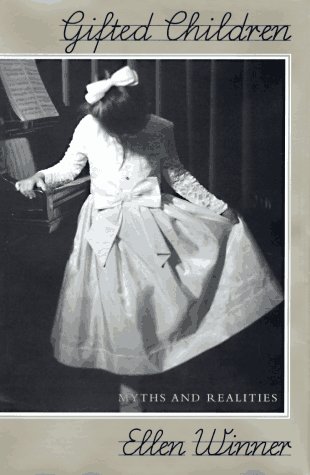

In this fascinating book, Ellen Winner uncovers and explores nine myths about giftedness, and shows us what gifted children are really like.Using vivid case studies, Winner paints a complex picture of the gifted child. Here we meet David, a three-year-old who learned to read in two weeks; KyLee, a five-year-old who mastered on his own all of the math concepts expected by the end of elementary school; and Nadia, an autistic and retarded savant” who nevertheless could draw like a Renaissance master.Winner uses her research with these and several other extraordinary children, as well as the latest biological and psychological evidence, to debunk the many myths about academic, musical, and artistic giftedness. Gifted Children also looks at the role played by schools in fostering exceptional abilities. Winner castigates schools for wasting resources on weak educational programs for the moderately gifted. Instead, she advocates elevating standards for all children, and focusing our resources for gifted education on those with extreme abilities children who are left untouched by the kinds of minimal programs we have today.
"synopsis" may belong to another edition of this title.
About the Author:
Ellen Winner is Professor of Psychology at Boston College.
From Kirkus Reviews:
Winner's ambitious study focuses on the hereditary, familial, and characterological factors shared by gifted children, and suggests ways in which American educators might help such students develop their special talents. Winner (Psychology/Boston Coll.) notes that precocious youth differ from their peers in being ``independent, self-directed, willful, dominant non-conformists,'' possessed of a raging desire to master new skills and an ability to improvise approaches to learning and problem-solving. Winner goes on to explode some myths about the gifted, including the belief that giftedness necessarily correlates with a high IQ, particularly among artists; some extremely talented young painters and sculptors have only average IQs, while others even suffer from learning disorders such as dyslexia. Gifted children also tend to have parents who provide intellectual stimulation and emotional support. Winner also points out the alarming fact that, while girls ``make up about half the population in . . . programs for the gifted in kindergarten through third grade,'' by junior high school ``they make up less than 30 percent.'' But it isn't only girls that society discourages: Our educational system lets down gifted children of both sexes, she asserts, by keeping them in classes with less advanced peers out of misguided egalitarianism, or by grouping them together in superficial programs that meet just a few hours a week. Winner's best section offers a convincing analysis of why some gifted children become highly creative adults--and why many do not. Gifted children must learn how to broaden, apply, and otherwise develop a talent that has come as a gift, transforming ``sheer technical skill into something more conceptual, interpretative, and original.'' Written in serviceable if unspectacular prose, her book should help parents and teachers to aid the gifted as they make the often difficult transition from being brilliant children to becoming genuinely creative and fulfilled adults. (44 b&w photos, not seen) -- Copyright ©1996, Kirkus Associates, LP. All rights reserved.
"About this title" may belong to another edition of this title.
- PublisherBasic Books
- Publication date1996
- ISBN 10 0465017606
- ISBN 13 9780465017607
- BindingHardcover
- Edition number1
- Number of pages464
- Rating
Buy New
Learn more about this copy
US$ 43.05
Shipping:
US$ 4.30
Within U.S.A.
Top Search Results from the AbeBooks Marketplace
Stock Image
Gifted Children: Myths And Realities
Published by
Basic Books
(1996)
ISBN 10: 0465017606
ISBN 13: 9780465017607
New
Hardcover
Quantity: 1
Seller:
Rating

Book Description Condition: new. Seller Inventory # FrontCover0465017606
Buy New
US$ 43.05
Convert currency
Stock Image
Gifted Children: Myths And Realities
Published by
Basic Books
(1996)
ISBN 10: 0465017606
ISBN 13: 9780465017607
New
Hardcover
Quantity: 1
Seller:
Rating
Book Description Hardcover. Condition: new. New. Fast Shipping and good customer service. Seller Inventory # Holz_New_0465017606
Buy New
US$ 44.17
Convert currency
Stock Image
Gifted Children: Myths And Realities
Published by
Basic Books
(1996)
ISBN 10: 0465017606
ISBN 13: 9780465017607
New
Hardcover
Quantity: 1
Seller:
Rating
Book Description Hardcover. Condition: new. New Copy. Customer Service Guaranteed. Seller Inventory # think0465017606
Buy New
US$ 45.01
Convert currency
Stock Image
Gifted Children: Myths And Realities
Published by
Basic Books
(1996)
ISBN 10: 0465017606
ISBN 13: 9780465017607
New
Hardcover
Quantity: 1
Seller:
Rating
Book Description Hardcover. Condition: new. New. Seller Inventory # Wizard0465017606
Buy New
US$ 45.92
Convert currency
Stock Image
Gifted Children: Myths And Realities
Published by
Basic Books
(1996)
ISBN 10: 0465017606
ISBN 13: 9780465017607
New
Hardcover
Quantity: 2
Seller:
Rating
Book Description Hardcover. Condition: New. Brand New!. Seller Inventory # VIB0465017606
Buy New
US$ 63.16
Convert currency
Stock Image
GIFTED CHILDREN: MYTHS AND REALI
Published by
Basic Books
(1996)
ISBN 10: 0465017606
ISBN 13: 9780465017607
New
Hardcover
Quantity: 1
Seller:
Rating

Book Description Condition: New. New. In shrink wrap. Looks like an interesting title! 1.75. Seller Inventory # Q-0465017606
Buy New
US$ 61.17
Convert currency