
Items related to The Misbehavior of Markets: A Fractal View of Financial...
Synopsis
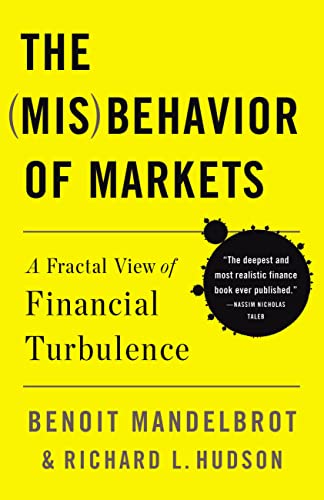
A groundbreaking mathematician presents a new model for understanding financial markets
Benoit B. Mandelbrot is world-famous for inventing fractal geometry, making mathematical sense of a fact everybody knows but that geometers from Euclid on down had never assimilated: Clouds are not round, mountains are not cones, coastlines are not smooth. To these insights we can now add another example: Markets are not the safe bet your broker may claim.
Mandelbrot, with co-author Richard L. Hudson, shows how the dominant way of thinking about the behavior of markets--a set of mathematical assumptions a century old and still learned by every MBA and financier in the world--simply does not work. He uses fractal geometry to propose a new, more accurate way of describing market behavior. From the gyrations of the Dow to the dollar-euro exchange rate, Mandlebrot shows how to understand the volatility of markets in far more accurate terms than the failed theories that have repeatedly brought the financial system to the brink of disaster. The result is no less than the foundation for a new science of finance.
"synopsis" may belong to another edition of this title.
About the Author
Benoit B. Mandelbrot was the inventor of fractal geometry, whose most famous example, the Mandlebrot Set, is one of the most iconic images in mathematics. He was Sterling Professor Emeritus of Mathematical Sciences at Yale University and a Fellow Emeritus at IBM's Thomas J. Watson Laboratory and the recipient of the Wolf Prize in Physics and the Japan Prize in science and technology, as well as awards from the U.S. National Academy of Sciences, the IEEE, and numerous universities in the U.S. and abroad.
His books include Fractals: Form, Chance and Dimension, which was later expanded into the classic The Fractal Geometry of Nature, and a memoir, The Fractalist, which was published posthumously.
Richard L. Hudson was the managing editor of the Wall Street Journal's European edition for six years, and a Journal reporter and editor for twenty-five years. He is a 1978 graduate of Harvard University and a 1991 Knight Fellow of MIT. Now the CEO and editor of Science Publishing Ltd., he lives in Brussels, Belgium.
"About this title" may belong to another edition of this title.
Search results for The Misbehavior of Markets: A Fractal View of Financial...

Stock Image
The Misbehavior of Markets: A Fractal View of Financial Turbulence
Seller: World of Books (was SecondSale), Montgomery, IL, U.S.A.
Seller rating 5 out of 5 stars

Paperback. Condition: Very Good. IN 1959-61, while the huge Saarinen-designed research laboratory at Yorktown Heights was being built, much of IBM's Research was housed nearby. My group occupied one of the many little houses on the Lamb Estate complex which had been a sanatorium housing wealthy alcoholics. The picture below was taken about 1960. It shows from right to left, T. e. Hu, now at the University of California, Santa Barbara. I am next, staring at a network I have just written on the blackboard. Then comes Paul Gilmore, late of the University of British Columbia, then (seated) Richard Levitan, now retired, and at the left is Benoit Mandelbrot. x FOREWORD EF Even in a Lamb Estate populated exclusively with bright research- oriented people, Benoit always stood out. His thinking was always fresh, and I enjoyed talking with him about any subject, whether technical, poli- tical, or historical. He introduced me to the idea that distributions having infinite second moments could be more than a mathematical curiosity and a source of counter-examples. This was a foretaste of the line of thought that eventually led to fractals and to the notion that major pieces of the physical world could be, and in fact could only be, modeled by distrib- utions and sets that had fractional dimensions. Usually these distributions and sets were known to mathematicians, as they were known to me, as curiosities and counter-intuitive examples used to show graduate students the need for rigor in their proofs. Seller Inventory # CIN0465043577VG
Stock Image
The Misbehavior of Markets: A Fractal View of Financial Turbulence
Seller: World of Books (was SecondSale), Montgomery, IL, U.S.A.
Seller rating 5 out of 5 stars
Paperback. Condition: Good. IN 1959-61, while the huge Saarinen-designed research laboratory at Yorktown Heights was being built, much of IBM's Research was housed nearby. My group occupied one of the many little houses on the Lamb Estate complex which had been a sanatorium housing wealthy alcoholics. The picture below was taken about 1960. It shows from right to left, T. e. Hu, now at the University of California, Santa Barbara. I am next, staring at a network I have just written on the blackboard. Then comes Paul Gilmore, late of the University of British Columbia, then (seated) Richard Levitan, now retired, and at the left is Benoit Mandelbrot. x FOREWORD EF Even in a Lamb Estate populated exclusively with bright research- oriented people, Benoit always stood out. His thinking was always fresh, and I enjoyed talking with him about any subject, whether technical, poli- tical, or historical. He introduced me to the idea that distributions having infinite second moments could be more than a mathematical curiosity and a source of counter-examples. This was a foretaste of the line of thought that eventually led to fractals and to the notion that major pieces of the physical world could be, and in fact could only be, modeled by distrib- utions and sets that had fractional dimensions. Usually these distributions and sets were known to mathematicians, as they were known to me, as curiosities and counter-intuitive examples used to show graduate students the need for rigor in their proofs. Seller Inventory # 00108423379
Stock Image
The Misbehavior of Markets: A Fractal View of Financial Turbulence
Seller: World of Books (was SecondSale), Montgomery, IL, U.S.A.
Seller rating 5 out of 5 stars
Paperback. Condition: Fair. IN 1959-61, while the huge Saarinen-designed research laboratory at Yorktown Heights was being built, much of IBM's Research was housed nearby. My group occupied one of the many little houses on the Lamb Estate complex which had been a sanatorium housing wealthy alcoholics. The picture below was taken about 1960. It shows from right to left, T. e. Hu, now at the University of California, Santa Barbara. I am next, staring at a network I have just written on the blackboard. Then comes Paul Gilmore, late of the University of British Columbia, then (seated) Richard Levitan, now retired, and at the left is Benoit Mandelbrot. x FOREWORD EF Even in a Lamb Estate populated exclusively with bright research- oriented people, Benoit always stood out. His thinking was always fresh, and I enjoyed talking with him about any subject, whether technical, poli- tical, or historical. He introduced me to the idea that distributions having infinite second moments could be more than a mathematical curiosity and a source of counter-examples. This was a foretaste of the line of thought that eventually led to fractals and to the notion that major pieces of the physical world could be, and in fact could only be, modeled by distrib- utions and sets that had fractional dimensions. Usually these distributions and sets were known to mathematicians, as they were known to me, as curiosities and counter-intuitive examples used to show graduate students the need for rigor in their proofs. Seller Inventory # CIN0465043577A
Seller Image
The Misbehavior of Markets: A Fractal View of Financial Turbulence
Seller: Goodwill Books, Hillsboro, OR, U.S.A.
Seller rating 5 out of 5 stars
Condition: acceptable. Fairly worn, but readable and intact. If applicable: Dust jacket, disc or access code may not be included. Seller Inventory # GICWV.0465043577.A
Stock Image
The Misbehavior of Markets: A Fractal View of Financial Turbulence
Seller: HPB-Diamond, Dallas, TX, U.S.A.
Seller rating 5 out of 5 stars
Paperback. Condition: Very Good. Connecting readers with great books since 1972! Used books may not include companion materials, and may have some shelf wear or limited writing. We ship orders daily and Customer Service is our top priority! Seller Inventory # S_479103226
Stock Image
The Misbehavior of Markets: A Fractal View of Financial Turbulence
Seller: Half Price Books Inc., Dallas, TX, U.S.A.
Seller rating 5 out of 5 stars
Paperback. Condition: Very Good. Connecting readers with great books since 1972! Used books may not include companion materials, and may have some shelf wear or limited writing. We ship orders daily and Customer Service is our top priority! Seller Inventory # S_475895355
Stock Image
The Misbehavior of Markets: A Fractal View of Financial Turbulence
Seller: HPB Inc., Dallas, TX, U.S.A.
Seller rating 5 out of 5 stars
Paperback. Condition: Very Good. Connecting readers with great books since 1972! Used books may not include companion materials, and may have some shelf wear or limited writing. We ship orders daily and Customer Service is our top priority! Seller Inventory # S_468077856
Stock Image
The Misbehavior of Markets: A Fractal View of Financial Turbulence
Seller: HPB-Ruby, Dallas, TX, U.S.A.
Seller rating 5 out of 5 stars
Paperback. Condition: Very Good. Connecting readers with great books since 1972! Used books may not include companion materials, and may have some shelf wear or limited writing. We ship orders daily and Customer Service is our top priority! Seller Inventory # S_476762062
Stock Image
The Misbehavior of Markets: A Fractal View of Financial Turbulence
Seller: Books From California, Simi Valley, CA, U.S.A.
Seller rating 4 out of 5 stars

Paperback. Condition: Good. Seller Inventory # mon0004278657
Stock Image
The Misbehavior of Markets: A Fractal View of Financial Turbulence
Seller: World of Books Inc, Montgomery, IL, U.S.A.
Seller rating 4 out of 5 stars
Paperback. Condition: Fair. IN 1959-61, while the huge Saarinen-designed research laboratory at Yorktown Heights was being built, much of IBM's Research was housed nearby. My group occupied one of the many little houses on the Lamb Estate complex which had been a sanatorium housing wealthy alcoholics. The picture below was taken about 1960. It shows from right to left, T. e. Hu, now at the University of California, Santa Barbara. I am next, staring at a network I have just written on the blackboard. Then comes Paul Gilmore, late of the University of British Columbia, then (seated) Richard Levitan, now retired, and at the left is Benoit Mandelbrot. x FOREWORD EF Even in a Lamb Estate populated exclusively with bright research- oriented people, Benoit always stood out. His thinking was always fresh, and I enjoyed talking with him about any subject, whether technical, poli- tical, or historical. He introduced me to the idea that distributions having infinite second moments could be more than a mathematical curiosity and a source of counter-examples. This was a foretaste of the line of thought that eventually led to fractals and to the notion that major pieces of the physical world could be, and in fact could only be, modeled by distrib- utions and sets that had fractional dimensions. Usually these distributions and sets were known to mathematicians, as they were known to me, as curiosities and counter-intuitive examples used to show graduate students the need for rigor in their proofs. Seller Inventory # CIN0465043577A