
Items related to Going Out: The Rise And Fall Of Public Amusements
Synopsis
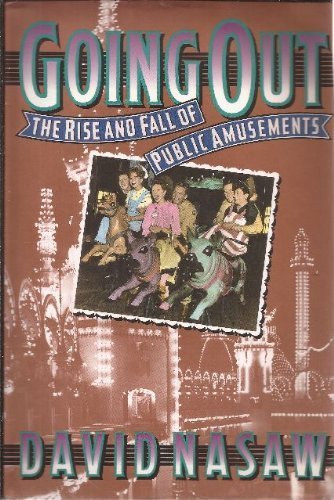
Chronicles public amusement from when it was strictly for the wealthy, to the rise of vaudeville halls, phonograph parlors, and penny arcades--which brought the privilege to the working class--to the present, discussing barriers of class, ethnicity, and race.
"synopsis" may belong to another edition of this title.
About the Author
David Nasaw is a Professor of History and American Studies at the Graduate Center of the City University of New York and the College of Staten Island.
Reviews
Another sparkling urban cultural history from Nasaw (History/The College of Staten Island; Children of the City, 1985, etc.), chronicling the great entertainment arenas--movie palaces, amusement parks, World Fairs, ballparks, etc.--of the late 19th and early 20th centuries, which, he says, helped to heat and stir the American melting pot. In the early 1800's, Nasaw contends, urbanites ``were segregated from one another at work and at home, by income, ethnicity, gender, and social class.'' But with the population explosion fostered by immigration, the increase in available income and leisure time, as well as technological innovations--especially the harnessing of electricity--entrepreneurs began creating venues for the middle- and working-classes, beginning with vaudeville theaters. But excluded, or at least segregated, from vaudeville performances--except as self-parodic performers (playing the ``imbecile,'' the ``dandy,'' the ``lazy fool,'' or, later, ``the razor-wielding coon'')--were African-Americans. This exception to the democratic mingling of socially diverse urban audiences served a specific purpose, argues Nasaw in a recurrent theme: to ``mute'' the social distinctions between ``decent'' audience members by elevating them above ``indecent'' blacks. For most Americans, though, it was an age of wonders: an 11-acre re-creation of Jerusalem at the 1904 St. Louis World's Fair; Coney Island's Luna Park, with its 250,000 light bulbs; Lowe's ``transcendently glorious'' Midland movie palace in Kansas City, Missouri (the movies' grip on public entertainment forms the somewhat familiar core of the latter half of Nasaw's study). It was only after WW II that the great wave of public amusements waned--a casualty, the author points out, not only of TV but also of suburbanization and the growing fear of urban violence. Elegant, well-researched Americana, highlighting both the sweet excitement of a golden age and the bitter racism that helped it thrive. (Illustrations--not seen) -- Copyright ©1993, Kirkus Associates, LP. All rights reserved.
Historian Nasaw chronicles the rise of amusement parks, vaudeville, world's fairs, baseball games, movie houses, and other public amusements in the late 19th and early 20th centuries. The origin of each amusement is sketched in a chapter or two, including in every instance a mention of how ethnic and class barriers were affected and how blacks were consistently excluded. The anecdotal style is engaging, but the narrative often only skims the surface. The chapter on baseball, for example, is a mere eight pages long. The last chapter, on the fall of public amusements, leaves one wondering if the decline was a consequence of racial integration and changing urban demographics or if in fact public amusements are as popular as ever, only in new forms. An optional purchase for history collections.
- Eric Hinsdale, Trinity Univ. Lib., San Antonio
Copyright 1993 Reed Business Information, Inc.
Nasaw paints a vivid and animated picture of urban nightlife around the turn of the century, when "going out" was all the rage for white-collar workers. Electricity had made city streets safer and more alluring at night, and clerks and salespeople felt they deserved a little fun after a dreary day on the job. All sorts of public amusements were created with inspired and greedy alacrity to keep pace with the demand for evening entertainment, from phonograph and kinetoscope parlors to vaudeville halls, "blood and thunder" melodrama theaters, dance halls, movie palaces, city ballparks, and the midways of world's fairs. What people seemed to like most during that heady, eclectic pretelevision era, according to Nasaw, were the lights, the music, and the exhilarating feeling of being surrounded by dozens of eager strangers. Nasaw believes that those rowdy pursuits created a sense of "civic sociability" that transcended class and ethnic divides, but he never loses sight of one crucial element, racism, and discusses at length segregation, racist stereotyping on stage and screen, and the {‚}elan of African American theaters and clubs. A fresh and intriguing assessment of American entertainment at its most spontaneous and uninhibited. Donna Seaman
"About this title" may belong to another edition of this title.
Search results for Going Out: The Rise And Fall Of Public Amusements

Seller Image
Going Out: The Rise And Fall Of Public Amusements
Seller: Zoom Books Company, Lynden, WA, U.S.A.
Seller rating 5 out of 5 stars

Condition: very_good. Book is in very good condition and may include minimal underlining highlighting. The book can also include "From the library of" labels. May not contain miscellaneous items toys, dvds, etc. . We offer 100% money back guarantee and 24 7 customer service. Seller Inventory # ZBV.0465070302.VG
Seller Image
Going Out: The Rise And Fall Of Public Amusements
Seller: Bay State Book Company, North Smithfield, RI, U.S.A.
Seller rating 5 out of 5 stars
Condition: good. The book is in good condition with all pages and cover intact, including the dust jacket if originally issued. The spine may show light wear. Pages may contain some notes or highlighting, and there might be a "From the library of" label. Boxed set packaging, shrink wrap, or included media like CDs may be missing. Seller Inventory # BSM.1B6JM
Seller Image
Going Out: The Rise And Fall Of Public Amusements
Seller: -OnTimeBooks-, Phoenix, AZ, U.S.A.
Seller rating 5 out of 5 stars
Condition: good. A copy that has been read, remains in good condition. All pages are intact, and the cover is intact. The spine and cover show signs of wear. Pages can include notes and highlighting and show signs of wear, and the copy can include "From the library of" labels or previous owner inscriptions. 100% GUARANTEE! Shipped with delivery confirmation, if you're not satisfied with purchase please return item! Ships via media mail. Seller Inventory # OTV.0465070302.G
Stock Image
Going Out : The Rise and Fall of Public Amusements
Seller: Better World Books, Mishawaka, IN, U.S.A.
Seller rating 5 out of 5 stars
Condition: Good. Pages intact with minimal writing/highlighting. The binding may be loose and creased. Dust jackets/supplements are not included. Stock photo provided. Product includes identifying sticker. Better World Books: Buy Books. Do Good. Seller Inventory # 2346839-75
Stock Image
Going Out : The Rise and Fall of Public Amusements
Seller: Better World Books: West, Reno, NV, U.S.A.
Seller rating 5 out of 5 stars
Condition: Good. Pages intact with minimal writing/highlighting. The binding may be loose and creased. Dust jackets/supplements are not included. Stock photo provided. Product includes identifying sticker. Better World Books: Buy Books. Do Good. Seller Inventory # 2346839-75
Stock Image
Going Out : The Rise and Fall of Public Amusements
Seller: Better World Books, Mishawaka, IN, U.S.A.
Seller rating 5 out of 5 stars
Condition: Good. Former library copy. Pages intact with minimal writing/highlighting. The binding may be loose and creased. Dust jackets/supplements are not included. Includes library markings. Stock photo provided. Product includes identifying sticker. Better World Books: Buy Books. Do Good. Seller Inventory # 2346840-6
Stock Image
Going Out : The Rise and Fall of Public Amusements
Seller: Better World Books, Mishawaka, IN, U.S.A.
Seller rating 5 out of 5 stars
Condition: Very Good. Former library copy. Pages intact with possible writing/highlighting. Binding strong with minor wear. Dust jackets/supplements may not be included. Includes library markings. Stock photo provided. Product includes identifying sticker. Better World Books: Buy Books. Do Good. Seller Inventory # 14445531-6
Stock Image
Going Out: The Rise and Fall of Public Amusements
Seller: Wonder Book, Frederick, MD, U.S.A.
Seller rating 5 out of 5 stars
Condition: Very Good. Very Good condition. Very Good dust jacket. A copy that may have a few cosmetic defects. May also contain light spine creasing or a few markings such as an owner's name, short gifter's inscription or light stamp. Seller Inventory # E08L-01371
Stock Image
Going Out: The Rise And Fall Of Public Amusements
Seller: ThriftBooks-Dallas, Dallas, TX, U.S.A.
Seller rating 5 out of 5 stars
Hardcover. Condition: Good. No Jacket. Pages can have notes/highlighting. Spine may show signs of wear. ~ ThriftBooks: Read More, Spend Less. Seller Inventory # G0465070302I3N00
Stock Image
Going Out: The Rise And Fall Of Public Amusements
Seller: ThriftBooks-Dallas, Dallas, TX, U.S.A.
Seller rating 5 out of 5 stars
Hardcover. Condition: Very Good. No Jacket. May have limited writing in cover pages. Pages are unmarked. ~ ThriftBooks: Read More, Spend Less. Seller Inventory # G0465070302I4N00