
Items related to Abraham: The First Historical Biography
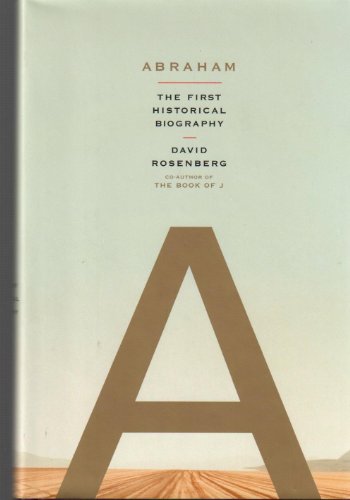
Synopsis
The world's major religions-Judaism, Christianity, and Islam-find a common root in one man: Abraham. Yet Abraham looms so large in the realm of world religions that he has remained a ward of the Divine rather than a flesh-and-blood citizen of Humanity. In his monumental new book, David Rosenberg provides a long-overdue history of the patriarch; while revealing that the original story embedded in the Bible is actually our oldest historical biography. We also discover that the wandering ascetic of tradition cannot explain our deep-seated feelings for Abraham and his God. The road that Abraham traveled was marked by signs of civilization that we still recognize: libraries, museums, hotels, and houses of worship. He is a sophisticated, educated Sumerian; an artisan who became the first Jew. Moreover, through Rosenberg's audacious translation of the Abraham story from Genesis, we learn that many of the core tenets of the monotheistic tradition-the idea of God's covenant and the soul-are Sumerian in origin. Rosenberg first finds Abraham at his father's workshop in the cosmopolitan city of ancient Ur and follows his journey through what is today the Middle East. What kind of baggage-emotional, material, and spiritual-would Abraham have taken with him on his migration to a new land? Abraham does more than present a founding spiritual figure and his dynamic relationships with father, wife, and son. We witness this man as he transforms his heritage into an anxious embrace of religion with secular culture-the human condition in which we are still enfolded today.
"synopsis" may belong to another edition of this title.
About the Author
David Rosenberg is a poet, essayist, and critic. He is the former editor of the Jewish Publication Society and was Harold Bloom's co-author on The Book of J. Rosenberg's other writings include A Poet's Bible and Lost Book of Paradise. He lives in Florida.
Reviews
Despite the subtitle, much of Rosenberg's fascinating and sometimes frustrating presentation of the biblical Abraham's life, while based on archeological evidence, is highly speculative. What Rosenberg does establish is a cultural context for Judaism's founder. Abraham, he says, would have been steeped in the sophisticated culture of his native Sumer, with its emphasis on history and continuity. The earliest of the biblical authors, called J (who was a woman, as Rosenberg postulated, with Harold Bloom, in The Book of J) would have known that culture, and Rosenberg analyzes how it informs her narrative. Abraham's new God, Yahweh, according to Rosenberg, was a blend of his old Sumerian household god and the creator god he found in Canaan; with Yahweh, Abraham created a new "cosmic theater" to replace the one Sumerians had enacted with their idols. Rosenberg's discussion can be dense and confusing as he switches over to considering the artistic and historical motives of J and two other biblical authors, known as E and P. But the book opens up into a compelling and moving interpretation that ponders the significance, for Abraham and his descendants, of his journey from Ur to Canaan, fraught with uncertainty for a man—expatriate, aging, childless—hanging between a lost past and a still unmapped future. (Apr. 3)
Copyright © Reed Business Information, a division of Reed Elsevier Inc. All rights reserved.
The ancient patriarch Abraham lives here as a vibrant historical presence. Rosenberg warns, however, that readers will not see this remarkable man of antiquity if they persist in looking for him over the shoulders of Christian or Islamic guardians of orthodoxy. Instead, Rosenberg invites readers to see Abraham against the cultural background of ancient Jerusalem in the tenth century BCE. Hardly the unlettered nomad of Christian imagination, the historical Abraham, Rosenberg argues, studied Sumerian and Akkadian texts intensely before embarking on his epoch-making journey to Canaan. It was these archival sources, melded with oral tradition, that produced the biographical narrative that enshrined Abraham in scripture. Rosenberg's explanations of how the God of Scripture and first Hebrew appeared together on the stage of history draw on both immense research and shrewd speculation. Many devout Bible readers will resist those speculations as incompatible with traditional religious faith, but lively controversy--such as that surrounding The Book of J, which Rosenberg coauthored with Harold Bloom in 1990--always attracts readers. Bryce Christensen
Copyright © American Library Association. All rights reserved
"About this title" may belong to another edition of this title.
Search results for Abraham: The First Historical Biography

Stock Image
Abraham: The 1st Historical Bi
Seller: World of Books (was SecondSale), Montgomery, IL, U.S.A.
Seller rating 5 out of 5 stars

Condition: Good. Good condition ex-library book with usual library markings and stickers. Seller Inventory # 00104821256
Stock Image
Abraham: The First Historical Biography
Seller: ThriftBooks-Dallas, Dallas, TX, U.S.A.
Seller rating 5 out of 5 stars
Hardcover. Condition: Good. No Jacket. Missing dust jacket; Pages can have notes/highlighting. Spine may show signs of wear. ~ ThriftBooks: Read More, Spend Less. Seller Inventory # G0465070949I3N01
Stock Image
Abraham: The First Historical Biography
Seller: ThriftBooks-Atlanta, AUSTELL, GA, U.S.A.
Seller rating 5 out of 5 stars
Hardcover. Condition: Fair. No Jacket. Readable copy. Pages may have considerable notes/highlighting. ~ ThriftBooks: Read More, Spend Less. Seller Inventory # G0465070949I5N00
Stock Image
Abraham: The First Historical Biography
Seller: Wonder Book, Frederick, MD, U.S.A.
Seller rating 5 out of 5 stars
Condition: As New. Like New condition. Very Good dust jacket. A near perfect copy that may have very minor cosmetic defects. Seller Inventory # K12R-00620
Stock Image
Abraham: The First Historical Biography
Seller: World of Books Inc, Montgomery, IL, U.S.A.
Seller rating 4 out of 5 stars

Hardback. Condition: Good. The world's major religions - Judaism, Christianity and Islam - find a common root in one man: Abraham. This work presents the modern history of the Biblical Abraham and his world, while revealing that the original story embedded in the Bible is actually our oldest historical biography. Seller Inventory # CIN0465070949G
Stock Image
Abraham: The First Historical Biography
Seller: World of Books Inc, Montgomery, IL, U.S.A.
Seller rating 4 out of 5 stars
Hardback. Condition: Very Good. The world's major religions - Judaism, Christianity and Islam - find a common root in one man: Abraham. This work presents the modern history of the Biblical Abraham and his world, while revealing that the original story embedded in the Bible is actually our oldest historical biography. Seller Inventory # CIN0465070949VG
Stock Image
Abraham: The First Historical Biography
Seller: Wonder Book, Frederick, MD, U.S.A.
Seller rating 5 out of 5 stars
Condition: Very Good. Very Good condition. Very Good dust jacket. A copy that may have a few cosmetic defects. May also contain light spine creasing or a few markings such as an owner's name, short gifter's inscription or light stamp. Seller Inventory # T05B-05235
Stock Image
Abraham: The First Historical Biography
Published by
Basic Books, 2006
ISBN 10: 0465070949
ISBN 13: 9780465070947
Used
Hardcover
First Edition
Seller: The Maryland Book Bank, Baltimore, MD, U.S.A.
Seller rating 5 out of 5 stars
hardcover. Condition: Very Good. First Edition. Used - Very Good. Seller Inventory # 3-VVV-1-0160
Stock Image
Abraham : The First Historical Biography
Seller: Better World Books: West, Reno, NV, U.S.A.
Seller rating 5 out of 5 stars
Condition: Very Good. Former library copy. Pages intact with possible writing/highlighting. Binding strong with minor wear. Dust jackets/supplements may not be included. Includes library markings. Stock photo provided. Product includes identifying sticker. Better World Books: Buy Books. Do Good. Seller Inventory # 48356336-75
Stock Image
Abraham : The First Historical Biography
Seller: Better World Books, Mishawaka, IN, U.S.A.
Seller rating 5 out of 5 stars
Condition: Good. Pages intact with minimal writing/highlighting. The binding may be loose and creased. Dust jackets/supplements are not included. Stock photo provided. Product includes identifying sticker. Better World Books: Buy Books. Do Good. Seller Inventory # 56386732-6