
Items related to Sunlight At Midnight St. Petersburg And The Rise Of...
Synopsis
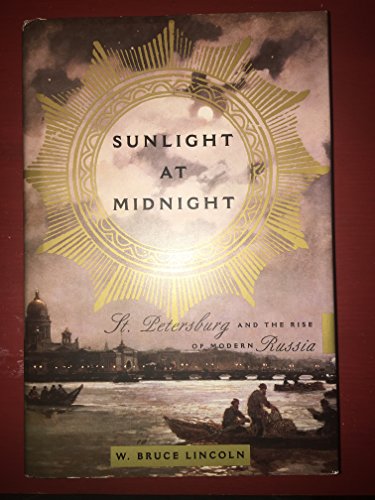
For Russians, St. Petersburg has embodied power, heroism, and fortitude. It has encompassed all the things that the Russians are and that they hope to become. Opulence and artistic brilliance blended with images of suffering on a monumental scale make up the historic persona of the late W. Bruce Lincoln's lavish "biography" of this mysterious, complex city. Climate and comfort were not what Tsar Peter the Great had in mind when, in the spring of 1703, he decided to build a new capital in the muddy marshes of the Neva River delta. Located 500 miles below the Arctic Circle, this area, with its foul weather, bad water, and sodden soil, was so unattractive that only a handful of Finnish fisherman had ever settled there. Bathed in sunlight at midnight in the summer, it brooded in darkness at noon in the winter, and its canals froze solid at least five months out of every year. Yet to the Tsar, the place he named Sankt Pieter Burkh had the makings of a "paradise." His vision was soon borne out: though St. Petersburg was closer to London, Paris, and Vienna than to Russia's far-off eastern lands, it quickly became the political, cultural, and economic center of an empire that stretched across more than a dozen time zones and over three continents. In this book, revolutionaries and laborers brush shoulders with tsars, and builders, soldiers, and statesmen share pride of place with poets. For only the entire historical experience of this magnificent and mysterious city can reveal the wealth of human and natural forces that shaped the modern history of it and the nation it represents.
"synopsis" may belong to another edition of this title.
About the Author
W. Bruce Lincoln was Distinguished Professor of Russian History at Northern Illinois University. He was the author of Between Heaven and Hell: The Story of a Thousand Years of Artistic Life in Russia and almost a dozen other books. W. Bruce Lincoln died on April 9, 2000, at the age of sixty-one.
Reviews
Published posthumously, this history is based on the old adage that St. Petersburg is Russia's "window to the West," that it represents a "psychological force, an intellectual vision, and a way of life against which everything else in Russia has been measured." Lincoln (Conquest of a Continent, one of PW's Best Books for 1994), a top Russian scholar and professor at Northern Illinois University for 31 years, offers a highly accessible and gripping account. ("Dancing was her favorite pastime, and fashion one of her chief concerns," Lincoln writes of Catherine the Great. "Pages at her court strutted in bottle-green uniforms trimmed with gold lace and faced in red as they served guests in the European fashion.") Lincoln focuses on major events like the city's construction, the October Revolution and the Great Blockade; Russian history buffs will find little new here. However, Lincoln's meticulous, colorful detail enlivens these well-trod stories. The work would have benefited from more current material Lincoln barely grazes post-WWII St. Petersburg and the city's window-to-the-West status rings more romantic than true today. Lincoln's homage to St. Petersburg doesn't address the city's present or future. He concludes with a platitude: "the people of St. Petersburg have always striven to reach beyond the limits of normal human experience. No doubt they will do so again, but only time can reveal what form their efforts will take." It's unfortunate that this fine, passionate work, too, didn't strive a bit more. 75 photos.
Copyright 2001 Cahners Business Information, Inc.
Whether to face east or west has been Russia's enduring dilemma in relation with the rest of the world, as the founding and history of St. Petersburg proclaim. This "biography" of the city is the late Lincoln's final work--regrettably, because his histories of Russia have been justifiably popular. Introducing St. Petersburg as a "psychological force, an intellection vision, and a way of life against which everything else in Russia has been measured" since Peter I started building it in 1703, Lincoln shapes his account around the attraction-repulsion that the Venice of the North has exerted on Russians. That ambivalence has been expressed by great artists who lived in the city, for instance, as a feeling of diffidence in Pushkin's The Bronze Horseman, a poem musing on the city's gigantic statue of its founder. Manual and intellectual proletarians drawn to the capital for 50 years before 1917 infused the city with a sense of impending apocalypse, which the Bolshevik regime and then the 1941-44 Nazi siege realized. Russophiles will be engrossed. Gilbert Taylor
Copyright © American Library Association. All rights reserved
Over the past 25 years, Lincoln has published a dozen books on Russia, most recently Between Heaven and Hell: 1000 Years of Artistic Life in Russia. Their cumulative effect establishes him at the forefront of Western historians of 19th- and 20th-century Russia. In this new work, Lincoln offers a survey of Russia's glittering (and sordid) former imperial capital, later the second city of the Soviet Union and post-Soviet Russia. He traces the story of its beginnings as the product of one man's titanic will, then lovingly depicts the glorious buildings of 18th-century empresses, followed by the rise of industrial slums, disaffection, violence, intellectual ferment, and revolution. The agonies and heroism of the city's 900 days under siege in World War II still provoke awe. One may doubt that the "rise of modern Russia" can be told in terms of one city, but Lincoln's concern to depict the pulls of the West and Russian history in terms of St Petersburg's life comes out clearly and convincingly. For public and academic libraries. Robert H. Johnston, McMaster Univ., Hamilton, Ont.
Copyright 2001 Reed Business Information, Inc.
"About this title" may belong to another edition of this title.
Search results for Sunlight At Midnight St. Petersburg And The Rise Of...

Stock Image
Sunlight at Midnight: St. Petersburg and the Rise of Modern Russia
Seller: World of Books (was SecondSale), Montgomery, IL, U.S.A.
Seller rating 5 out of 5 stars

Hardback. Condition: Fair. In 1703, Tsar Peter the Great decided to build a new capital in the marshes of the Neva River delta, located 500 miles below the Arctic Circle. St. Petersburg quickly became the political, cultural, and centre of an empire, described here in this historical biography. Seller Inventory # 00109909847
Stock Image
Sunlight at Midnight: St. Petersburg and the Rise of Modern Russia
Seller: World of Books (was SecondSale), Montgomery, IL, U.S.A.
Seller rating 5 out of 5 stars
Hardback. Condition: Very Good. In 1703, Tsar Peter the Great decided to build a new capital in the marshes of the Neva River delta, located 500 miles below the Arctic Circle. St. Petersburg quickly became the political, cultural, and centre of an empire, described here in this historical biography. Seller Inventory # 00109300252
Stock Image
Sunlight at Midnight: St. Petersburg and the Rise of Modern Russia
Seller: World of Books (was SecondSale), Montgomery, IL, U.S.A.
Seller rating 5 out of 5 stars
Hardback. Condition: Good. In 1703, Tsar Peter the Great decided to build a new capital in the marshes of the Neva River delta, located 500 miles below the Arctic Circle. St. Petersburg quickly became the political, cultural, and centre of an empire, described here in this historical biography. Seller Inventory # 00109820344
Stock Image
Sunlight At Midnight St. Petersburg And The Rise Of Modern Russia
Seller: Gulf Coast Books, Cypress, TX, U.S.A.
Seller rating 5 out of 5 stars
hardcover. Condition: As New. Seller Inventory # 0465083234-1-36269982
Seller Image
Sunlight At Midnight St. Petersburg And The Rise Of Modern Russia
Seller: Greenworld Books, Arlington, TX, U.S.A.
Seller rating 5 out of 5 stars
Condition: like_new. Fast Free Shipping â" Excellent condition book with clean cover and pages. Barely handled, with minimal wear. An outstanding copy, close to enjoy! Seller Inventory # GWV.0465083234.LN
Stock Image
Sunlight At Midnight St. Petersburg And The Rise Of Modern Russia
Seller: Wonder Book, Frederick, MD, U.S.A.
Seller rating 5 out of 5 stars
Condition: Good. Good condition. Good dust jacket. A copy that has been read but remains intact. May contain markings such as bookplates, stamps, limited notes and highlighting, or a few light stains. Seller Inventory # D14B-01608
Stock Image
Sunlight At Midnight St. Petersburg And The Rise Of Modern Russia
Seller: Wonder Book, Frederick, MD, U.S.A.
Seller rating 5 out of 5 stars
Condition: As New. Like New condition. Very Good dust jacket. A near perfect copy that may have very minor cosmetic defects. Seller Inventory # P02P-00011
Stock Image
Sunlight at Midnight : St. Petersburg and the Rise of Modern Russia
Seller: Better World Books, Mishawaka, IN, U.S.A.
Seller rating 5 out of 5 stars
Condition: Good. Pages intact with minimal writing/highlighting. The binding may be loose and creased. Dust jackets/supplements are not included. Stock photo provided. Product includes identifying sticker. Better World Books: Buy Books. Do Good. Seller Inventory # 573113-6
Stock Image
Sunlight at Midnight : St. Petersburg and the Rise of Modern Russia
Seller: Better World Books, Mishawaka, IN, U.S.A.
Seller rating 5 out of 5 stars
Condition: Very Good. Former library copy. Pages intact with possible writing/highlighting. Binding strong with minor wear. Dust jackets/supplements may not be included. Includes library markings. Stock photo provided. Product includes identifying sticker. Better World Books: Buy Books. Do Good. Seller Inventory # 4716750-75
Stock Image
Sunlight At Midnight St. Petersburg And The Rise Of Modern Russia
Seller: ThriftBooks-Dallas, Dallas, TX, U.S.A.
Seller rating 5 out of 5 stars
Hardcover. Condition: Very Good. No Jacket. Missing dust jacket; May have limited writing in cover pages. Pages are unmarked. ~ ThriftBooks: Read More, Spend Less. Seller Inventory # G0465083234I4N01