
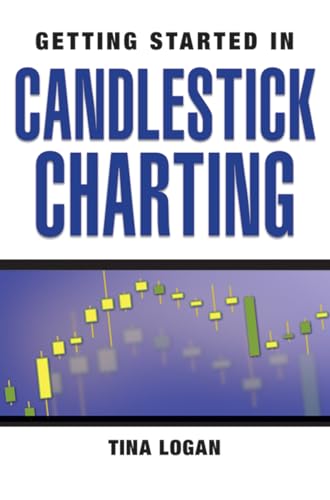
Synopsis
If you want to gain an edge in today’s competitive markets, adding the candlestick methodology to your repertoire of technical analysis skills is essential. Getting Started in Candlestick Charting can help you achieve this goal, whether you’re new to chart analysis or looking to enhance your understanding of the approach. This reliable resource covers thirty of the most widely recognized candlestick patterns and includes real-world charting examples backed by informative commentary.
"synopsis" may belong to another edition of this title.
About the Author
Tina Logan is an active trader, coach, trainer, and speaker. Having spent several years tutoring traders, and possessing an in-depth understanding of technical analysis, Logan is known for her ability to break down technical trading concepts into easily digestible pieces so that novices can begin trading with confidence and clarity. Her Web site is www.tinalogan.com.
From the Back Cover
Praise for Getting Started In Candlestick Charting
"Tina Logan offers the beginning trader an insightful blend of candlesticks with traditional technical tools. Her skillful use of candles, chart patterns, and indicators makes this book a first choice among traders or investors wanting to explore the world of candlesticks."
Thomas N. Bulkowski, author of Encyclopedia of Candlestick Charts and
Encyclopedia of Chart Patterns, Second Edition
"Tina Logan has added significantly to the lore of Japanese candlestick literature with new and different insights for analysis. It has more depth than the 'getting started' in the title might suggest. All who are interested in learning about candlesticks should consider this book."
Gregory L. Morris, Senior Portfolio Manager, PMFM, Inc., and author of
Candlestick Charting Explained, Third Edition and
The Complete Guide to Market Breadth Indicators
"Tina Logan utilizes her talents for training investors in how to use candlestick signals in a very clear and concise fashion, allowing investors to cut to the core of the important features of candlestick analysis. Every investor wanting to become familiar with the benefits of candlestick signals should read this book. Tina's illustration of how and where to use the signals successfully makes understanding candlestick signals very easy. I highly recommend this to all investors that want to understand the intricacies of price moves."
Stephen W. Bigalow, President of the Candlestickforum.com, and author of Profitable Candlestick Trading and High Profit Candlestick Patterns
"Tina Logan does an excellent job of showing the basics of candlesticks and how to improve on the methodology using unique charting tactics and technical analysis, and goes even further to show how you can spot high- probability reversal candles with the aid of computer analysis. This is an excellent book that does more than just 'get you started.' It helps you map out prime trading strategies to help you navigate into a successful trading career."
John Person, President of Nationalfutures.com, and author of Forex Conquered
From the Inside Flap
Praise for Getting Started In Candlestick Charting
Tina Logan offers the beginning trader an insightful blend of candlesticks with traditional technical tools. Her skillful use of candles, chart patterns, and indicators makes this book a first choice among traders or investors wanting to explore the world of candlesticks.
--Thomas N. Bulkowski, author of Encyclopedia of Candlestick Charts and
Encyclopedia of Chart Patterns, Second Edition
Tina Logan has added significantly to the lore of Japanese candlestick literature with new and different insights for analysis. It has more depth than the 'getting started' in the title might suggest. All who are interested in learning about candlesticks should consider this book.
--Gregory L. Morris, Senior Portfolio Manager, PMFM, Inc., and author of
Candlestick Charting Explained, Third Edition and
The Complete Guide to Market Breadth Indicators
Tina Logan utilizes her talents for training investors in how to use candlestick signals in a very clear and concise fashion, allowing investors to cut to the core of the important features of candlestick analysis. Every investor wanting to become familiar with the benefits of candlestick signals should read this book. Tina's illustration of how and where to use the signals successfully makes understanding candlestick signals very easy. I highly recommend this to all investors that want to understand the intricacies of price moves.
--Stephen W. Bigalow, President of the Candlestickforum.com, and author of Profitable Candlestick Trading and High Profit Candlestick Patterns
Tina Logan does an excellent job of showing the basics of candlesticks and how to improve on the methodology using unique charting tactics and technical analysis, and goes even further to show how you can spot high- probability reversal candles with the aid of computer analysis. This is an excellent book that does more than just 'get you started.' It helps you map out prime trading strategies to help you navigate into a successful trading career.
--John Person, President of Nationalfutures.com, and author of Forex Conquered
Excerpt. © Reprinted by permission. All rights reserved.
Getting Started in Candlestick Charting
By Tina LoganJohn Wiley & Sons
Copyright © 2008 Tina LoganAll right reserved.
ISBN: 978-0-470-18200-0
Chapter One
Introduction to Candlestick Charting
When I first began using technical analysis years ago, I used the standard bar chart. Eventually, though, I discovered the candlestick chart with its unique display of price action. Just switching from bar charts to candlestick lines alone helped my chart analysis tremendously. Candlesticks light up the chart's canvas, making it very quick and easy to see price trends and changes in the sentiment of market participants.
The next step was to learn the candlestick patterns with their unusual yet interesting names. After I understood the psychology behind the various patterns, I never went back to using bar charts. Once you learn to put this powerful charting tool to work, I am confident that you, too, will get hooked on candlesticks.
As valuable as candlesticks are as a chart analysis tool, they are simply that-one tool. They should not be viewed in isolation, but instead in the context of the surrounding chart landscape. Japanese candlestick charting should be blended with classic Western technical analysis methods rather than replacing them. It is the synergy of the two methods-Eastern merged with Western-that provides the means for superior technical analysis.
Getting Started in Candlestick Charting will not only provide you with an introduction to candlesticks, but will show you how to analyze them with the aid of Western techniques. It will guide you down the path toward advancing your charting skills and improving profitability.
Evolution of Candlesticks
Japanese candlestick charting is a centuries old methodology that was a secret of the Far East for generations. Candlestick charting took root in Japan, where the first rice exchange was set up in the 1600s. Eventually the exchange was institutionalized and the Dojima Rice Exchange in Osaka, Japan opened for business. Initially, the merchants dealt only in the exchange of the actual product: rice. In the early 1700s, the exchange shifted to the use of rice coupons. Rice coupons were sold against future rice deliveries resulting in the creation of futures contracts. The Dojima Rice Exchange was Japan's largest rice exchange, and the world's first futures market.
The legendary Japanese businessman Munehisa Homma made a considerable contribution to the early development of what we know today as candlestick charting. In 1750, Homma was granted control of his family's business, which included a large rice farming estate. He began trading at the local rice exchange in Sakata, Japan, a busy port for the collection and distribution of rice, and still an important port city today.
Homma accumulated a great fortune trading in the local and regional rice exchanges. It was said that he set up a network that stretched from Sakata to Osaka (a few hundred miles), which consisted of men using flags to communicate from rooftops. Homma kept records of his observations of the psychology of rice traders, as well as a historical record of weather conditions and rice prices. The trading rules and principles that Homma developed were instrumental to the evolution of candlestick analysis.
It wasn't until a few centuries later that candlestick charting was introduced in the United States. Candlestick charts have become extremely popular since first being introduced in the West in 1989 by author Steve Nison. The first edition of his groundbreaking book Japanese Candlestick Charting Techniques was released in 1991 (New York Institute of Finance). Before that time, candlesticks were virtually unknown in America. If not for Mr. Nison's perseverance and passion for the subject matter, the Western hemisphere may have continued to be unaware of this remarkable analysis tool.
Fortunately for us, Mr. Nison spent an immense amount of time and effort researching this charting methodology. This was no easy task. He began his research and study of candlesticks before the advent of mainstream charting programs, and as such, initially had to create the charts by hand. In addition, it also involved the tedious and difficult translation from Japanese to English. Add to that the challenge of interpretation, and some subjectivity that is an inherent part of technical analysis, and you can see the magnitude of this undertaking. As with most great endeavors, he accomplished those tasks with the help of key contacts he developed in the United States and abroad.
Traders who are new to candlestick charting will enjoy the benefits of Nison's persistent efforts, as well as the contributions by other authors who followed his lead. As candlesticks took hold in America, traders embraced them and helped integrate this technology into the realm of Western technical analysis.
The use of candlestick charts has now become so common that nearly all charting programs include them. With the widespread use of computerized chart analysis, the candlestick chart has become as well known as the bar chart. In fact, almost every trader that I know uses candlesticks; so I'd surmise that the candlestick chart has caught up with the bar chart in popularity, and perhaps even surpassed it.
If a technology is not effective it will not last. Experienced traders will eventually abandon a methodology if it does not prove worthy as an analysis tool, which, directly or indirectly, enhances their profits. The fact that candlestick charting has been around for centuries is a testament to its effectiveness.
Strengths of Candlesticks
Candlestick charts are superior to bar charts. That is only my opinion, of course, but it is one that is shared by many skilled chartists. Compare a bar chart (Figure 1.1) to a candlestick chart (Figure 1.2) and you'll see that they include the same price data: the open, high, low and closing prices. The candlestick line, however, provides insight into the current psychology of the investing crowd, which is not as easily identified in a bar chart. Once you become comfortable with the candlesticks, and understand their implications, you may find that a standard bar chart looks incomplete.
Since the candlesticks include the same price data as bar charts, you can utilize any of the popular technical analysis tools and techniques that can be used with bar charts, such as moving averages and trendlines.
Candlesticks make analysis quicker and more efficient. Since the area between the opening and closing prices is boxed and colored, it is obvious whether the bar is bearish (black) or bullish (white). In addition, the length of the boxed area tells us how dominant the bears or bulls were during a trading session. You don't have to stop and "think it through."
Candlesticks are tremendous for signaling turning points. They help identify the sentiment of investors as price becomes overextended or tests support and resistance levels. Their signals are often received earlier than those from traditional Western indicators or reversal patterns, which make them a strong tool for timing entries and exits.
Although the notion of candlesticks providing primarily short-term signals may be seen as a weakness by some traders, that trait can actually be put to good use by swing traders. Swing traders tend to take profits after short-term price moves. Precision entries and exits can make a substantial difference to their bottom line. Candlesticks provide short-term signals, so they are an excellent swing-trading tool. It is one of the primary ways in which I use them.
Limitations of Candlesticks
Candlesticks are not perfect. Like any technical analysis tool, they do have their limitations and weaknesses as indicated below:
Because of their boxed construction, candlestick lines take up more space on a chart. When a chart is tightly compressed, it may be difficult to see the detail of each candlestick line. This is not usually a major hindrance for most chartists though. Modern charting programs offer the ability to quickly zoom out or zoom in to see more or less data on the chart.
Most candlestick patterns provide only a short-term glance into investor psychology. Candlestick signals that form on daily charts may be more beneficial for shorter-term trading than for longer-term investing. However, since candlesticks can be employed on any time frame, investors may benefit from utilizing them on weekly charts.
Candlestick patterns do not provide price targets. However, Western technical analysis does provide techniques for projecting targets, which is a strong argument for blending the two methodologies.
Candlestick reversal patterns do not predict the duration, or magnitude, of a price move. They simply alert chartists to a potential change in the direction of price.
With certain setups, by the time a candlestick signal is confirmed price may be well off its low (bullish pattern) or well off its high (bearish pattern). Therefore, an entry should not be initiated for a new long or short position based solely on the pattern. The reward compared to the risk should always be considered when taking any trade.
Most candlestick advocates will agree that the benefits of candlesticks far outweigh their limitations and weaknesses.
Getting Started with Candlestick Charting
Choosing candlesticks as your chart type, and really implementing candlestick analysis, are two different things entirely. Although numerous traders now prefer to view price action displayed as candlestick lines, there are still many users who are not proficient in their interpretation. In addition, many traders fail to take advantage of the candlestick patterns.
Some traders just feel overwhelmed by the number of patterns, along with their unusual names, that they must commit to memory and learn to recognize. Others may not understand the message of the emotional crowd that is evident in the candlestick lines and patterns, and which makes them so valuable. And still other users may not be well versed in Western technical analysis and, as a result, fail to use candlesticks in the proper context.
Getting Started in Candlestick Charting tackles those challenges. It will provide you a strong foundation of the following:
The construction of the candlestick lines and how the candles can provide insights into market behavior. By using candlesticks to display data, you should see an immediate improvement in your chart analysis skills.
An understanding of the psychology of investors that underlies the formation of several common reversal patterns. You'll learn how to identify those patterns, which will help you to select higher probability trading setups and also improve the timing of your entries and exits.
An introduction to several key Western technical analysis concepts. This knowledge will give you a broader view of price action in contrast to the narrower view provided by candlesticks.
Blending candlestick charting with Western technical analysis in order to enhance their signals. By doing so, you'll enjoy a higher level of success than using either Japanese candlesticks or Western technical analysis in isolation.
A common complaint that I hear from traders is that they just get overwhelmed by all there is to be learned in this business. I encourage them to remain steadfastly focused on the outcome of trading, which is to make money. The outcome is not to fill your mind with an exhaustive amount of data. You must learn to sift through what appears to be a mountain of information and hone in on the key areas that will achieve the outcome of increasing profits and reducing risk. That is precisely the intention of this book. That "sifting" process has been done for you with the goal of shortening your learning curve.
In the beginning, it is better to learn a limited number of candlestick patterns, and to learn them very well, rather than trying to absorb several dozen patterns by rote memorization. If you really dig in deep and understand the meaning behind a pattern, and then practice identifying it using real-time charts, that knowledge will be lasting rather than fleeting. Once you have a strong foundation of understanding in place, you'll find it easy to add more candlestick patterns later if desired.
Although there is no way around putting in the time needed to learn a new subject, there are ways to learn that can expedite the process. Getting Started in Candlestick Charting will save you an invaluable amount of time by putting your focus in the key areas that will have an immediate and significant impact on your trading.
Learning a new subject, especially a technical one such as chart analysis, takes time and practice. You may need to review this book more than once in order to become proficient at utilizing candlestick charts. Remember that repetition is the mother of skill. The benefits you'll reap will far outweigh the initial outlay of time and effort.
Additional Introductory Comments
The term candlestick charting is often abbreviated to candlesticks or candles. The terms are interchangeable and are all used throughout this book.
Mention of Western technical analysis, bar charts, or chart patterns refers to techniques that have been used in America for many decades. Reference to Japanese or Eastern technical analysis refers to candlestick lines and candlestick patterns that have been used in the Far East for centuries. Whenever the term reversal pattern is used, it should be construed to mean a candlestick reversal pattern. If a Western reversal pattern is referenced, it will be clearly stated as such.
The daily chart is the most commonly viewed time frame. Most of the discussion and chart examples in this book refer to daily charts; therefore, the term day, session, or trading session is often used to reference a candlestick line. (A trading session is one day of trading from the opening bell to the closing bell.) Candlestick charting can be used on any time frame. If a time frame other than daily is referenced, it will be clearly noted. The term bar, period, or trading period may be used in reference to a candlestick line in such cases.
The discussion and illustrations in this book focus on U.S. stocks. Therefore, the word price is used often; for instance, to describe a price advance or a price decline. However, candlestick charting can be used as an analysis and timing tool in most markets. Candlesticks are commonly used in the futures markets. As long as the prices, or values, that are needed are available, a candlestick line can be constructed. For example, the opening, high, low, and closing prices are used to construct candle charts for stocks. Index charts, such as the Dow Jones Industrial Average, do not have prices. Those four price points are represented by numerical values for an index.
In most charting programs, the chart can be compressed horizontally and vertically. The level of compression may impact the look of the candlesticks. In addition, the chart adjusts to accommodate new higher, or lower, price points. Therefore, if you are looking back from the right edge at historical data, it may look different than it did when it was at the right edge of the chart. Make sure to move the chart back when analyzing candlestick lines or patterns using historical data. Most mainstream charting programs allow you to back up the chart; however, free online services may not offer this feature.
All chart examples in this book were produced with permission by TeleChart 2007(r), a registered trademark of Worden Brothers, Inc., Five Oaks Office Park, 4905 Pine Cone Drive, Durham, NC 27707; phone (800) 776-4940 or (919) 408-0542, www.worden.com.
For ease of instruction, the terms trader and investor may be used interchangeably to refer to persons who execute trades, either short or long term. However, it should be noted that trading typically applies to holding short-term positions and investing generally refers to a longer-term strategy that may include the analysis of a company's fundamentals. The term bulls refers to bullish market participants either holding, or considering, long positions. The term bears refers to bearish market participants holding or considering short positions.
(Continues...)
Excerpted from Getting Started in Candlestick Chartingby Tina Logan Copyright © 2008 by Tina Logan. Excerpted by permission.
All rights reserved. No part of this excerpt may be reproduced or reprinted without permission in writing from the publisher.
Excerpts are provided by Dial-A-Book Inc. solely for the personal use of visitors to this web site.
"About this title" may belong to another edition of this title.
Search results for Getting Started in Candlestick Charting

Seller Image
Getting Started in Candlestick Charting
Seller: Zoom Books East, Glendale Heights, IL, U.S.A.
Seller rating 5 out of 5 stars

Condition: very_good. Book is in very good condition and may include minimal underlining highlighting. The book can also include "From the library of" labels. May not contain miscellaneous items toys, dvds, etc. . We offer 100% money back guarantee and 24 7 customer service. Seller Inventory # ZEV.0470182008.VG
Seller Image
Getting Started in Candlestick Charting
Seller: Greenworld Books, Arlington, TX, U.S.A.
Seller rating 5 out of 5 stars
Condition: good. Fast Free Shipping â" Good condition. It may show normal signs of use, such as light writing, highlighting, or library markings, but all pages are intact and the book is fully readable. A solid, complete copy that's ready to enjoy. Seller Inventory # GWV.0470182008.G
Stock Image
Getting Started in Candlestick Charting
Seller: Evergreen Goodwill, Seattle, WA, U.S.A.
Seller rating 5 out of 5 stars
paperback. Condition: Good. Seller Inventory # mon0000248712
Seller Image
Getting Started in Candlestick Charting
Seller: Zoom Books East, Glendale Heights, IL, U.S.A.
Seller rating 5 out of 5 stars
Condition: good. Book is in good condition and may include underlining highlighting and minimal wear. The book can also include "From the library of" labels. May not contain miscellaneous items toys, dvds, etc. . We offer 100% money back guarantee and 24 7 customer service. Seller Inventory # ZEV.0470182008.G
Stock Image
Getting Started in Candlestick Charting
Seller: World of Books (was SecondSale), Montgomery, IL, U.S.A.
Seller rating 5 out of 5 stars
Condition: Good. Item in good condition and has highlighting/writing on text. Used texts may not contain supplemental items such as CDs, info-trac etc. Seller Inventory # 00104420295
Stock Image
Candlestick Charting
Seller: ThriftBooks-Phoenix, Phoenix, AZ, U.S.A.
Seller rating 5 out of 5 stars
Paperback. Condition: Good. No Jacket. Pages can have notes/highlighting. Spine may show signs of wear. ~ ThriftBooks: Read More, Spend Less. Seller Inventory # G0470182008I3N00
Stock Image
Candlestick Charting
Seller: ThriftBooks-Reno, Reno, NV, U.S.A.
Seller rating 5 out of 5 stars
Paperback. Condition: Good. No Jacket. Pages can have notes/highlighting. Spine may show signs of wear. ~ ThriftBooks: Read More, Spend Less. Seller Inventory # G0470182008I3N00
Stock Image
Candlestick Charting
Seller: ThriftBooks-Dallas, Dallas, TX, U.S.A.
Seller rating 5 out of 5 stars
Paperback. Condition: Good. No Jacket. Missing dust jacket; Pages can have notes/highlighting. Spine may show signs of wear. ~ ThriftBooks: Read More, Spend Less. Seller Inventory # G0470182008I3N01
Stock Image
Candlestick Charting
Seller: ThriftBooks-Atlanta, AUSTELL, GA, U.S.A.
Seller rating 5 out of 5 stars
Paperback. Condition: Good. No Jacket. Pages can have notes/highlighting. Spine may show signs of wear. ~ ThriftBooks: Read More, Spend Less. Seller Inventory # G0470182008I3N00
Stock Image
Candlestick Charting
Seller: ThriftBooks-Atlanta, AUSTELL, GA, U.S.A.
Seller rating 5 out of 5 stars
Paperback. Condition: Very Good. No Jacket. May have limited writing in cover pages. Pages are unmarked. ~ ThriftBooks: Read More, Spend Less. Seller Inventory # G0470182008I4N00