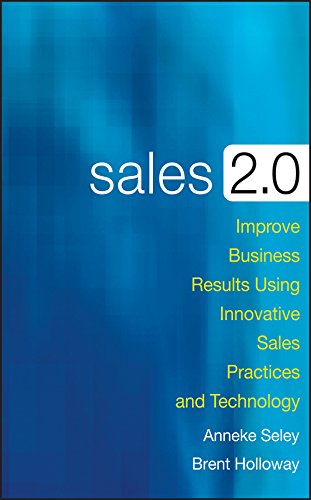
Sales 2.0: Improve Business Results Using Innovative Sales Practices and Technology - Hardcover

Seley, Anneke; Holloway, Brent

  • 3.74 out of 5 stars
    34 ratings by Goodreads
 
9780470373750: Sales 2.0: Improve Business Results Using Innovative Sales Practices and Technology

Synopsis

Two Silicon Valley insiders reveal the emerging Sales 2.0 trend and how companies can profit from it

Sales 2.0 explores the emerging Sales 2.0 phenomenon, how it is characterized, why it is imperative for a company’s long-term success, and how anyone can get started with this new approach to generating revenue. Driven by an explosion of online products and changing customer buying preferences, Sales 2.0 is the marriage of Web 2.0 technologies with innovative sales processes. The book shows readers how to redeploy their sales teams for greater bottom-line results and reveals all the differences between Sales 2.0 and traditional selling. Through real world case studies, readers will learn how industry leaders achieved phenomenal results and a competitive advantage. Applicable to sales teams in any industry, Sales 2.0 presents the future of sales today.

"synopsis" may belong to another edition of this title.

About the Author

ANNEKE SELEY was the twelfth employee at Oracle and the designer of the company's revolutionary inside sales operation. She is currently the CEO and founder of Phone Works, a consultancy that helps large and small businesses build and restructure sales teams to achieve predictable, measurable, and sustainable sales growth.

BRENT HOLLOWAY is a practicing sales manager with more than a decade of direct and channel sales experience at high-tech companies. He currently manages a sales team at Verint Systems that has dramatically increased incremental revenue, profit, and customer retention.

From the Back Cover

The high-tech revolution that brought us the Internet and online communication has changed the way people talk to each other and how they buy the products they need. But it hasn't led to a revolution in sales strategies. Despite the explosion of online products and changing customer buying habits, the sales profession still lacks an innovative set of sales practices that really work in the new reality.

Enter Sales 2.0, a newer, better way to identify and communicate with today's customers. It's the art of sales with updated best practices for predictable, measurable selling in today's online world. It's not just about using new technology to sell. It's about what works best in concert with Web 2.0 customer-centric sales processes, strong relationships, and the strategic allocation of sales resources for maximum profitability.

In Sales 2.0, authors Seley and Holloway demystify the emerging Sales 2.0 trend and provide a framework that business leaders and sales professionals can use to implement it in their organizations. They explain why traditional sales tactics no longer work and why you should change the way you sell. They explore Sales 2.0 in practice and showcase four industry-leading companies currently using Sales 2.0 successfully and profitably. They show you how to align your sales resources with customer opportunities to create better sales force deployment and territory coverage. That means segmenting your sales process steps, customers, and opportunities and using the most profitable sales channel or communication medium to engage more buyers.

Ideal for sales teams in any industry, Sales 2.0 finally marries Web 2.0 technologies with the innovative sales practices those technologies enable, resulting in improved sales productivity and results. The business of sales is changing; whether your business changes with it will determine your long-term success. Sales 2.0 is the next step in the evolution of sales.

From the Inside Flap

The high-tech revolution that brought us the Internet and online communication has changed the way people talk to each other and how they buy the products they need. But it hasn't led to a revolution in sales strategies. Despite the explosion of online products and changing customer buying habits, the sales profession still lacks an innovative set of sales practices that really work in the new reality.

Enter Sales 2.0, a newer, better way to identify and communicate with today's customers. It's the art of sales with updated best practices for predictable, measurable selling in today's online world. It's not just about using new technology to sell. It's about what works best in concert with Web 2.0?customer-centric sales processes, strong relationships, and the strategic allocation of sales resources for maximum profitability.

In Sales 2.0, authors Seley and Holloway demystify the emerging Sales 2.0 trend and provide a framework that business leaders and sales professionals can use to implement it in their organizations. They explain why traditional sales tactics no longer work and why you should change the way you sell. They explore Sales 2.0 in practice and showcase four industry-leading companies currently using Sales 2.0 successfully and profitably. They show you how to align your sales resources with customer opportunities to create better sales force deployment and territory coverage. That means segmenting your sales process steps, customers, and opportunities and using the most profitable sales channel or communication medium to engage more buyers.

Ideal for sales teams in any industry, Sales 2.0 finally marries Web 2.0 technologies with the innovative sales practices those technologies enable, resulting in improved sales productivity and results. The business of sales is changing; whether your business changes with it will determine your long-term success. Sales 2.0 is the next step in the evolution of sales.

Excerpt. © Reprinted by permission. All rights reserved.

Sales 2.0

Improve Business Results Using Innovative Sales Practices and TechnologyBy Anneke Seley

John Wiley & Sons

Copyright © 2009 Anneke Seley
All right reserved.

ISBN: 978-0-470-37375-0

Chapter One

Selling In The Twenty-First Century

1. What is Sales 2.0? 2. Why is Sales 2.0 Imperative for Your Business? 3. Sales 1.0 to Sales 2.0: Changing Mindset 4. Sales 2.0 Results and Rewards 5. Seven Misperceptions about Sales 2.0 6. Eight Sales 2.0 Imperatives 7. R U Sales 2.0? A Checklist

HOW INNOVATIVE SELLING BEGAN IN SILICON VALLEY

In the 1970s, IBM was the company to emulate in high technology. IBM's salespeople were considered the best in the business. Their image-symbolized by the dress code of dark business suits with nicely pressed white shirts and ties-was the height of professionalism. IBM's customer service and sales training program were legendary. Sales professionals like Mike Seashols, who started his career in sales at IBM, were highly regarded and sought-after for top jobs across the technology industry. Seashols was recruited to head Oracle's sales organization during the company's high-growth years of the 1980s and currently serves as chairman and CEO of Avolent. As an IBM sales professional, he virtually lived with his customers, one of whom was Steve Jobs; he spent more time at their offices than his own to make sure they received instant attention and were completely satisfied with IBM's products. Customers responded well to this level of service and rewarded IBM with their orders. It was said that "nobody ever got fired for buying Big Blue."

In the days before the advent of the personal computer and the commercial use of the Internet, computers cost hundreds of thousands of dollars and required large, dedicated, temperature-controlled rooms, and staffs of technical people to keep them running. Software, which cost tens of thousands to millions of dollars to license, was sold top down to what we now call the chief information officer (CIO)-the head of information technology-and approved by senior management. It was distributed on physical reels of magnetic tape and procured as a perpetual use license, personally delivered and installed at the customer's site by a technical specialist or team and carefully monitored until the application went live and was stable. Software upgrades also required onsite installation by a technical expert.

Mike Seashols remembers, "A typical IBM sales cycle was 12 months or longer. Sales reps usually made four sales calls to customers each day, two in the morning and two in the afternoon after lunch." Often, multiple meetings were required to close a sale, given the large financial investment required, the levels of customer management needed for approval, and the evangelical type of selling required to educate customers on new products. Lengthy contract negotiations were often needed as well before products were sold. Legal departments and contract administrators on both sides of the table could add weeks to the sales cycle, just to fulfill their responsibility to protect their company's interests and secure the best possible terms.

Due to the high costs associated with these installations, only the largest companies and government agenncies could afford such expenditures. And these customers expected not only dedicated technical resources-which ensured smooth and successful implementations-but also perks that added to the cost of doing business. Customers often enjoyed invitations to expensive meals or rounds of golf, accompanied by their salesperson. As a result, technology vendors' cost of selling and servicing customers was so high and sales rep productivity was so limited that only the largest deals and biggest customers could be targeted in order to make a healthy profit.

Those were the good old days of Sales 1.0 selling in Silicon Valley. Boy, has the world changed.

In the mid-1980s, as computers became smaller, more affordable, and more ubiquitous, the market blew wide open for a much bigger range of less expensive software and hardware that appealed to a bigger universe of potential customers. No longer were these complex products the domain of only the Fortune 1000 and big government. The super-high-touch, labor-intensive way we used to sell technology products no longer made economic sense for markets, customers, or products requiring a high volume of sales transactions. Sales strategies and distribution channels in Silicon Valley had to evolve.

The old way of selling wasn't a fit for the new buyers either. Customers with smaller computers became more self-sufficient and often installed their own software without involving their information technology (IT) departments or requiring CIO or senior management approval. Contracts for smaller systems were initially simplified and shrink-wrapped with the product, which was shipped on discs. This approach made the negotiation of terms between legal departments increasingly rare. When it became possible to license software over the Internet, many software products became available for download through a web site link, and users would just check the "Accept" box online to agree to contractual terms. The simplification of the shipping, installation, and contractual requirements also reduced sales-cycle lengths and cost of sales and paved the way for much more software to be sold.

One could argue that the telephone was the first Sales 2.0 disruptive technology to be integrated into the sales process, as Oracle found in 1985. Under certain circumstances, prospects proved to be comfortable interacting with salespeople and even buying complex technology-such as packaged software-from them by phone, as long as they could get quick, accurate answers to their questions and discuss how a product could meet their business requirements. They often had the decision-making and budget authority for smaller purchases, and many preferred the efficiency and instant gratification of phone communication to the lengthy process and delays of scheduling onsite meetings. Trial license programs with liberal return policies preceded the downloadable demos and trials that are offered through many software vendors' web sites today.

The comfort level associated with this manner of buying products along with a thirst for purchasing them more efficiently has expanded to include bigger-ticket items with more complex sales cycles in technology-as well as in other industries. As our customers change, companies that are open, flexible, and changing the way they sell are creating competitive advantage, and leaving behind those that don't do so. This new, emerging framework for selling effectively in the twenty-first century is called Sales 2.0.

WHAT IS SALES 2.0?

Sales 2.0 is the use of innovative sales practices, focused on creating value for both buyer and seller and enabled by Web 2.0 and next-generation technology. Sales 2.0 practices combine the science of process-driven operations with the art of collaborative relationships, using the most profitable and most expedient sales resources required to meet customers' needs. This approach produces superior, predictable, repeatable business results, including increased revenue, decreased sales costs, and sustained competitive advantage.

THE FOUNDATION OF SALES 2.0

The innovations associated with Sales 2.0 practices fit into four interrelated, interdependent categories: strategy, people, process, and technology (Figure 1.1). Sales 2.0 organizations feature:

1. Strategy which includes alignment of sales resources with customer opportunities and leverages your most expensive professionals while providing coverage for buyers regardless of location, size, or stage in the sales cycle. Sales 2.0 companies also have the right go-to-market plan and integrated, coordinated sales and marketing plans.

2. People who are relationship-focused, open, authentic, and flexible. They create and maintain collaborative interactions with people both inside and outside the company, using the most appropriate medium to engage and maintain relationships. Sales 2.0 professionals are trusted and enjoy support from customers, partners, colleagues, and peers alike, which leads to improved business results for all parties.

3. Process that is customer-focused, measurable, reproducible, and automated, and which can be duplicated across a sales organization to produce predictable sales results from quarter to quarter. The Sales 2.0 process results in optimized sales efficiency and effectiveness, and ultimately high-velocity, high-volume, and high-value transactions. Deals close faster, there are more of them, and they are more profitable.

4. Technology which enables sales process and relationship-building, and which helps your people be more productive and successful.

Sales 2.0 Strategy: Alignment and Resource Allocation Sales 2.0 businesses perform market analysis to identify customer types and requirements and assign the most profitable sales resources appropriate for each customer segment and market. Your most experienced and expensive sales teams should be focused on your largest qualified customers or sales opportunities. You can leverage their time and attention with a sales strategy that includes sales resources dedicated to sales opportunities that do not require face-to-face interaction. This includes qualifying buyers of all sizes in early stages of your sales cycle, smaller sales opportunities or prospects that may be geographically distant, and customers who have already purchased products from you. These communities can often be served by lower-cost sales resources using the phone and online technology. Sales 2.0 strategy leverages the most expensive sales reps while keeping sales pipelines consistently full, increasing customer acquisition and revenue generation, which keeps cost of sales low to deliver maximum value to investors and shareholders.

Sales and marketing alignment is especially important in Sales 2.0. These departments function together as one continuum to generate interest and engage customers. They collaborate on key strategy decisions as well as customer acquisition and relationship-building programs. Without the right go-to-market strategy, companies cannot enjoy Sales 2.0 benefits. These strategic prerequisites include product offering, positioning, messaging, pricing, target audience and qualified lead definitions, and channel distribution appropriate for the customers in your market. Without getting these right, Sales 2.0 initiatives-and Sales in general-will be ineffective. Although this book does not address these preconditions for success-numerous other books explore these marketing fundamentals in great detail-we do cover Sales 2.0 practices that can be used to test and refine or correct your marketing and sales strategies.

Sales 2.0 People: Open, Flexible, Collaborative, and Tech-Savvy

Relationships, interaction, and collaboration among different constituencies are major themes in Sales 2.0. The main selling relationship focus is on the connection between sales reps and their prospects or customers. As time progresses, the majority of these interactions are occurring by phone and Web. In addition, teamwork among colleagues is another prerequisite for Sales 2.0 success. The aforementioned sales and marketing alignment is a classic example of a Sales 2.0 relationship, and with technology, the line between the two functions is blurring. Also, close collaboration between inside and field reps, sales reps and sales support staff such as subject matter experts (SMEs), and contracts or legal leads to shorter sales cycles and increased revenue in Sales 2.0 companies.

In order to achieve Sales 2.0 levels of relationships and collaboration, company cultures will inevitably shift and managers may need to rethink their hiring strategies and compensation plans for sales employees. This new breed of sales rep must be open to change in the sales profession. As they focus on building relationships with customers and peers, these open-minded reps use the phone and Web extensively in place of on-site visits to contain costs, improve productivity, and provide more immediate service. They need to come up to speed on new technologies as customers adopt them. These Sales 2.0 reps often have team-selling goals-in addition to individual ones-that are supported by compensation plans that reward Sales 2.0 behavior. And for maximum performance gains, they must embrace a sales process that evolves with changing customer and market conditions.

Sales 2.0 Process: A Customer-Centric Yardstick for KPIs (Key Performance Indicators)

Salespeople take certain steps to advance a sale, and their prospective customers take parallel steps to make a purchase decision. Sales 2.0 process is designed with customers at the forefront and asks: What are their business initiatives? What actions must they take at each step? What do they need from you and by when? Are you easy to do business with? This customer-focused process gives you a framework by which to measure your business metrics and key performance indicators (KPIs): to figure out what's working and what's not. Without it, you can't predict business results; nor can you duplicate successes by sharing knowledge and best practices, fine-tune your sales approaches when markets and customers' businesses change, or make continuous improvements as you experiment with different sales and marketing programs. Think of Sales 2.0 process measurement as part yardstick, part crystal ball.

Sales 2.0 Technology: The Right Tools for Your Sales Reps and Customers

The predictability, constant improvement in business processes, and strong, engaged online relationships that are the hallmarks of Sales 2.0 are supported by technology. It may be customer relationship management (CRM), business analytics, e-mail and web site tracking software; or products that accelerate account research or lead generation that help make sales reps more effective and efficient. Or it may by video e-mail, webinar software, or sales portals that encourage interaction, collaboration, and engagement. Without today's technology enabling detailed sales process measurement and analysis-as well as the meaningful building of relationships without in-person meetings-Sales 2.0 simply wouldn't be possible.

Recognizing the opportunity to enable these practices-which result in improved sales metrics-technology vendors have responded with an explosion of available online products. In general, these are Web 2.0 or advanced technologies that include software and services that speed up, enhance, or provide visibility into the sales cycle, or improve customer experience and engagement. In Part 4, we cover some of these technologies and how they are improving sales productivity. Later in Part 1, we discuss eight imperatives for Sales 2.0 strategy, people, process, and technology in more detail. But first, we want to address some questions that may be on your mind:

Why is it so important to begin a transformation to Sales 2.0?

What happens if you don't?

What do you need to change from the way you're selling now?

What are the rewards for implementing Sales 2.0?

(Continues...)


Excerpted from Sales 2.0by Anneke Seley Copyright © 2009 by Anneke Seley. Excerpted by permission.
All rights reserved. No part of this excerpt may be reproduced or reprinted without permission in writing from the publisher.
Excerpts are provided by Dial-A-Book Inc. solely for the personal use of visitors to this web site.

"About this title" may belong to another edition of this title.