
Items related to Teach Yourself VISUALLY Beadwork: Learning Off-Loom...
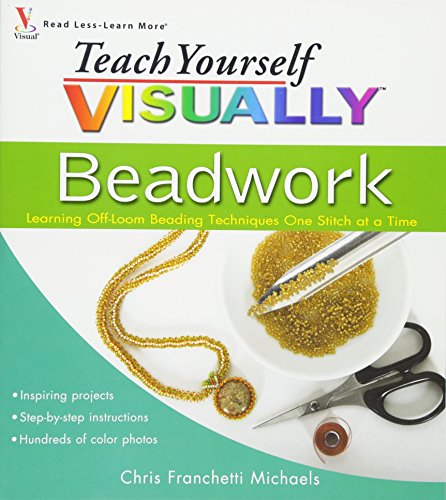
Teach Yourself VISUALLY Beadwork: Learning Off-Loom Beading Techniques One Stitch at a Time (Teach Yourself VISUALLY Consumer) - Softcover
Synopsis
A step-by-step visual guide to off-loom bead weaving
This photo-intensive guide is a comprehensive resource for creating off-loom beadwork, from simple stitches that any beginner can do to more advanced techniques that you can work up to as you build your skills. Every page includes detailed color photos and diagrams that make it easy to follow along. You'll learn how to weave the peyote, ladder, brick, square, right angle weave, and herringbone stitches, as well as make beaded netting and create beaded clasps and other decorative details. Plus, you'll get patterns to make modern, stylish pieces, from necklaces, bracelets, and earrings to napkin rings.
"synopsis" may belong to another edition of this title.
About the Author
Chris Franchetti Michaels is a writer and jewelry artisan specializing in beaded designs, wirework, and metal fabrication. She is the author of Teach Yourself VISUALLY Jewelry Making & Beading, Beading VISUAL Quick Tips, and Wire Jewelry VISUAL Quick Tips. Chris has appeared on several episodes of DIY Network's "Jewelry Making," and her designs have been featured in popular books.
From the Back Cover
This photo-intensive guide walks you through all the steps to creating intricately woven, one-of-a-kind, and colorful beadwork. You'll learn all of the most popular bead-weaving stitches, from peyote stitch and beaded netting to right-angle weave and her
Concise two-page lessons show you all the steps to a skill and are ideal for quick review
- Each skill or technique is defined and described
- Detailed color photos demonstrate each step
- Step-by-step instructions accompany each photo
- Helpful tips provide additional guidance
From the Inside Flap
This photo-intensive guide walks you through all the steps to creating intricately woven, one-of-a-kind, and colorful beadwork. You'll learn all of the most popular bead-weaving stitches, from peyote stitch and beaded netting to right-angle weave and her
Concise two-page lessons show you all the steps to a skill and are ideal for quick review
- Each skill or technique is defined and described
- Detailed color photos demonstrate each step
- Step-by-step instructions accompany each photo
- Helpful tips provide additional guidance
Excerpt. © Reprinted by permission. All rights reserved.
Teach Yourself VISUALLY Beadwork
Learning Off-Loom Beading Techniques One Stitch at a TimeBy Chris Franchetti MichaelsJohn Wiley & Sons
Copyright © 2009 John Wiley & Sons, LtdAll right reserved.
ISBN: 978-0-470-45466-4
Chapter One
Introduction to Beadwork
Have you admired intricately woven, colorful beadwork, but assumed that you could never make it yourself? Perhaps you were intimidated by the tiny dimensions and sheer number of the beads, or maybe you felt overwhelmed by the complex project instructions in a book or magazine. Put your worries aside, and allow this book to guide you, step by step, through the most popular contemporary beadwork techniques. You will discover that bead weaving is not overly difficult, and that it is more rewarding than you may have imagined.
How to Use This Book 4 Beads Used for Bead Weaving 5 Beading Needles and Thread 12 More Tools and Supplies 16
How to Use This Book
Bead weaving is the process of stitching beads together using a needle and thread. With off-loom bead weaving, you stitch beads while holding the beaded fabric-called beadwork-in your hands, rather than using a loom to support it. You can use off-loom bead-weaving techniques to create jewelry, artwork, and items of dcor for your home.
This book covers introductory off-loom bead weaving for beginners, but it also includes some intermediate techniques that you can learn over time as your skills develop. As you progress, remember that successful bead weaving takes lots of practice, and your initial swatches and projects will not be perfect. Be patient, and enjoy the process of watching your skills improve. Below is an overview of how this book is organized and how you can use it to get started.
Learn the Basics of Bead Weaving
Begin by reading the sections on beads, needles, thread, tools, and supplies in this chapter. They contain important terminology that is used in bead-weaving project instructions and will help you set up a work area stocked with essential materials.
After you finish Chapter 1, look over all of the sections in Chapter 2. They explain the basic techniques required to start and complete most bead-weaving projects. Pay especially close attention to the final section, which defines essential terms that are used throughout the rest of the book. Keep in mind that you can return to Chapter 2 anytime, and you do not need to learn all of the techniques covered there at once.
EXPERIMENT WITH OFF-LOOM STITCHES
Chapters 3 through 8 demonstrate how to perform the most popular off-loom bead-weaving stitches, which are ways that you can weave beads together. Each stitch has a unique name and produces beadwork with a distinct look and feel. You can use most stitches to create beadwork that is flat, tubular, or circular in shape.
Many new beaders begin with peyote stitch, featured in Chapter 3, but you are free to try any stitch that interests you. To learn a new stitch, begin with its flat version and make a practice swatch: Prepare an initial length of thread (see Chapter 2), and then follow the steps for that stitch until you have a length of beadwork. You can use practice swatches to improve your overall skills, and to test alternative methods for beginning and ending thread. Once you feel comfortable with the flat version of a stitch, you can move on to its tubular or circular version, or you can try a flat-beadwork project (see the next section). Later, you can return to that stitch's chapter to learn how to add shape and dimension to your beadwork using increases and decreases.
TRY THE EXAMPLE PROJECTS
Once you feel comfortable performing a stitch in swatches, you can make one of the beginner-level projects in Chapter 10 that uses that stitch. When you're ready to attempt more complex projects, try those in Chapter 11. Both chapters give you an opportunity to practice following project instructions, reading patterns, using stitches in interesting ways, and adding the decorative details and clasps that are covered in Chapter 9.
Beads Used for Bead Weaving
Small, glass beads called seed beads are most commonly used for bead weaving. They are available in many sizes and shapes, and in hundreds of colors and finishes.
Varieties of Seed Beads
TRUE SEED BEADS
True seed beads (sometimes called rocailles, E-beads, round seed beads, or simply "seed beads") are tiny, slightly cylindrical glass beads that have rounded edges, like doughnuts. The highest-quality modern seed beads are made in Japan, the Czech Republic, and France. Many beaders use only Japanese beads, which tend to be very consistent in size. You can also find vintage seed beads in some bead shops and on the Internet. These are typically extra-small beads that were once made in Europe, but are no longer manufactured.
You can use true seed beads for any type of bead-weaving stitch. They produce a textural, flowing style of beaded fabric.
FAQ
My local bead shop sells beads labeled "Rocaille," which seem different from regular seed beads, and I have some project instructions that call for "E-beads," but they do not specify a shape or size. Do these terms refer to special kinds of seed beads?
Yes, in these instances, "rocaille" and "E-bead" have more specific meanings than the general term "seed bead." The Miyuki company of Japan adopted the name Rocaille for its specialty line of tiny (size 15/0), very evenly shaped, rounded seed beads. "E-beads" sometimes refer specifically to large (size 5/0 or 6/0) seed beads. (To learn about sizing, see "Bead Sizes" on page 8.) When your project instructions or patterns call for E-beads, without providing any other size information, you can normally use seed beads that are either size 5/0 or size 6/0.
CYLINDER BEADS
Cylinder beads are small glass beads made exclusively in Japan. They are manufactured by a special process that gives them a pronounced cylindrical, or tubular, shape with straight edges (unlike true seed beads, which are only slightly cylindrical and have rounded edges). Cylinder beads are extremely uniform in size and shape, and they have especially large holes to accommodate multiple passes with a needle and thread. Currently, most cylinder beads are produced by two Japanese companies, Miyuki and Toho. You may find these beads for sale under the brand names Delica, Treasure, and Aiko.
Use cylinder beads when you want your beadwork to have a very dense look and smooth feel. They work best with flat or tubular peyote, brick, and square stitches; and they are rarely recommended for loosely woven, or open, stitches, such as right-angle weave, netting, and circular stitches.
BUGLE BEADS
Bugle beads are narrow glass tubes that are longer and less uniform than cylinder beads. Standard bugle beads are straight, but you can also find ornate twisted bugle beads.
Some bugle beads have unpolished, jagged edges that can cut through thread and damage your beadwork. Look for high-quality, Japanese versions of these beads (which may have polished ends), or "buffer" them by stringing a smooth bead immediately in front of and behind each one, as shown on the far right.
TIP
Purchasing Seed Beads by the Unit
Seed beads are usually sold in bulk units rather than by the number of beads in a container or bag. Sometimes these are units of weight. For example, most Japanese seed beads and all cylinder beads are sold by the gram, and French seed beads are usually sold by the ounce. In contrast, many Czech seed beads are sold per 10- to 20-inch strand, or by the hank, which is a bundle of between 8 and 14 strands. Project instructions normally indicate how many grams, ounces, strands, or hanks of beads are required, and over time you should develop a feel for how many beads it takes to complete a given type of design. See the online Appendix (www. wiley.com/go/tyvbeadwork) for some typical beads-per-gram, beads-per-ounce, and beads-per-hank estimates.
CUT SEED BEADS
Cut seed beads are seed beads with one or more flat edges, which create facets. Here are the three most common types:
Two-cuts (also called hex-cuts) are similar to very short bugle beads, but have six relatively even facets that run lengthwise. Three-cuts are two-cuts with extra facets at the ends. Charlottes (also called one-cuts) are true seed beads with a single facet.
SHAPED SEED BEADS
Shaped seed beads are manufactured in different shapes than true seed beads. Here are the most popular:
Triangle beads have three equal sides and ends that are shaped like triangles. Drop beads (also called fringe beads) are tiny, broad, teardrop-shaped beads used to create texture or to accent the ends of fringe. (These include Magatamas, which are manufactured by the Toho company.) Cube beads (also called square beads) have four equal sides and ends that are shaped like squares.
TIP
Using Larger Beads for Bead Weaving
You can use larger glass beads as accents with many bead-weaving stitches. Czech fire-polished beads and Austrian crystal beads are two popular varieties. With beads made from other materials, check to ensure that the holes are large enough to accommodate multiple passes with a needle and thread-and that they are free from sharp edges that may damage thread-before using those beads in a project.
Bead Sizes
The sizes of true seed beads, cylinder beads, charlottes, two-cuts, three-cuts, and some triangle beads are denoted by numbers called aught sizes. Historically, aught sizes may have corresponded to the number of beads that made up 1 inch of beads stacked side by side (not strung end to end). Accordingly, a larger aught number refers to a smaller bead, and a smaller aught number to a larger bead. (See the online Appendix, at www.wiley.com/go/tyvbeadwork, for a chart that compares aught sizes with their approximate lengths in millimeters.)
Note: Because bead size standards have changed over time, aught sizes are not a good indicator of how many beads make up 1 inch of side-by-side beads in your beadwork. To determine that number accurately, create a test swatch (see page 49 in Chapter 2).
An aught size may be written as a fraction (11/0), as a number followed by a degree symbol (11), or simply as a number (11). Seed beads range in size from about 24/0 (smallest) to about 5/0 (largest). Originally, cylinder beads were only manufactured in size 11/0, but some are now produced in sizes 15/0, 10/0, and 8/0. Be aware that different manufacturers may size their beads slightly differently. For example, a size 8/0 Czech seed bead may not have exactly the same dimensions as a size 8/0 Japanese bead. For this reason, it's a good idea to use beads from a single manufacturer for a given project.
Note: These images are not shown to scale; the actual measurements of the beads are provided.
Cube beads, drop beads, some bugle beads, some triangle beads, and most beads that are larger than seed beads are sized in millimeters rather than in aught sizes. These beads are usually measured lengthwise end to end (hole opening to hole opening), with the exception of drop beads, which are often measured top to bottom.
Some Japanese and Czech bugle beads have their own sizing systems. Their sizes are denoted by a pound sign followed by a fraction or a whole number (such as #1 or #2). These beads are available in a more limited range of sizes than other seed beads. (See the online Appendix [www. wiley.com/go/tyvbeadwork] for a chart that matches typical bugle bead sizes with their approximate lengths in millimeters.)
TIP
Culling Beads
The bead-manufacturing process results in beads that have slightly different dimensions, even among beads of the same "size." Occasionally, you may come across a bead that is noticeably smaller or larger than the others, a bead that appears misshapen, or a bead that is chipped or otherwise damaged. To keep your beadwork looking smooth and even, you should cull, or remove, those beads from your supply. An easy way to cull beads is to examine the beads in your bead dish or on your mat (see page 16) and use a needle to pick them up and set them aside. You can either discard culled beads or keep them for possible future use. For example, extra-narrow and extra-wide beads are useful for making certain increases and decreases in peyote stitch (see Chapter 3).
Seed Bead Colors and Finishes
Seed beads are available in an enormous array of colors and with many kinds of treatments, called finishes. Here are the most common types of colors and finishes, and what you should know about them.
OPAQUE, TRANSPARENT, AND TRANSLUCENT COLORS
These are basic bead colors, with no special finishes applied. Opaque colors are solid; they absorb light and very little light passes through them. Transparent colors allow much light to pass through. As a result, you can see through most transparent beads, which makes thread color an especially important choice when using them. Translucent colors are very similar to transparent colors, but they allow slightly less light to pass through. When you use opaque and transparent or translucent colors together in a design, the opaque colors usually appear to come forward, or be slightly raised, and the transparent or translucent colors seem to fade into the background.
Whether a bead is opaque, transparent, or translucent is usually indicated in its name, often by an abbreviation such as "Opq" for opaque or "Tr" for transparent or translucent (ask your bead supplier for a key to their abbreviations). If a color is a light or dark version of a standard color, the name may also include an abbreviation such as "Lt" for light or "Dk" for dark.
TIP
Using Manufacturers' Numbers to Identify Beads
Some major seed bead manufacturers assign numbers to their beads, rather than (or in addition to) naming them with descriptive terms. (For example, Miyuki assigns the number "DB0875" to its opaque, mauve Delica beads that have a matte aurora borealis finish.) Some online bead suppliers provide the option to shop for beads using these numbers, in addition to the beads' descriptive names. This is a valuable service, because some patterns use manufacturers' numbers to identify the beads required for a design. Some suppliers also use the numbers to create lists or charts of matching beads in different shapes and sizes, which can help you to develop your own designs.
SPECIAL FINISHES
Aurora borealis is a multicolored, reflective finish. It is commonly indicated by the letters "AB" in bead names, but it may also be called iris, iridescent, rainbow, or oil slick. Dyed beads are colored at the surface and not all the way through, which makes them prone to losing their color over time. You should coat them with a clear protective spray before using them (see "Apply a Protective Coating to Beads" in the online Appendix [www.wiley.com/go/tyvbeadwork]). Color-lined beads have a colored finish on the inside surfaces of their holes. Be careful not to scratch these linings with your needle, and be aware that beads lined with metallic colors may darken over time as their linings tarnish from exposure to air. Lined beads are usually labeled with an abbreviation such as "S/L" for silver lined or "G/L" for gold lined. Matte and frosted beads have a lightly etched surface, which gives them a soft, less reflective appearance than other beads. Satin beads are manufactured to have numerous tiny bubbles that create a reflective sheen that glistens in different directions. Metallic beads are finished to look like metal. Lower-quality metallic beads are painted with metal-colored paint and are likely to chip or wear over time. (Continues...)
Excerpted from Teach Yourself VISUALLY Beadworkby Chris Franchetti Michaels Copyright © 2009 by John Wiley & Sons, Ltd. Excerpted by permission.
All rights reserved. No part of this excerpt may be reproduced or reprinted without permission in writing from the publisher.
Excerpts are provided by Dial-A-Book Inc. solely for the personal use of visitors to this web site.
"About this title" may belong to another edition of this title.
Search results for Teach Yourself VISUALLY Beadwork: Learning Off-Loom...

Stock Image
Teach Yourself VISUALLY Beadwork: Learning Off-Loom Beading Techniques One Stitch at a Time
Published by
John Wiley and Sons Ltd, 2009
ISBN 10: 0470454660
ISBN 13: 9780470454664
Used
Paperback
Seller: World of Books (was SecondSale), Montgomery, IL, U.S.A.
Seller rating 5 out of 5 stars

Paperback. Condition: Very Good. A step-by-step visual guide to off-loom bead weaving This photo-intensive guide is a comprehensive resource for creating off-loom beadwork, from simple stitches that any beginner can do to more advanced techniques that you can work up to as you build your skills. Every page includes detailed color photos and diagrams that make it easy to follow along. You'll learn how to weave the peyote, ladder, brick, square, right angle weave, and herringbone stitches, as well as make beaded netting and create beaded clasps and other decorative details. Plus, you'll get patterns to make modern, stylish pieces, from necklaces, bracelets, and earrings to napkin rings. Seller Inventory # CIN0470454660VG
Stock Image
Teach Yourself VISUALLY Beadwork: Learning Off-Loom Beading Techniques One Stitch at a Time
Published by
John Wiley and Sons Ltd, 2009
ISBN 10: 0470454660
ISBN 13: 9780470454664
Used
Paperback
Seller: World of Books (was SecondSale), Montgomery, IL, U.S.A.
Seller rating 5 out of 5 stars
Paperback. Condition: Good. A step-by-step visual guide to off-loom bead weaving This photo-intensive guide is a comprehensive resource for creating off-loom beadwork, from simple stitches that any beginner can do to more advanced techniques that you can work up to as you build your skills. Every page includes detailed color photos and diagrams that make it easy to follow along. You'll learn how to weave the peyote, ladder, brick, square, right angle weave, and herringbone stitches, as well as make beaded netting and create beaded clasps and other decorative details. Plus, you'll get patterns to make modern, stylish pieces, from necklaces, bracelets, and earrings to napkin rings. Seller Inventory # 00110123631
Seller Image
Teach Yourself VISUALLY Beadwork: Learning Off-Loom Beading Techniques One Stitch at a Time (Teach Yourself VISUALLY Consumer)
Seller: Bay State Book Company, North Smithfield, RI, U.S.A.
Seller rating 5 out of 5 stars
Condition: very_good. Seller Inventory # BSM.1FFGF
Stock Image
Teach Yourself VISUALLY Beadwork: Learning Off-Loom Beading Techniques One Stitch at a Time
Published by
John Wiley and Sons Ltd, 2009
ISBN 10: 0470454660
ISBN 13: 9780470454664
Used
Paperback
Seller: World of Books Inc, Montgomery, IL, U.S.A.
Seller rating 4 out of 5 stars

Paperback. Condition: Very Good. A step-by-step visual guide to off-loom bead weaving This photo-intensive guide is a comprehensive resource for creating off-loom beadwork, from simple stitches that any beginner can do to more advanced techniques that you can work up to as you build your skills. Every page includes detailed color photos and diagrams that make it easy to follow along. You'll learn how to weave the peyote, ladder, brick, square, right angle weave, and herringbone stitches, as well as make beaded netting and create beaded clasps and other decorative details. Plus, you'll get patterns to make modern, stylish pieces, from necklaces, bracelets, and earrings to napkin rings. Seller Inventory # CIN0470454660VG
Stock Image
Teach Yourself VISUALLY Beadwork: Learning Off-Loom Beading Techniques One Stitch at a Time
Published by
John Wiley and Sons Ltd, 2009
ISBN 10: 0470454660
ISBN 13: 9780470454664
Used
Paperback
Seller: World of Books Inc, Montgomery, IL, U.S.A.
Seller rating 4 out of 5 stars
Paperback. Condition: Good. A step-by-step visual guide to off-loom bead weaving This photo-intensive guide is a comprehensive resource for creating off-loom beadwork, from simple stitches that any beginner can do to more advanced techniques that you can work up to as you build your skills. Every page includes detailed color photos and diagrams that make it easy to follow along. You'll learn how to weave the peyote, ladder, brick, square, right angle weave, and herringbone stitches, as well as make beaded netting and create beaded clasps and other decorative details. Plus, you'll get patterns to make modern, stylish pieces, from necklaces, bracelets, and earrings to napkin rings. Seller Inventory # CIN0470454660G
Stock Image
Teach Yourself Visually Beadwork: Learning Off-Loom Beading Techniques One Stitch at a Time
Seller: ThriftBooks-Reno, Reno, NV, U.S.A.
Seller rating 5 out of 5 stars
Paperback. Condition: Good. No Jacket. Pages can have notes/highlighting. Spine may show signs of wear. ~ ThriftBooks: Read More, Spend Less. Seller Inventory # G0470454660I3N00
Stock Image
Teach Yourself Visually Beadwork: Learning Off-Loom Beading Techniques One Stitch at a Time
Seller: ThriftBooks-Dallas, Dallas, TX, U.S.A.
Seller rating 5 out of 5 stars
Paperback. Condition: Good. No Jacket. Former library book; Pages can have notes/highlighting. Spine may show signs of wear. ~ ThriftBooks: Read More, Spend Less. Seller Inventory # G0470454660I3N10
Stock Image
Teach Yourself Visually Beadwork: Learning Off-Loom Beading Techniques One Stitch at a Time
Seller: ThriftBooks-Atlanta, AUSTELL, GA, U.S.A.
Seller rating 5 out of 5 stars
Paperback. Condition: Fair. No Jacket. Readable copy. Pages may have considerable notes/highlighting. ~ ThriftBooks: Read More, Spend Less. Seller Inventory # G0470454660I5N00
Stock Image
Teach Yourself Visually Beadwork: Learning Off-Loom Beading Techniques One Stitch at a Time
Seller: ThriftBooks-Atlanta, AUSTELL, GA, U.S.A.
Seller rating 5 out of 5 stars
Paperback. Condition: Very Good. No Jacket. Former library book; May have limited writing in cover pages. Pages are unmarked. ~ ThriftBooks: Read More, Spend Less. Seller Inventory # G0470454660I4N10
Stock Image
Teach Yourself Visually Beadwork: Learning Off-Loom Beading Techniques One Stitch at a Time
Seller: ThriftBooks-Phoenix, Phoenix, AZ, U.S.A.
Seller rating 5 out of 5 stars
Paperback. Condition: Good. No Jacket. Former library book; Pages can have notes/highlighting. Spine may show signs of wear. ~ ThriftBooks: Read More, Spend Less. Seller Inventory # G0470454660I3N10