
Items related to Cliffsnotes Algebra I: Practice Pack (CliffsNotes (Paperback...
Synopsis
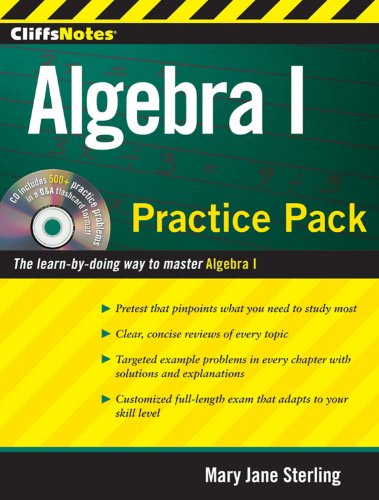
<div><p>About the Contents:</p><p>Pretest<p> Helps you pinpoint where you need the most help and directs you to the corresponding sections of the book <p>Topic Area Reviews<ul><li><p>Math Basics</p></li><li><p>Numbers (Signed Numbers and Fractions)</p></li><li><p>Linear Equations and Algebraic Fractions</p></li><li><p>Polynomials and Factoring</p></li><li><p>Inequalities, Absolute Value Inequalities, and Radicals</p></li><li><p>Introducing Quadratic Equations—Testing Solutions</p></li><li><p>Graphing and Systems of Equations</p></li><li><p>Functions</p></li><li><p>Story Problems</p></li></ul><p>Customized Full-Length Exam<p> Covers all subject areas <ul><li><p>Pretest that pinpoints what you need to study most</p></li><li><p>Clear, concise reviews of every topic</p></li><li><p>Targeted example problems in every chapter with solutions and explanations</p></li><li><p>Customized full-length exam that adapts to your skill level</p></li></ul></p></p></p></p></p></div>
"synopsis" may belong to another edition of this title.
About the Author
Mary Jane Sterling is a professor of mathematics at Bradley University in Peoria, Illinois. She has been teaching mathematics for more than 30 years.
Excerpt. © Reprinted by permission. All rights reserved.
CliffsNotes Algebra I Practice Pack
By Mary Jane SterlingJohn Wiley & Sons
Copyright © 2010 John Wiley & Sons, LtdAll right reserved.
ISBN: 978-0-470-49596-4
Chapter One
The Basics
Think of this first chapter as a resource or reference for much of what follows. You can come back to review this material if something puzzles you in a later chapter. These underlying principles make up much of every kind of mathematics.
Order of Operations
Mathematics deals in so many symbols. This is a good thing. The use of symbols is efficient; it saves time and writing. It also makes the language of mathematics universal-understood worldwide. Likewise, a universal agreement exists about how operation symbols such as add, subtract, and so on are to be handled in an equation. The order in which things are done makes a difference. Think of putting the cap on a bottle of soda pop and then shaking the bottle. The result is a lot different than if you first shake the bottle and then put the cap on. The same is true here; order makes a difference. Many operations are used in mathematics, and, accompanying them, some rules and conventions need to be followed. These rules or procedures were established so that anyone reading a mathematical statement written by someone else would know exactly what was intended. Mathematicians throughout the world use the same rules.
Basic Order of Operations
When more than one operation is indicated in an algebraic expression, the operations are done in the following order, except when grouping symbols, such as parentheses, interrupt:
First: Powers and roots Second: Multiplication and division Third: Addition and subtraction
If more than one of the same level of operation appears in the expression, do them in order, moving from left to right.
Example Problems
These problems show the answers and solutions.
1. Simplify 50 - [2.sup.2] 6.
answer: 26
By the Order of Operations, calculate the power first, then the multiplication, and then the subtraction.
First do the power, 50 - [2.sup.] 6 = 50 - 4 6.
Then multiply, 50 - 4 6 = 50 - 24.
Finally subtract, 50 - 24 = 26.
2. Simplify [square root of 625] - 2 6 + [7.sup.2].
answer: 62
By the Order of Operations, the root of 625 and the power of 7 are done first.
[square root of 625] - 2 6 + [7.sup.2] = 25 - 2 6 + 49
Next, multiply the 2 and 6, 25 - 2 6 + 49 = 25 - 12 + 49.
Then add and subtract. Since addition and subtraction are on the same level, perform the operations moving from left to right.
25 - 12 + 49 = 13 + 49 = 62
Grouping Symbols
Grouping symbols can "interrupt" the Order of Operations. The most commonly used grouping symbols are parentheses ( ), brackets , and braces { }. Also, fraction lines and radicals (root symbols) act to group expressions above, below, and inside them. The rule is that you perform the operations within the grouping symbols first and then go to the Order of Operations. Grouping symbols more often than not help clarify what is meant in a mathematical statement. Think of them as being like punctuation in a written statement-helping you to understand the meaning.
Example Problems
These problems show the answers and solutions.
1. Simplify 6(14 - 3) + 8.
answer: 74
Perform what's in the parentheses first. 6(14 - 3) + 8 = 6(11) + 8
Then multiply and, finally, add. 6(11) + 8 = 66 + 8 = 74
2. Simplify 3 [square root of 16 - 7] + (5 - 3) 7 - 14/9 - 2.
answer: 21
Three grouping symbols are here: radical, parentheses, and fraction line. Perform the operations within, above, or below them first.
3 [square root of 16 - 7] + (5 - 3) 7 - 14/9 - 2 = 3[square root of 9] + (2) 7 - 14/7
The root has to be calculated next, because powers and roots are on the first level.
3[square root of 9] + (2) 7 - 14/7 = 3 3 + (2) 7 - 14/7
Now, do the two multiplications and the division. 3 3 + (2) 7 - 14/7 = 9 + 14 - 2 Now add and subtract, moving from left to right.
9 + 14 - 2 = 23 - 2 = 21
Work Problems
Use these problems to give yourself additional practice.
1. [4.sup.2] + 3 6 - 2
2. 15 - 3/4 - [square root of 9] + 8
3. [6.sup.2] + 9/9 + 5(8 - [2.sup.2]) - 1
4. 10 + [3.sup.2] - 4 ([square root of 36] - 52)
Worked Solutions
1. 32 First raise 4 to the second power.
[4.sup.2] + 3 6 - 2 = 16 + 3 6 - 2
Next, multiply the 3 and 6.
16 + 3 6 - 2 = 16 + 18 - 2
Last, add and subtract from left to right.
16 + 18 - 2 = 34 - 2 = 32
2. 8 First, subtract the 3 from 15, because they're "grouped."
15 - 3/4 - [square root of 9] + 8 = 12/4 - [square root of 9] + 8
Next, find the square root of 9.
12/4 - [square root of 9] + 8 = 12/4 - 3 + 8
Now, divide 12 by 4 and combine the terms from left to right.
12/4 - 3 + 8 = 3 - 3 + 8 = 0 + 8 = 8
3. 24 First, raise the 6 in the numerator of the fraction to the second power and raise the 2 in the parentheses to the second power.
[MATHEMATICAL EXPRESSION NOT REPRODUCIBLE IN ASCII]
Now add the two numbers in the numerator of the fraction and subtract the two numbers in the parentheses.
36 + 9/9 + 5 (8 - 4) - 1 = 45/9 + 5(4) - 1
Next, do the division and multiplication.
45/9 + 5(4) - 1 = 5 + 20 - 1
Last, add and subtract in order from left to right.
5 + 20 - 1 = 25 - 1 = 24
4. 15 First, raise the 3 to the second power and find the square root of 36.
10 + [3.sup.2] - 4 ([square root of 36] - 5) = 10 + 9 - 4 (6 - 5)
Now combine the two numbers in the parentheses and then multiply the result by 4.
10 + 9 - 4(6 - 5) = 10 + 9 - 4(1) = 10 + 9 - 4
Last, add and subtract in order.
10 + 9 - 4 = 19 - 4 = 15
5. 26 First perform the operations in the parentheses and in the denominator of the fraction.
3(6 - 2) + [7.sup.2](5 - 1)/5 + 3 = 3(4) + [7.sup.2](4)/8
Now square the 7.
3(4) + [7.sup.2](4)/8 = 3(4) + 49(4)/8
Now do the multiplications in the numerator. The two terms can't be added until those multiplications are first performed.
3(4) + 49(4)/8 = 12 + 196/8
Add the two numbers in the numerator and then divide the result by 8.
12 + 196/8 = 208/8 = 26
Basic Math Operations
The basic math operations that apply to numbers also apply to variables, which are represented by letters. The main difference between dealing with numbers and variables is that with numbers you can see, directly, what the operation does to them. When dealing with variables, you sometimes don't know what the variable represents, and difficulties could arise depending on whether the variable represents a positive or negative number, a fraction or whole number, an even or odd number, and so on. Following is a discussion of the basic operations and how variables are handled in each situation.
Addition and Subtraction
When you add and subtract terms with the same variable in them, the coefficient (number multiplier) indicates how many of that variable there are. So just combine the coefficients. For instance, 3a + 2a = 5a (Think: "Three apples plus two apples equals five apples. You don't change the things that are being added to `apple-apples'.") 7b - 5b = 2b 8c + c = 9c (No coefficient shows on the second term, so you can assume that it's 1.)
Multiplication and Division
When multiplying or dividing expressions with variables by numbers, just multiply or divide the coefficients by the multiplying or dividing number. For example, if z stands for a number of zebras at the zoo, then 2z means two times or double that number. Multiplying by 5, 5 2z represents five times that doubled number, or 5 2z = 10z. If p is the number of octopuses in a tank, then 8p is the number of legs in the tank. If the 8p number of legs is to be divided into four groups, then there would be 8p/4 = 2p or 2p legs in each of the four groups. Here are some more examples.
[MATHEMATICAL EXPRESSION NOT REPRODUCIBLE IN ASCII]
Powers (Exponents)
Before mathematicians agreed on superscripts as the notation for powers (in [8.sup.2], the 2 is the power or exponent), multiplying a variable times itself repeatedly was shown by repeating that letter. What you write as [y.sup.5] was once written as y y y y y. The power or superscript tells you how many times the variable multiplies itself. The expression 2xxxxxx is more conveniently written as 2[x.sup.6]. The 2 is written in front. By the Order of Operations, you compute the power first and then multiply the result by 2. This is, of course, if you know what number the x represents. Also, a convenient way of writing repeated multiples of a variable when it occurs in the denominator of a fraction is to use a negative exponent: 1/wwww = 1/[w.sup.4] = [w.sup.-4]
Example Problems
These problems show the answers and solutions.
1. Write 3aaaaaaaaaa using exponents. answer: 3[a.sup.10]
Simply count the number of identical variables (that is, the number of a's used) and make that number the exponent.
2. Write 2 2 2xxyyzzzz using exponents.
answer: [2.sup.3] [x.sup.2] [y.sup.2] [z.sup.4]
The letters can't be combined, because they can stand for different numbers. Also, notice that the multiplication dot () is shown between the 2s but not between the letters or variables. That's because when the letters are written next to one another, multiplication is assumed. If I didn't put the multiplication dot between the 2s, you would think I meant the number 222.
Roots
A root of a number is the value that has to be multiplied over and over to get the original number. The symbol for taking a root is a radical, [square root of]. If there's no number above the "shelf" on the left, then it's assumed that you mean the square root. A "square" root indicates that you want to find the value whose square (multiplied twice) gives you the number under the radical. If there is a 3 above the shelf, then you want the cube root, or the value whose third power gives you the value under the radical. Assume, in each case here, that the variable under the radical represents a positive number. If you want more information on what happens when you don't know whether the variable is positive or not see "Absolute Value," which follows the Example Problems.
Example Problems
These problems show the answers and solutions.
Simplify each root.
1. [square root of 9]
answer: 3
[square root of 9] = [square root of 3 3] = 3
2. [square root of 400]
answer: 20
[square root of 400] = [square root of 20 20] = 20
3. [MATHEMATICAL EXPRESSION NOT REPRODUCIBLE IN ASCII]
answer: 5
[MATHEMATICAL EXPRESSION NOT REPRODUCIBLE IN ASCII]
4. [MATHEMATICAL EXPRESSION NOT REPRODUCIBLE IN ASCII]
answer: m
[MATHEMATICAL EXPRESSION NOT REPRODUCIBLE IN ASCII]
5. [square root of 4[b.sup.4]]
answer: 2[b.sup.2]
[square root of 4[b.sup.4]] = [square root of 2 2 [b.sup.2] [b.sup.2]] = 2[b.sup.2]
Absolute Value
This operation appears to change negative numbers to positive numbers and leave positive numbers as they are. Although this is what happens, practically, the operation is really telling you how far a number is from 0. Absolute value is written with two vertical bars: |some number| = the number if it's positive and the opposite of a number if it's negative. (The opposite of a negative is a positive.) For example,
[absolute value of -2] = 2
[absolute value of 4] = 4
[absolute value of 6 - 5] = [absolute value of 1] = 1 Absolute value can be a grouping symbol. Do what's inside first.
[absolute value of m] = m if the variable represents a positive number and -m if the variable represents a negative number. The -m is read, "The opposite of m."
[absolute value of [x.sup.2]] = [absolute value of x] when you don't know whether the variable x is positive or negative.
Work Problems
Use these problems to give yourself additional practice.
1. Simplify: 14a - 10a + 3(2b)
2. Simplify: 3(5a - a)
3. Simplify: 2 3 n n n n p
4. Simplify: [square root of [a.sup.2] [b.sup.6]]
5. Simplify: [square root of 49[x.sup.2] [y.sup.10]]
Worked Solutions
1. 4a + 6b First multiply the 3 and 2b.
14a - 10a + 3(2b) = 14a - 10a + 6b
Now combine the two terms with the variable a.
14a - 10a + 6b = 4a + 6b
2. 12a First combine the terms in the parentheses. Then multiply the result by 3.
3(5a - a) = 3(4a) = 12a
3. 6[n.sup.4] p Multiply the 2 and 3 and rewrite the repeated multiplication of n as a factor with an exponent.
2 3 n n n n p = 6[n.sup.4]p
4. [ab.sup.3] Rewrite the factors under the radical as two repeated variables before taking the square root.
[square root of [a.sup.2][b.sup.6]] = [square root of a a b.sup.3] [b.sup.3]] = a[b.sup.3]
5. 7x[y.sup.5] Rewrite the factors under the radical as two repeated variables before taking the square root.
[MATHEMATICAL EXPRESSION NOT REPRODUCIBLE IN ASCII]
Combining "Like" Terms
One major objective of working with algebraic expressions is to write them as simply as possible and in a logical, generally accepted arrangement. When there is more than one term (a term consists of one or more factors multiplied together and separated from other terms by + or -), then you check to see whether they can be combined with other terms that are "like" them. Numbers, by themselves without letters or variables, are "like" terms. You can combine 14 and 8 because you know what they are and know the rules. For instance, 14 + 8 = 22, 14 - 8 = 6, 14(8) = 112, and so on. Most numbers can be written so that they can combine with one another. Fractions can be added if they have a common denominator. Decimals can be subtracted if you line up the decimal points in the two decimal numbers so that the tens place is under the tens place, the hundredths place is under the hundredths place, etc. The exception to this is that some numbers, written under a radical, can't be combined. These numbers are called "irrational." This is a good name for them, because they sometimes are difficult to manipulate.
Algebraic expressions involving variables or letters have to be dealt with carefully. Because the numbers that the letters represent aren't usually known, you can't add or subtract terms with different letters. The expression 2a + 3b has to stay that way. That's as simple as you can write it. But, the expression 4c + 3c can be simplified. You don't know what c represents, but you can combine the terms to tell how many of them you have (even though you don't know what they are!): 4c + 3c = 7c. Here are some other examples.
[MATHEMATICAL EXPRESSION NOT REPRODUCIBLE IN ASCII]
Notice that two different kinds of terms are shown, one with the x squared and the other with the y squared. Only those that have the letters exactly alike with the exact same powers can be combined. The only thing affected by adding and subtracting these terms is the coefficient.
(Continues...)
Excerpted from CliffsNotes Algebra I Practice Packby Mary Jane Sterling Copyright © 2010 by John Wiley & Sons, Ltd. Excerpted by permission.
All rights reserved. No part of this excerpt may be reproduced or reprinted without permission in writing from the publisher.
Excerpts are provided by Dial-A-Book Inc. solely for the personal use of visitors to this web site.
"About this title" may belong to another edition of this title.
Search results for Cliffsnotes Algebra I: Practice Pack (CliffsNotes (Paperback...

Stock Image
CliffsNotes Algebra I Practice Pack (CliffsNotes (Paperback))
Seller: Your Online Bookstore, Houston, TX, U.S.A.
Seller rating 5 out of 5 stars

Paperback. Condition: Very Good. Seller Inventory # 0470495960-2-19151149
Stock Image
CliffsNotes Algebra I Practice Pack
Published by
Houghton Mifflin Harcourt Publishing Company, 2010
ISBN 10: 0470495960
ISBN 13: 9780470495964
Used
Paperback
Seller: World of Books (was SecondSale), Montgomery, IL, U.S.A.
Seller rating 5 out of 5 stars
Paperback. Condition: Good. "CliffsNotes Algebra I Practice Pack". Seller Inventory # 00087125901
Stock Image
Cliffsnotes Algebra I: Practice Pack (CliffsNotes (Paperback))
Published by
Cliff Notes (edition PAP/CDR), 2010
ISBN 10: 0470495960
ISBN 13: 9780470495964
Used
Paperback
Seller: BooksRun, Philadelphia, PA, U.S.A.
Seller rating 5 out of 5 stars
Paperback. Condition: Very Good. PAP/CDR. CD or DVD included. It's a well-cared-for item that has seen limited use. The item may show minor signs of wear. All the text is legible, with all pages included. It may have slight markings and/or highlighting. Seller Inventory # 0470495960-11-1-15
Stock Image
CliffsNotes Algebra I Practice Pack [With CDROM]
Seller: ThriftBooks-Atlanta, AUSTELL, GA, U.S.A.
Seller rating 5 out of 5 stars
Paperback. Condition: As New. No Jacket. Pages are clean and are not marred by notes or folds of any kind. ~ ThriftBooks: Read More, Spend Less. Seller Inventory # G0470495960I2N00
Stock Image
CliffsNotes Algebra I Practice Pack (CliffsNotes (Paperback))
Seller: Half Price Books Inc., Dallas, TX, U.S.A.
Seller rating 5 out of 5 stars
paperback. Condition: Very Good. Connecting readers with great books since 1972! Used books may not include companion materials, and may have some shelf wear or limited writing. We ship orders daily and Customer Service is our top priority! Seller Inventory # S_438894064
Stock Image
Algebra I
Published by
Houghton Mifflin Harcourt Publishing Company, 2010
ISBN 10: 0470495960
ISBN 13: 9780470495964
Used
Softcover
Seller: Better World Books, Mishawaka, IN, U.S.A.
Seller rating 5 out of 5 stars
Condition: Good. 2nd Edition. Pages intact with minimal writing/highlighting. The binding may be loose and creased. Dust jackets/supplements are not included. Stock photo provided. Product includes identifying sticker. Better World Books: Buy Books. Do Good. Seller Inventory # 4389859-6
Stock Image
CliffsNotes Algebra I Practice Pack (CliffsNotes (Paperback))
Seller: Wonder Book, Frederick, MD, U.S.A.
Seller rating 5 out of 5 stars
Condition: Very Good. Very Good condition. A copy that may have a few cosmetic defects. May also contain light spine creasing or a few markings such as an owner's name, short gifter's inscription or light stamp. Bundled media such as CDs, DVDs, floppy disks or access codes may not be included. Seller Inventory # X09B-01254
Stock Image
CliffsNotes Algebra I Practice Pack
Published by
Houghton Mifflin Harcourt Publishing Company, 2010
ISBN 10: 0470495960
ISBN 13: 9780470495964
Used
Paperback
Seller: World of Books Inc, Montgomery, IL, U.S.A.
Seller rating 4 out of 5 stars

Paperback. Condition: Good. "CliffsNotes Algebra I Practice Pack". Seller Inventory # CIN0470495960G
Stock Image
Cliffsnotes Algebra I: Practice Pack (CliffsNotes (Paperback))
Seller: The Maryland Book Bank, Baltimore, MD, U.S.A.
Seller rating 5 out of 5 stars
paperback. Condition: Good. PAP/CDR. Corners are slightly bent. Used - Good. Seller Inventory # 10-A-3-0243
Stock Image
CliffsNotes Algebra I Practice Pack (CliffsNotes (Paperback))
Seller: HPB Inc., Dallas, TX, U.S.A.
Seller rating 5 out of 5 stars
paperback. Condition: Very Good. Connecting readers with great books since 1972! Used books may not include companion materials, and may have some shelf wear or limited writing. We ship orders daily and Customer Service is our top priority! Seller Inventory # S_466781366