
Items related to Kanzi: The Ape at the Brink of the Human Mind
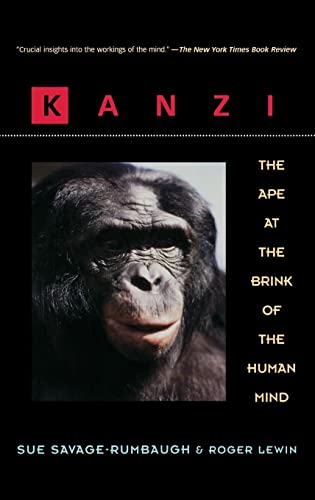
Synopsis
The remarkable story of a "talking" chimp, a leading scientist, and the profound insights they have uncovered about our species
He has been featured in cover stories in Time, Newsweek, and National Geographic, and has been the subject of a ""NOVA"" documentary. He is directly responsible for discoveries that have forced the scientific community to recast its thinking about the nature of the mind and the origins of language.
He is Kanzi, an extraordinary bonobo chimpanzee who has overturned the idea that symbolic language is unique to our species. This is the moving story of how Kanzi learned to converse with humans and the profound lessons he has taught us about our animal cousins, and ourselves.
". . . The underlying thesis is informative and well argued . . . Savage-Rumbaugh's results are impressive." — The Washington Post
"This popular, absorbing, and controversial account is recommended." — Library Journal
"synopsis" may belong to another edition of this title.
About the Author
SUE SAVAGE-RUMBAUGH (Decatur, Georgia) is one of the world's leading ape-language researchers.
ROGER LEWIN (Cambridge, Massachusetts) is the author of 12 books, including co-authorship of the best-selling Origins with Richard Leakey.
Reviews
When ape-language research fell into disfavor in the 1970s, Savage-Rumbaugh, associate professor of biology at Georgia State Univ. and a leading researcher in the field, set a new course, focusing on apes' ability to comprehend symbols. At the Yerkes Regional Primate Research Center in Atlanta, she worked with common chimpanzees and bonobos (pygmy chimps), using a computer-based keyboard system. With Roger Lewin (coauthor with Richard Leakey of Origins), she tells the remarkable story of Kanzi, a bonobo who at 14 understands spoken English well enough that his teachers spell out words they don't want him to hear. He asks and answers questions and invents games by manipulating an electronic keyboard. His accomplishments prove chimps can spontaneously acquire language skills through social interaction in a language-rich environment. For readers interested in the origin of language and those who have followed Washoe, Koko and Lucy. Photos not seen by PW.
Copyright 1994 Reed Business Information, Inc.
Ape-language specialist Savage-Rumbaugh and science writer Lewin (co-author of Origins with Richard Leakey, 1977) run the superchimp Kanzi past us once again with this latest in the current deluge of books on animal brain power. Kanzi--already a phenom with Newsweek, Time, and National Geographic covers to his credit--is an ape with a mind of his own; his facility with communication (via a special keyboard) is a marvel. But Kanzi gets only limited airtime here; he's more like a sideshow barker's prop to entice the customers. The authors spend most of the book going over the history of ape-language research (and it does go back: Samuel Pepys's name is mentioned), briefly rummage in linguistic theory (long enough to unconvincingly trash Noam Chomsky), and visit with other ape subjects. When it comes to the use of language by the great apes, the jury is still out; they might have even gone home. Theorists continue to debate the importance of production versus comprehension, to dispute intentionality, to worry about an ape's reflectiveness. It is to Savage-Rumbaugh's credit that she gives as much importance to glances, gestures, and postures as communicative modes as she does to utterances and keyboard talent. It seems quite clear that the apes have no interest in joining the Yale debating squad, so why put them to that measure? When Kanzi is brought into the story, the tone lightens. He is a clever, humorous, astonishing character, and his developing relationship with Savage-Rumbaugh is where Lewin really shines. The quickly sketched vignettes are uniformly winning: For instance, Savage-Rumbaugh has her keys snatched by an obstreperous member of the ape troupe. She asks Kanzi to get them back. He shuffles over to the offending ape, murmurs in his ear, and the keys are returned forthwith. Call this effort ``Notes Toward an Understanding,'' for every theory is conjecture, but there are also many fine nuggets to be mined. (Photos, not seen) (First serial to Discover) -- Copyright ©1994, Kirkus Associates, LP. All rights reserved.
Much initial ape-language research has fallen into disfavor in the last two decades. Linguists, in particular, claim that the apes' failure to demonstrate syntactical competence precludes real language ability. Savage-Rumbaugh, a leading researcher in the field, disputes their rationale, arguing that the cognitive foundations of human speech can be found with these animals. Working with chimpanzees and later Kanzi, a bonobo, the author focused on the ape's ability truly to comprehend symbols-something that earlier researchers had neglected. As an infant, Kanzi demonstrated a surprising ability to learn symbols spontaneously and to understand human speech. Savage-Rumbaugh, who has been shunned by some of the major scientific journals, has been encouraged and assisted by scientific writer Lewin. Their popular, absorbing, and controversial account is recommended for wide purchase.
Laurie Bartolini, Legislative Research, Springfield, Ill.
Copyright 1994 Reed Business Information, Inc.
Although we share 99 percent of our genetic makeup with chimpanzees and even more humanlike characteristics with bonobos (miniature chimpanzees), language sets us apart from our hairy brothers and sisters. Ape researcher Sue Savage-Rumbaugh and her coauthor document her years of psychological studies, laboratory work, and life experiences with bonobos. The book is a blend of Dian Fossey living in the forests with her gorillas and case studies of other scientists' experiences. Through years of skepticism and some remarkable breakthroughs, Savage-Rumbaugh was able to train a bonobo named Kanzi to communicate using a lexigram--a keyboard of symbols representing set words or actions. Kanzi differs from a trained ape in that his responses are thought motivated instead of conditioned. After years of language "school," Kanzi is able to understand English voice commands and appropriately respond using the lexigram, which then generates an electronically activated voice response. His achievements are more than admirable--they are miraculously close to language and comprehensible syntax as we know it. Kanzi is not only a fabulous scientific triumph but also an affectionate story of bonobos. Lisa Orzepowski
"About this title" may belong to another edition of this title.
Search results for Kanzi: The Ape at the Brink of the Human Mind

Stock Image
Kanzi
Published by
Turner Publishing Company, 1994
ISBN 10: 0471585912
ISBN 13: 9780471585916
Used
Hardcover
Seller: World of Books (was SecondSale), Montgomery, IL, U.S.A.
Seller rating 5 out of 5 stars

Hardback. Condition: Good. The remarkable story of a talking chimp, a leading scientist, and the profound insights they have uncovered about our species He has been featured in cover stories in Time, Newsweek, and National Geographic, and has been the subject of a NOVA documentary. He is directly responsible for discoveries that have forced the scientific community to recast its thinking about the nature of the mind and the origins of language. He is Kanzi, an extraordinary bonobo chimpanzee who has overturned the idea that symbolic language is unique to our species. This is the moving story of how Kanzi learned to converse with humans and the profound lessons he has taught us about our animal cousins, and ourselves. . . . The underlying thesis is informative and well argued . . . Savage-Rumbaugh's results are impressive. -- The Washington Post This popular, absorbing, and controversial account is recommended. -- Library Journal. Seller Inventory # 00104512637
Stock Image
Kanzi: The Ape at the Brink of the Human Mind
Seller: Evergreen Goodwill, Seattle, WA, U.S.A.
Seller rating 5 out of 5 stars
hardcover. Condition: Good. Seller Inventory # mon0000715927
Stock Image
Kanzi: The Ape at the Brink of the Human Mind
Seller: Your Online Bookstore, Houston, TX, U.S.A.
Seller rating 5 out of 5 stars
hardcover. Condition: Very Good. Seller Inventory # 0471585912-2-37097613
Stock Image
Kanzi: The Ape at the Brink of the Human Mind
Seller: Gulf Coast Books, Cypress, TX, U.S.A.
Seller rating 5 out of 5 stars
hardcover. Condition: As New. Seller Inventory # 0471585912-1-37097613
Stock Image
Kanzi: The Ape at the Brink of the Human Mind
Seller: ThriftBooks-Reno, Reno, NV, U.S.A.
Seller rating 5 out of 5 stars
Hardcover. Condition: Very Good. No Jacket. May have limited writing in cover pages. Pages are unmarked. ~ ThriftBooks: Read More, Spend Less. Seller Inventory # G0471585912I4N00
Stock Image
Kanzi: The Ape at the Brink of the Human Mind
Seller: ThriftBooks-Reno, Reno, NV, U.S.A.
Seller rating 5 out of 5 stars
Hardcover. Condition: Good. No Jacket. Former library book; Pages can have notes/highlighting. Spine may show signs of wear. ~ ThriftBooks: Read More, Spend Less. Seller Inventory # G0471585912I3N10
Stock Image
Kanzi: The Ape at the Brink of the Human Mind
Seller: ThriftBooks-Atlanta, AUSTELL, GA, U.S.A.
Seller rating 5 out of 5 stars
Hardcover. Condition: Very Good. No Jacket. May have limited writing in cover pages. Pages are unmarked. ~ ThriftBooks: Read More, Spend Less. Seller Inventory # G0471585912I4N00
Stock Image
Kanzi: The Ape at the Brink of the Human Mind
Seller: ThriftBooks-Atlanta, AUSTELL, GA, U.S.A.
Seller rating 5 out of 5 stars
Hardcover. Condition: Good. No Jacket. Former library book; Pages can have notes/highlighting. Spine may show signs of wear. ~ ThriftBooks: Read More, Spend Less. Seller Inventory # G0471585912I3N10
Stock Image
Kanzi: The Ape at the Brink of the Human Mind
Seller: ThriftBooks-Dallas, Dallas, TX, U.S.A.
Seller rating 5 out of 5 stars
Hardcover. Condition: Very Good. No Jacket. May have limited writing in cover pages. Pages are unmarked. ~ ThriftBooks: Read More, Spend Less. Seller Inventory # G0471585912I4N00