
Items related to Repetitive Strain Injury: A Computer User's Guide
Synopsis
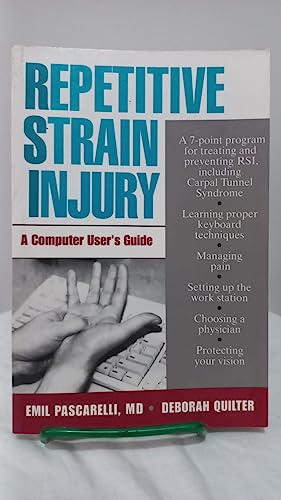
Repetitive Strain Injury "A wealth of information for people who have repetitive strain injury, for those who want to prevent it, and especially for those who think it doesn’t concern them. Every computer user has the potential for repetitive strain injury and should heed the advice in this book." —Caroline Rose, Editor The RSI Network "This is the most useful book I have seen for RSI sufferers. It is refreshing to read a book that takes these injuries seriously and offers sound advice." —Robert Dieterich, Managing Editor VDT News "Easy-to-read, expertly illustrated, and filled with hundreds of commonsense explanations and practical suggestions for those suffering from all types of repetitive strain injuries. Particularly outstanding is Dr. Pascarelli’s sensitivity to the impact of emotional distress and fear on physical well-being and recovery." —Stewart Leavitt, PhD Office of Ergonomics Researchers Leavitt Medical Communications The great speed, ease, and efficiency of personal computers can lead to severe physical and emotional pain. The problem is called "Repetitive Strain Injury," or RSI, and includes a wide range of conditions—from Carpal Tunnel Syndrome to Tenosynovitis. Over time, this "epidemic of the ’90s" damages the muscles, nerves, and tendons of the hands, wrists, and arms. Dr. Pascarelli’s seven-point plan offers proven ways of preventing the onset of RSI as well as tested methods that will help RSI sufferers to once again lead healthy, productive, and pain-free lives.
"synopsis" may belong to another edition of this title.
About the Author
EMIL F. PASCARELLI, MD, is an Attending Physician at Columbia-Presbyterian Medical Center, practices as a consultant in cumulative trauma disorders at Columbia-Presbyterian Eastside, and is Director of Ambulatory Care at St. Luke’s/Roosevelt Hospital in New York City. He is also the founder and Medical Director of the Miller Institute for Performing Artists, Professor of Clinical Medicine at the College of Physicians and Surgeons of Columbia University, and Associate Professor of Clinical Public Health at New York Hospital-Cornell Medical Center. DEBORAH QUILTER is a veteran health writer who has contributed to the Columbia Journalism Review, The New York Daily News, Woman’s World, and San Francisco Focus, among others.
Reviews
In this highly instructive and readable guide to health in the age of computers, Pascarelli, professor of clinical medicine at Columbia University and Cornell Medical Center, and Quilter, a health writer, explore the causes, symptoms and treatments of varied injuries stemming from prolonged computer keyboard work. RSI (repetitive strain injury) is the authors' catchword for Carpal Tunnel Syndrome, tendinitis, epycondylitis (also called tennis elbow) and a slew of other potentially chronic conditions that render not just computer work but also driving, washing dishes, holding a phone and opening a book difficult, if not agonizing. The authors identify the factors contributing to RSI; emphasize preventive measures, such as upper-body exercises, stretches and the pacing of keyboard work; and insist that finding the right professional diagnosis and treatment is the basis for recovery. They also include names of RSI support groups, ergonomic catalogues and on-line newsgroups. Each chapter offers personal exercises and checklists along with countless anecdotes from commiserating RSI sufferers. If some readers find this work somewhat repetitive and alarmist--all too ready to proclaim RSI "the occupational epidemic of the '90s" and to attribute it to overly demanding office productivity standards--most will find it a consoling trove of practical advice.
Copyright 1994 Reed Business Information, Inc.
Repetitive strain injury (RSI), the occupational disease of the 1990s, accounts for more than half of all workplace illnesses and costs businesses billions of dollars annually. RSI affects the muscles, nerves, and tendons of the hands, wrists, and arms. It starts at the keyboard of the personal computer and stems from prolonged repetitive, forceful hand movements, poor posture, ill-designed furniture and equipment, and the pressure of a heavy workload. To help the lay reader understand this complex disorder, RSI expert Pascarelli has collaborated with health writer and RSI victim Quilter to write a self-help guide for computer users and employers, describing the variable symptoms of RSI as well as treatment options and prevention. Techniques include maintaining good posture, pacing, exercises, and pain management. Containing useful illustrations, reference notes, and a directory of resources, this is a welcome addition to the growing literature on work-related arm problems. Recommended for public, academic, business, and medical libraries.
- Nancy Chipman-Shlaes, Governors State Univ., University Park, Ill.
Copyright 1994 Reed Business Information, Inc.
"About this title" may belong to another edition of this title.
Search results for Repetitive Strain Injury: A Computer User's Guide

Stock Image
Repetitive Strain Injury: A Computer User's Guide
Seller: BooksRun, Philadelphia, PA, U.S.A.
Seller rating 5 out of 5 stars

Paperback. Condition: Very Good. It's a well-cared-for item that has seen limited use. The item may show minor signs of wear. All the text is legible, with all pages included. It may have slight markings and/or highlighting. Seller Inventory # 0471595330-11-1
Stock Image
Repetitive Strain Injury: A Computer User's Guide
Seller: World of Books (was SecondSale), Montgomery, IL, U.S.A.
Seller rating 5 out of 5 stars
Condition: Acceptable. Item in good condition. Textbooks may not include supplemental items i.e. CDs, access codes etc. Seller Inventory # 00062196660
Stock Image
Repetitive Strain Injury: A Computer User's Guide
Seller: World of Books (was SecondSale), Montgomery, IL, U.S.A.
Seller rating 5 out of 5 stars
Condition: Good. Item in good condition. Textbooks may not include supplemental items i.e. CDs, access codes etc. Seller Inventory # 00084041232
Stock Image
Repetitive Strain Injury: A Computer User's Guide
Seller: Orion Tech, Kingwood, TX, U.S.A.
Seller rating 5 out of 5 stars
paperback. Condition: Good. Seller Inventory # 0471595330-3-27767912
Seller Image
Repetitive Strain Injury: A Computer User's Guide
Seller: Greenworld Books, Arlington, TX, U.S.A.
Seller rating 5 out of 5 stars
Condition: good. Fast Free Shipping â" Good condition. It may show normal signs of use, such as light writing, highlighting, or library markings, but all pages are intact and the book is fully readable. A solid, complete copy that's ready to enjoy. Seller Inventory # GWV.0471595330.G
Stock Image
Repetitive Strain Injury: A Computer User's Guide
Seller: BooksRun, Philadelphia, PA, U.S.A.
Seller rating 5 out of 5 stars
Paperback. Condition: Fair. The item might be beaten up but readable. May contain markings or highlighting, as well as stains, bent corners, or any other major defect, but the text is not obscured in any way. Seller Inventory # 0471595330-7-1
Stock Image
Repetitive Strain Injury: A Computer User's Guide
Seller: Evergreen Goodwill, Seattle, WA, U.S.A.
Seller rating 5 out of 5 stars
paperback. Condition: Good. Seller Inventory # mon0000764153
Stock Image
Repetitive Strain Injury: A Computer User's Guide
Published by
John Wiley and Sons Ltd, 1994
ISBN 10: 0471595330
ISBN 13: 9780471595335
Used
Paperback
Seller: World of Books Inc, Montgomery, IL, U.S.A.
Seller rating 4 out of 5 stars

Paperback. Condition: Good. Seller Inventory # CIN0471595330G
Stock Image
Repetitive Strain Injury: A Computer User's Guide
Published by
John Wiley and Sons Ltd, 1994
ISBN 10: 0471595330
ISBN 13: 9780471595335
Used
Paperback
Seller: World of Books Inc, Montgomery, IL, U.S.A.
Seller rating 4 out of 5 stars
Paperback. Condition: Fair. Seller Inventory # CIN0471595330A
Stock Image
Repetitive Strain Injury: A Computer User's Guide
Seller: Book Gurus, Tallahassee, FL, U.S.A.
Seller rating 5 out of 5 stars
paperback. Condition: Good. Seller Inventory # 01KY3JE4F1R0XSB