
Items related to Money, Greed and Risk: Why Financial Crises and Crashes...
Synopsis
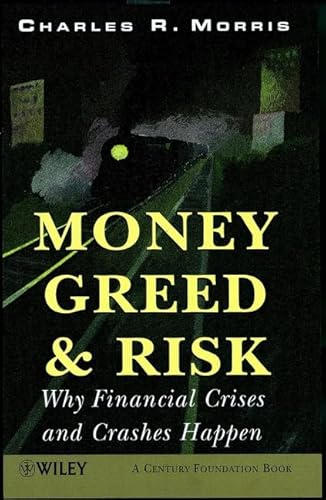
Imagine the American republic of the 19th century: at the beginning, a sparsely populated agrarian nation where the president, Thomas Jefferson, fords rivers on horseback to make it to his own inauguration; at the end of the century, it's a land of densely populated cities, teeming with factories and linked by a network of railroads. This extraordinary transition--and all the economic upheavals that went along with it--is described in the opening chapters of Money, Greed, and Risk, and provides the historical context for a broader look at how booms and busts happen. Charles Morris tells the story of American financial markets by looking at its larger-than-life characters: Nicholas Biddle (the first U.S. central banker), Jay Gould (a much-hated financial genius who patched together a network of rail lines), steel magnate Andrew Carnegie, oil baron John D. Rockefeller, and, of course, J.P. Morgan, who made America the world's banker. By the time these men had all passed from public life, the U.S. economy had changed from a primitive system that could be bent to the will of a single financier, such as Morgan, to a sophisticated, highly regulated, world-dominating conglomeration of massive corporations.
Then along came Michael Milken and things changed again. Morris makes this chronicle entertaining and enlightening, although the reader is expected to have some previous knowledge of finance and history. He finds connections where we don't expect them--for example, linking the leverage tactics of junk-bond king Milken to early-19th-century "wildcat" bankers. He also makes it easy to understand the accordion-like expansions and contractions in the world's developing economies. Once you've read this book, you'll feel as if you've seen everything before. --Lou Schuler
"synopsis" may belong to another edition of this title.
Review
Imagine the American republic of the 19th century: at the beginning, a sparsely populated agrarian nation where the president, Thomas Jefferson, fords rivers on horseback to make it to his own inauguration; at the end of the century, it's a land of densely populated cities, teeming with factories and linked by a network of railroads. This extraordinary transition--and all the economic upheavals that went along with it--is described in the opening chapters of Money, Greed, and Risk, and provides the historical context for a broader look at how booms and busts happen. Charles Morris tells the story of American financial markets by looking at its larger-than-life characters: Nicholas Biddle (the first U.S. central banker), Jay Gould (a much-hated financial genius who patched together a network of rail lines), steel magnate Andrew Carnegie, oil baron John D. Rockefeller, and, of course, J.P. Morgan, who made America the world's banker. By the time these men had all passed from public life, the U.S. economy had changed from a primitive system that could be bent to the will of a single financier, such as Morgan, to a sophisticated, highly regulated, world-dominating conglomeration of massive corporations.
Then along came Michael Milken and things changed again. Morris makes this chronicle entertaining and enlightening, although the reader is expected to have some previous knowledge of finance and history. He finds connections where we don't expect them--for example, linking the leverage tactics of junk-bond king Milken to early-19th-century "wildcat" bankers. He also makes it easy to understand the accordion-like expansions and contractions in the world's developing economies. Once you've read this book, you'll feel as if you've seen everything before. --Lou Schuler
From the Back Cover
Praise for Charles R. Morris's previous books: American Catholic
"The rarest of books: one that justifies its jacket blurbs . . . Morris's blend of thorough research, original analysis and carefully supported opinion is rare in popular histories, ecclesial or otherwise. And these virtues shine through all the brighter for being embodied in his smooth and unobtrusive prose."
--Washington Post Book World
"Journalism of a very high order . . . a cracking good tale."--Los Angeles Times Book Review
Computer Wars (with Charles H. Ferguson)
"One of the ten best business books of the year."--Business Week
"A useful and highly instructive book, with an appealing moral."--The New York Times
A Time of Passion: America 1960-1980
"[Morris] has a remarkable facility for elucidating such potentially murky subjects as economics and sociology. Part of the reason for this is that he writes better than most social observers . . . he makes a fascinating case."--The New York Times
The Cost of Good Intentions
"One of the ten best books of 1980."--The New York Times Book Review
"About this title" may belong to another edition of this title.
Search results for Money, Greed and Risk: Why Financial Crises and Crashes...

Seller Image
Money, Greed, and Risk: Why Financial Crises and Crashes Happen Century Foundation Book;
Published by
John Wiley & Sons, 1999
ISBN 10: 0471626015
ISBN 13: 9780471626015
Used
Hardcover
First Edition
Seller: books4less (Versandantiquariat Petra Gros GmbH & Co. KG), Welling, Germany
Seller rating 5 out of 5 stars

gebundene Ausgabe. Condition: Gut. 1st Edition. 297 Seiten; Der Erhaltungszustand des hier angebotenen Werks ist trotz seiner Bibliotheksnutzung sehr sauber. Es befindet sich neben dem Rückenschild lediglich ein Bibliotheksstempel im Buch; ordnungsgemäß entwidmet. Originalschutzumschlag vorhanden, jedoch beschädigt (kleinere Einrisse im Randbereich). In ENGLISCHER Sprache. Sprache: Englisch Gewicht in Gramm: 590. Seller Inventory # 2002806
Buy Used
US$ 9.40
US$ 18.31 shipping
Ships from Germany to U.S.A.
Ships from Germany to U.S.A.
Quantity: 1 available
Stock Image
Money, Greed, and Risk: Why Financial Crises and Crashes Happen (Century Foundation Book)
Seller: Goodbooks-Wien, Schleinbach, AT, Austria
Seller rating 5 out of 5 stars
Hardcover. Condition: Gut. Hardcover, Schutzumschlag etwas gebrauchsspurig / ansonsten im guten Zustand, John Wiley 1999, Versand weltweit / international shipping. Seller Inventory # s44-1506171p-9
Buy Used
US$ 35.35
US$ 83.22 shipping
Ships from Austria to U.S.A.
Ships from Austria to U.S.A.
Quantity: 1 available