
Items related to Beethoven's Letters: with explanatory notes Dr....
Beethoven's Letters: with explanatory notes Dr. A.C. Kalischer (Dover Books On Music: Composers) - Softcover
Synopsis
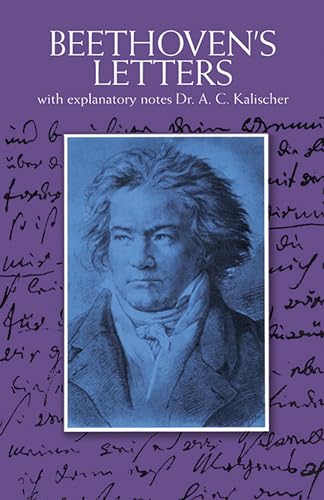
Ludwig van Beethoven (1770–1827), the protagonist of freedom for music, disentangled music from the control of the ruling class. In publishing his music and writing for the rising classes, Beethoven claimed freedom and expressed the emotions of the new rulers, the artists. The Eroica, Fidelio, and the piano works express the emotions of the new rulers — the intense love, the need for companionship of people, the forces that conspired to defeat the artist, and the strength and superiority of the artist in overcoming the weaknesses. The letters of Beethoven are the principal nonmusical expression of his personality in its relationship with the world of his time.
In what he called the "dry letters of the alphabet," Beethoven depicted his fears, his loves, and his friendly relations: his fears of deafness and of corrupted texts by pirating printers; his loves, Bettina Brentano and Giulietta Guicciardi; and his friendly relations with Baron Zmeskall, Frau Nannette Streicher, and the music publishers Steiner and Company. He praises the poetry of Goethe and Schiller but condemns Goethe for his obeisance toward royalty. He solicits help during his perpetual trouble with his health and with his servants. He castigates publishers, sets prices for his works, and calculates letters of dedication. He expresses his love for his nephew, Carl, but documents the trouble that Carl was causing him by taking up his precious time. And although Beethoven liked to decorate the letters with musical openings and closings and an occasional song to the receiver, he increasingly signed his letters, "In haste."
The 457 letters collected here are the most important of the letters of the spirit that was to shape and move a century. Explanatory notes comment upon works, on persons mentioned, and on the puns of which Beethoven was fond. The letters chronicle his business, his needs, his humor and bitterness, and his philosophy. They will give many insights into Beethoven's methods, his influences, his moods, and the conditions under which the master worked.
"synopsis" may belong to another edition of this title.
About the Author
The triumphant genius of Ludwig van Beethoven (1770–1827) casts a long shadow over classical music — no other composer of the past two centuries has exercised an influence more profound than his. A product of the classicist generation, he was the first of the Romantics, and his exhilarating works remain undiminished in their powers of enchantment.
"About this title" may belong to another edition of this title.
Search results for Beethoven's Letters: with explanatory notes Dr....

Seller Image
Beethoven's Letters: with explanatory notes Dr. A.C. Kalischer (Dover Books On Music: Composers)
Seller: Zoom Books East, Glendale Heights, IL, U.S.A.
Seller rating 5 out of 5 stars

Condition: good. Book is in good condition and may include underlining highlighting and minimal wear. The book can also include "From the library of" labels. May not contain miscellaneous items toys, dvds, etc. . We offer 100% money back guarantee and 24 7 customer service. Seller Inventory # ZEV.0486227693.G
Stock Image
Beethoven's Letters (Dover Books on Music)
Seller: Wonder Book, Frederick, MD, U.S.A.
Seller rating 5 out of 5 stars
Condition: Good. Good condition. A copy that has been read but remains intact. May contain markings such as bookplates, stamps, limited notes and highlighting, or a few light stains. Seller Inventory # O11E-01902
Stock Image
Beethoven's Letters: with explanatory notes Dr. A.C. Kalischer (Dover Books On Music: Composers)
Seller: Read&Dream, SAINT LOUIS, MO, U.S.A.
Seller rating 4 out of 5 stars

Condition: Fair. The item is fairly worn but still readable. The book may have some cosmetic wear like creased spine, cover, scratches, curled corners, folded pages, sunburn, stains, water damage, bent, torn, damaged binding, dent. The dust jacket if present, may be marked, and have considerable heavy wear. The book might be ex-library copy, and may have the markings and stickers associated from the library - The book may have considerable highlights, notes, underlined pages but the text is legible. Seller Inventory # 769K_MA_H0004OHX
Stock Image
Beethoven's Letters: With Explanatory Notes Dr. A.C. Kalischer
Seller: ThriftBooks-Dallas, Dallas, TX, U.S.A.
Seller rating 5 out of 5 stars
Paperback. Condition: Good. No Jacket. Pages can have notes/highlighting. Spine may show signs of wear. ~ ThriftBooks: Read More, Spend Less. Seller Inventory # G0486227693I3N00
Stock Image
Beethoven's Letters: With Explanatory Notes Dr. A.C. Kalischer
Seller: ThriftBooks-Atlanta, AUSTELL, GA, U.S.A.
Seller rating 5 out of 5 stars
Paperback. Condition: Good. No Jacket. Former library book; Pages can have notes/highlighting. Spine may show signs of wear. ~ ThriftBooks: Read More, Spend Less. Seller Inventory # G0486227693I3N10
Stock Image
Beethoven's Letters: With Explanatory Notes Dr. A.C. Kalischer
Seller: ThriftBooks-Atlanta, AUSTELL, GA, U.S.A.
Seller rating 5 out of 5 stars
Paperback. Condition: Fair. No Jacket. Readable copy. Pages may have considerable notes/highlighting. ~ ThriftBooks: Read More, Spend Less. Seller Inventory # G0486227693I5N00
Stock Image
Beethoven's Letters (Dover Books On Music: Composers)
Seller: HPB-Ruby, Dallas, TX, U.S.A.
Seller rating 5 out of 5 stars
paperback. Condition: Very Good. Connecting readers with great books since 1972! Used books may not include companion materials, and may have some shelf wear or limited writing. We ship orders daily and Customer Service is our top priority! Seller Inventory # S_469006426
Stock Image
Beethoven's Letters (Dover Books On Music: Composers)
Seller: HPB-Emerald, Dallas, TX, U.S.A.
Seller rating 5 out of 5 stars
paperback. Condition: Very Good. Connecting readers with great books since 1972! Used books may not include companion materials, and may have some shelf wear or limited writing. We ship orders daily and Customer Service is our top priority! Seller Inventory # S_474082900
Stock Image
Beethoven's Letters
Published by
Dover Publications Inc., 1972
ISBN 10: 0486227693
ISBN 13: 9780486227696
Used
Softcover
Seller: World of Books (was SecondSale), Montgomery, IL, U.S.A.
Seller rating 5 out of 5 stars
Condition: Good. Ludwig van Beethoven (1770-1827), the protagonist of freedom for music, disentangled music from the control of the ruling class. In publishing his music and writing for the rising classes, Beethoven claimed freedom and expressed the emotions of the new rulers, the artists. The Eroica, Fidelio, and the piano works express the emotions of the new rulers -- the intense love, the need for companionship of people, the forces that conspired to defeat the artist, and the strength and superiority of the artist in overcoming the weaknesses. The letters of Beethoven are the principal nonmusical expression of his personality in its relationship with the world of his time.In what he called the dry letters of the alphabet, Beethoven depicted his fears, his loves, and his friendly relations: his fears of deafness and of corrupted texts by pirating printers; his loves, Bettina Brentano and Giulietta Guicciardi; and his friendly relations with Baron Zmeskall, Frau Nannette Streicher, and the music publishers Steiner and Company. He praises the poetry of Goethe and Schiller but condemns Goethe for his obeisance toward royalty. He solicits help during his perpetual trouble with his health and with his servants. He castigates publishers, sets prices for his works, and calculates letters of dedication. He expresses his love for his nephew, Carl, but documents the trouble that Carl was causing him by taking up his precious time. And although Beethoven liked to decorate the letters with musical openings and closings and an occasional song to the receiver, he increasingly signed his letters, In haste.The 457 letters collected here are the most important of the letters of the spirit that was to shape and move a century. Explanatory notes comment upon works, on persons mentioned, and on the puns of which Beethoven was fond. The letters chronicle his business, his needs, his humor and bitterness, and his philosophy. They will give many insights into Beethoven's methods, his influences, his moods, and the conditions under which the master worked. Seller Inventory # 00105178045