
Items related to An Essay on the Principle of Population
Synopsis
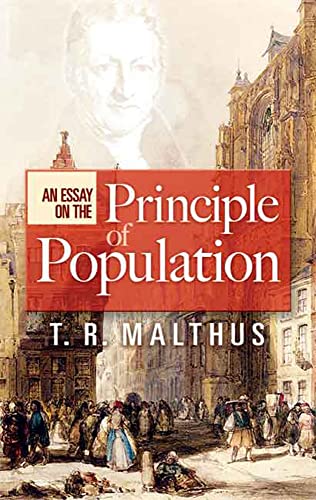
The first major study of population size and its tremendous importance to the character and quality of society, this polemic examines the tendency of human numbers to outstrip their resources. Pivotal in establishing the field of demography, it remains crucial to understanding modern problems with food production and distribution.
Anglican parson Thomas Robert Malthus wrote his famous essay in 1798 in response to speculations on social perfectibility aroused by the French Revolution. Because human powers of procreation so greatly exceed the production of food, Malthus explained, population will always exceed available resources, and many will inevitably live at the ragged edge of subsistence. His simple yet powerful argument — demonstrating that scarcity and inequality arise even in a society purged of all unjust laws and institutions — was highly controversial in its day. Many of Malthus' contemporaries despised him for dashing their hopes of social progress, and the grim logic of his "population principle" led Thomas Carlyle to dub economics "the dismal science."
Today, Malthus' name is practically synonymous with active concern about demographic and ecological prospects, and his classic remains ever relevant to issues of social policy, theology, evolution, and the environment.
"synopsis" may belong to another edition of this title.
About the Author
The Reverend Thomas Robert Malthus FRS was an English cleric and scholar, influential in the fields of political economy and demography. Malthus himself used only his middle name Robert. (Wikipedia)
"About this title" may belong to another edition of this title.
Search results for An Essay on the Principle of Population

Stock Image
An Essay on the Principle of Population
Published by
Dover Publications, Incorporated, 2007
ISBN 10: 0486456080
ISBN 13: 9780486456089
Used
Softcover
Seller: Better World Books: West, Reno, NV, U.S.A.
Seller rating 5 out of 5 stars

Condition: Very Good. Pages intact with possible writing/highlighting. Binding strong with minor wear. Dust jackets/supplements may not be included. Stock photo provided. Product includes identifying sticker. Better World Books: Buy Books. Do Good. Seller Inventory # 10241163-6
Stock Image
An Essay on the Principle of Population
Published by
Dover Publications, Incorporated, 2007
ISBN 10: 0486456080
ISBN 13: 9780486456089
Used
Softcover
Seller: Better World Books, Mishawaka, IN, U.S.A.
Seller rating 5 out of 5 stars
Condition: Good. Pages intact with minimal writing/highlighting. The binding may be loose and creased. Dust jackets/supplements are not included. Stock photo provided. Product includes identifying sticker. Better World Books: Buy Books. Do Good. Seller Inventory # 2023568-6
Stock Image
An Essay on the Principle of Population
Published by
Dover Publications (edition ), 2007
ISBN 10: 0486456080
ISBN 13: 9780486456089
Used
Paperback
Seller: BooksRun, Philadelphia, PA, U.S.A.
Seller rating 5 out of 5 stars
Paperback. Condition: Very Good. It's a well-cared-for item that has seen limited use. The item may show minor signs of wear. All the text is legible, with all pages included. It may have slight markings and/or highlighting. Seller Inventory # 0486456080-11-1
Stock Image
An Essay on the Principle of Population
Seller: Half Price Books Inc., Dallas, TX, U.S.A.
Seller rating 5 out of 5 stars
paperback. Condition: Very Good. Connecting readers with great books since 1972! Used books may not include companion materials, and may have some shelf wear or limited writing. We ship orders daily and Customer Service is our top priority! Seller Inventory # S_476588413
Stock Image
An Essay on the Principle of Population
Seller: The Book Bin, Salem, OR, U.S.A.
Seller rating 5 out of 5 stars
paperback. Condition: Very Good. This book is from an inventory that we have been able to price inexpensively because it has minimal description. All of the books from this inventory are in very good condition or better, with the potential for light shelf-wear; many are particularly nice examples. May have a small remainder mark at textblock edge. Seller Inventory # WRM-B1005683
Seller Image
An Essay on the Principle of Population
Seller: Bill & Ben Books, Faringdon, United Kingdom
Seller rating 5 out of 5 stars
Paperback. Condition: New. The first major study of population size and its tremendous importance to the character and quality of society, this polemic examines the tendency of human numbers to outstrip their resources. Pivotal in establishing the field of demography, it remains crucial to understanding modern problems with food production and distribution. Anglican parson Thomas Robert Malthus wrote his famous essay in 1798 in response to speculations on social perfectibility aroused by the French Revolution. Because human powers of procreation so greatly exceed the production of food, Malthus explained, population will always exceed available resources, and many will inevitably live at the ragged edge of subsistence. His simple yet powerful argument â" demonstrating that scarcity and inequality arise even in a society purged of all unjust laws and institutions â" was highly controversial in its day. Many of Malthus' contemporaries despised him for dashing their hopes of social progress, and the grim logic of his "population principle" led Thomas Carlyle to dub economics "the dismal science." Today, Malthus' name is practically synonymous with active concern about demographic and ecological prospects, and his classic remains ever relevant to issues of social policy, theology, evolution, and the environment. Seller Inventory # 0094283
Buy New
US$ 5.45
US$ 13.40 shipping
Ships from United Kingdom to U.S.A.
Ships from United Kingdom to U.S.A.
Quantity: 2 available
Stock Image
An Essay on the Principle of Population [Paperback] Malthus, T.R.
Seller: Hay-on-Wye Booksellers, Hay-on-Wye, HEREF, United Kingdom
Seller rating 4 out of 5 stars

Condition: Good. Used, some outer edges have minor scuffs, cover has light scratches, book content is in very good condition. Seller Inventory # 068464-10
Buy Used
US$ 4.10
US$ 33.18 shipping
Ships from United Kingdom to U.S.A.
Ships from United Kingdom to U.S.A.
Quantity: 1 available
Seller Image
ESSAY ON THE PRINCIPLE OF POPU
Seller: Book Broker, Berlin, Germany
Seller rating 5 out of 5 stars
Condition: Gut. 152 Seiten Alle Bücher & Medienartikel von Book Broker sind stets in gutem & sehr gutem gebrauchsfähigen Zustand. Dieser Artikel weist folgende Merkmale auf: Helle/saubere Seiten in fester Bindung. Leichte Gebrauchsspuren. Sprache: Englisch Gewicht in Gramm: 113 Taschenbuch, Größe: 14 x 0.8 x 21.4 cm. Seller Inventory # 660865159
Buy Used
US$ 15.83
US$ 36.63 shipping
Ships from Germany to U.S.A.
Ships from Germany to U.S.A.
Quantity: 1 available
Stock Image
An Essay on the Principle of Population
Seller: BennettBooksLtd, Los Angeles, CA, U.S.A.
Seller rating 5 out of 5 stars
paperback. Condition: New. In shrink wrap. Looks like an interesting title! Seller Inventory # Q-0486456080