
Items related to Tree of Rivers: The Story of the Amazon
Synopsis
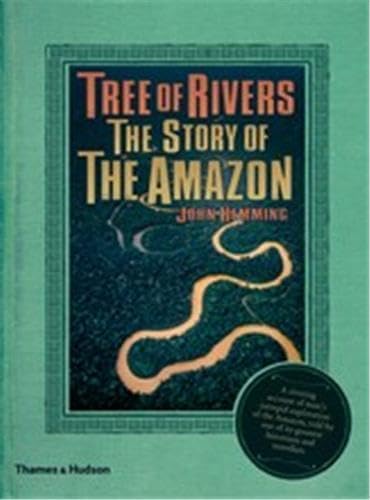
A history of the Amazon, its peoples, and those who have explored the river by an author with unsurpassed knowledge and experience in the region
By far the world's largest river, the Amazon flows through the greatest expanse of tropical rain forest on earth. Human beings settled in Amazonia ten thousand years ago and learned to live well on its bounty. Europeans first saw the Amazon around 1500 and started settling there in the seventeenth century. Always in fear or awe of the jungle, they tried in vain to introduce crops and livestock.
John Hemming's account of the river and its history is full of larger-than-life personalities this unique environment attracted: explorers, missionaries, and naturalists among them. By the nineteenth century, Amazonian natives had almost been destroyed by alien diseases and slavery, as well as violent class rebellion. Although the rubber industry created huge fortunes, it too was at a fearful cost in human misery.
In the last hundred years, the Amazon has seen intrepid explorers, entreprenurial millionaires, and political extremists taking refuge in jungle retreats. Alongside them, natural scientists, anthropologists, and archaeologists have sought to discover the secrets of this mighty habitat.
Today, the world's appetite for timber, beef, and soya is destroying this great tropical forest. Hemming explains why the Amazon is environmentally crucial to survival and brilliantly describes the passionate struggles to exploit and protect it.
"synopsis" may belong to another edition of this title.
About the Author
Formerly the Director of the Royal Geographical Society in London, John Hemming has traveled in and written extensively about the Amazon region. His previous books include Tree of Rivers.
Reviews
Reviewed by Edgardo Krebs
In "Atlas," a book about travel, Jorge Luis Borges wrote that we should not assume all discoveries and explorations to be things of the past. No place can justify this assertion more literally than the Amazon basin. Dominated by the longest river in the world, its geography extends over a surface the size of Europe, much of it inaccessible. The river is the center of a web of life --
plants, insects, fish, reptiles, birds, mammals -- dauntingly richer than any other region's on Earth. Its rainforests also serve as home or refuge to a resilient diversity of Indian groups, some of whom, in dwindling numbers, still refuse contact with the larger world, the maker and narrator of history. Yet, this impressive list of attributes can also lure us to imagine the Amazon in mythical terms, or to misrepresent it or take it for granted.
The stories John Hemming tells in Tree of Rivers are a passionate corrective to many stereotypes of this complex area and its history. An explorer, former director of the Royal Geographical Society and author of three scholarly books on the Amazon as well as one on the conquest of Peru, Hemming has dedicated a lifetime of research to the Amazon and knows his vast topic with a rigorous intimacy.
The book has 11 chapters, spanning a range of historical periods and subjects, from the little publicized (but engrossing) archaeology of the region to present-day problems of deforestation and climate change. Each chapter is a self-contained essay. Taken together, they read like the Thousand and One Nights of the Amazon, a rich, multifaceted narrative that strives to mirror the place itself.
Some stories will be familiar to the informed reader. The first navigation of the Amazon, for instance, undertaken by Francisco de Orellana in 1542, was "one of the greatest explorations of all time" in Hemming's judgment, a tropical match for Shackleton's Antarctic odyssey. The voyage was chronicled by the Dominican friar Gaspar de Carvajal, who lost an eye in a skirmish with Indians and survived the strike of an arrow that pierced his ribs. Carvajal's report was the first panoramic portrait of the Amazon and the Indians who lived on the banks of the watery maze. Carvajal described the populous villages of the Omagua, for instance, whose glazed, enameled and "vividly colored" pottery he judged as "the finest in the world." Hemming also speculates that the tall, pale female Amazon warriors Orellana claimed to have seen were, in fact, long-haired Wai Wai men, "Carib-speaking peoples who now live several days' journey up the Mapuera and Trombetas rivers."
Another familiar story is that of the infamous Basque soldier Lope de Aguirre, a brooding member of the Pedro de Ursúa expedition, who made his way down the Amazon in 1560. Hemming is not partial to the Werner Herzog/Klaus Kinski film "Aguirre, the Wrath of God," which recounts this feverish, failed search for El Dorado. But the madness and mayhem that took over the traveling party is a fitting topic for German expressionism, and madness itself is one of the recurring human shadows cast over the landscape of the Amazon. As all these expeditions floated downstream on precarious canoes, their soldiers, priests and adventurers kept a notary's eye on things, drafting and signing documents addressed to the king of Spain every time murder or an act of treason occurred. They knew that their ultimate fate would be decided at court.
For the Indians of the Amazon, the encounter with Europeans was devastating from the beginning. In 1556, Spanish settlers in the Peruvian hamlet of Chachapoyas "were amazed by the arrival of a flotilla of indigenous canoes" carrying around 300 Indians -- survivors of a party that had walked and paddled up stream for 10 years to flee the Portuguese colonies on the Atlantic coast.
The tree of rivers became a net for trapping Indians and conveying them to the coast and to settlements upriver. The settlements were run mercilessly as systems of production with native men, women and children providing expendable slave labor. "A few thousand colonists," Hemming states, "gradually destroyed every human being along thousands of kilometers of the main river and its tributaries." Some of the episodes he recounts -- the burning of entire villages, the raping of women in front of their children -- are reminiscent of the experiences of present-day villagers in Darfur. These were the precursors of the Belgian King Leopold's brutal operatives in the Congo. In the 17th century, in the Mato Grosso of Brazil, that heart of darkness belonged to António Rapôso Tavares, "the toughest of all the slavers operating out of the distant southern town of Sao Paulo."
Other characters, much less known, such as Curt Nimuendajú and Colonel Cândido Rondon, illustrate the loftier aspects of human nature. Rondon was Theodore Roosevelt's guide in the almost deadly (for Roosevelt) River of Doubt expedition. An orphan and descendant of Bororo Indians, Rondon was, in Hemming's estimation, "Brazil's most intrepid explorer," that country's "answer to Dr. David Livingstone." Rondon surveyed and mapped an enormous swath of unknown territory and then published a series of reports of great ethnographic value. He became an advocate for Indian rights, founded the Indian Protection Service, and admonished his urban audiences to "tremble with indignation and shame" at the genocidal slaughter of the native population. "Die if you must, but never kill" was his advice to "men confronting hostile tribes."
Nimuendajú, on the other hand, was born Curt Unkel, in Jena, Germany. Fascinated by South American Indians since childhood, he immigrated, penniless, to Brazil in 1903. He is probably one of the most admirable anthropologists in history. His technique was to spend as much time as possible with a tribe, learn its language and thoroughly document its way of life. He authored monographs on 45 tribes. "Perhaps because he was self-taught," Hemming remarks wryly, "he wrote in jargon-free prose." The Guarani gave him the name Nimuendajú ("He who resides among us"), which he adopted as his legal name when he became a Brazilian citizen.
The Amazon, in the collective imagination, is a synonym for nature. One shortcoming in Hemming's narrative is his failure to note that Indians have a completely different way of understanding this concept -- or lack anything resembling it. The French ethnologist Claude Lévi-Strauss (who will turn 100 this November) was the first to systematize the complex intellectual heritage of Amazonian Indians. He famously wrote: "Indians use animals to think." Conservationists, who rightly abhor the prospect of invaluable rainforest being replaced by soybean plantations stretching to the horizon, pin their hopes on government protected areas and Indian stewardship. Yet they may not always acknowledge that Indians and biologists operate within different taxonomies, and do not see "nature" eye-to-eye.
The modernist Brazilian writers and painters of the 1920s realized that new symbols were needed to understand the country's hybrid history and culture. "Tupi or not Tupi?" asked the poet-polemicist Olegario Andrade in his Cannibal Manifesto, capturing the spirit of the moment. Turning the negative European perceptions of Tupi cannibalism on its head, Andrade suggested that Brazilians would achieve a true sense of nation only when they embraced their indigenous ancestry and, in a metaphorical cannibal feast, ate the world.
Hemming does not engage in such symbolic and psychological questions. Tree of Rivers is a straightforward, majestic narrative, told in many voices, with a multitude of characters, and composed by a scholar and explorer who has earned a rightful place in the history of the region.
Copyright 2008, The Washington Post. All Rights Reserved.
"About this title" may belong to another edition of this title.
Search results for Tree of Rivers: The Story of the Amazon

Stock Image
Tree of Rivers: The Story of the Amazon
Published by
Thames & Hudson (edition ), 2008
ISBN 10: 0500514011
ISBN 13: 9780500514016
Used
Hardcover
Seller: BooksRun, Philadelphia, PA, U.S.A.
Seller rating 5 out of 5 stars

Hardcover. Condition: Very Good. With dust jacket. It's a well-cared-for item that has seen limited use. The item may show minor signs of wear. All the text is legible, with all pages included. It may have slight markings and/or highlighting. Seller Inventory # 0500514011-11-1-29
Stock Image
Tree of Rivers: The Story of the Amazon
Seller: World of Books (was SecondSale), Montgomery, IL, U.S.A.
Seller rating 5 out of 5 stars
Hardback. Condition: Fair. Describes the struggles that have taken place in order to utilize, protect and understand the wonder that is the Amazon. This account recalls the adventures and misadventures down the centuries of the explorers, missionaries, indigenous Indians, naturalists, rubber barons, scientists, anthropologists, archaeologists, and political extremists. Seller Inventory # 00110520785
Stock Image
Tree of Rivers: The Story of the Amazon
Seller: World of Books Inc, Montgomery, IL, U.S.A.
Seller rating 4 out of 5 stars

Hardback. Condition: Fair. Describes the struggles that have taken place in order to utilize, protect and understand the wonder that is the Amazon. This account recalls the adventures and misadventures down the centuries of the explorers, missionaries, indigenous Indians, naturalists, rubber barons, scientists, anthropologists, archaeologists, and political extremists. Seller Inventory # CIN0500514011A
Stock Image
Tree of Rivers : The Story of the Amazon
Seller: Better World Books, Mishawaka, IN, U.S.A.
Seller rating 5 out of 5 stars
Condition: Good. illustrated edition. Pages intact with minimal writing/highlighting. The binding may be loose and creased. Dust jackets/supplements are not included. Stock photo provided. Product includes identifying sticker. Better World Books: Buy Books. Do Good. Seller Inventory # 7917294-6
Stock Image
Tree of Rivers: The Story of the Amazon
Published by
Thames and Hudson, NY, 2008
ISBN 10: 0500514011
ISBN 13: 9780500514016
Used
Hardcover
First Edition
Seller: AardBooks, Fitzwilliam, NH, U.S.A.
Seller rating 5 out of 5 stars
Condition: VG+/Near Fine (see notes). 1st US. 8vo. 368pp. Slight cant to spine. Seller Inventory # MAIN036331I
Seller Image
Tree of Rivers: The Story of the Amazon
Published by
Thames & Hudson, New York, 2008
ISBN 10: 0500514011
ISBN 13: 9780500514016
Used
Hardcover
First Edition
Seller: Lost Paddle Books, IOBA, Albany, CA, U.S.A.
Seller rating 5 out of 5 stars
Hardcover. Condition: Very Good. Dust Jacket Condition: Fine. First Edition. In green blindstamped boards with gilt to type on spine. Green ribbon marker with some fraying to the end. Light wear to spine ends with Bump to heel. Sharp corners, clean interior and tight binding. Jacket is unclipped, glossy and beautiful. 1st Printing. Seller Inventory # LPB010854JH
Seller Image
Tree of rivers: the story of the Amazon.
Published by
London: Thames and Hudson, 2008., 2008
ISBN 10: 0500514011
ISBN 13: 9780500514016
Used
Softcover
Seller: Andrew Isles Natural History Books, Prahran, VIC, Australia
Seller rating 5 out of 5 stars
Octavo, dustwrapper,368 pp.,illustrations. This enthralling book brilliantly describes the passionate struggles that have taken place in order to utilize, protect and understand the wonder that is the Amazon. Hemmings riveting account recalls the adventures and misadventures down the centuries of the explorers, missionaries, indigenous Indians, naturalists, rubber barons, scientists, anthropologists, archaeologists, political extremists, prospectors and many more, who have been in thrall to the Amazon, the largest river in the world, with the greatest expanse of tropical rain forest and most luxuriant biological diversity on earth. Also available in paperback [stock id 30685]. Seller Inventory # 28256
Buy Used
US$ 30.82
US$ 31.00 shipping
Ships from Australia to U.S.A.
Ships from Australia to U.S.A.
Quantity: 1 available
Stock Image
Tree of Rivers: The Story of the Amazon
Published by
Thames and Hudson Ltd, London, 2008
ISBN 10: 0500514011
ISBN 13: 9780500514016
Used
Hardcover
First Edition
Seller: Stirling Books, Stirling, United Kingdom
Seller rating 5 out of 5 stars
Hardcover. Condition: Very Good. Dust Jacket Condition: Very Good. 1st Edition. Hardback: Very Good Condition. Dust Jacket: Very Good Condition. Pages Bright, Clean And Unmarked. Binding Tight And Secure. Clean Covers, Minimal Wear. Photograph Is Added By Selling Site And Not Ours, Therefore May Not Reflect This Edition Or Condition. Please Contact Us For Pictures If Desired. Seller Inventory # 046307
Buy Used
US$ 27.79
US$ 39.54 shipping
Ships from United Kingdom to U.S.A.
Ships from United Kingdom to U.S.A.
Quantity: 1 available
Stock Image
Tree of Rivers: The Story of the Amazon
Seller: GoldBooks, Denver, CO, U.S.A.
Seller rating 5 out of 5 stars
Hardcover. Condition: new. New Copy. Customer Service Guaranteed. Seller Inventory # 45Z27_47_0500514011
Stock Image
Tree of Rivers: The Story of the Amazon
Seller: Stephen White Books, Bradford, United Kingdom
Seller rating 5 out of 5 stars
hardcover. Condition: Good. Ex-library book, usual marking. Clean copy in good condition. With Dust Cover. Quick dispatch from UK seller. Seller Inventory # mon0000572075
Buy Used
US$ 28.60
US$ 43.99 shipping
Ships from United Kingdom to U.S.A.
Ships from United Kingdom to U.S.A.
Quantity: 1 available