
Items related to London: The Novel
Synopsis
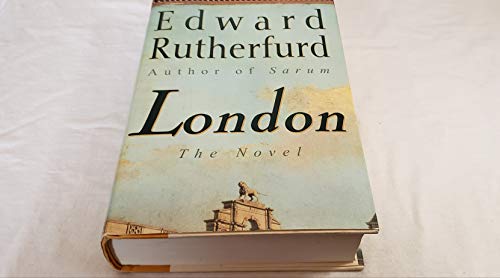
London follows six different families from the Roman settlement to the dockland development of today. Real-life characters and events of British history are found in London as well, but it is the period details and the stories of ordinary Londoners, whose daily lives are affected by events that have shaped the city over two thousand years, that bring the novel to life.
In London Rutherfurd provides more than just the familiar sights and revelations, he gives a voice to a city whose history is one of the most remarkable in the world.
"synopsis" may belong to another edition of this title.
About the Author
Edward Rutherfurd was born in Salisbury, England, and was educated in Wiltshire and at Cambridge. He has since lived on both sides of the Atlantic, in Dublin and New York, but he returned to his roots to write his first novel, the best-selling Sarum, a history of Salisbury. This was followed by the best-selling Russka, a sweeping history of Russia from the cossack horsemen to the Bolshevik revolution.
Until the 1980s, Edward Rutherfurd pursued a business career -- he attended Stanford Business School, worked for W.H. Smith, and was employed by Tory Party Central Office. As a child, he had been fascinated by the novels of C.S. Forester, Henty, and the historical romances of Sir Arthur Conan Doyle. His grandmother, Evelyn Winch, was a well-known romantic novelist of the 1930s. Rutherfurd was also influenced by the novels of James Michener, such as Covenant and Texas, and saw that no one had attempted a similar approach in the United Kingdom.
Rutherfurd gave up his secure day job and spent two years researching and writing Sarum. When it was half-finished, and funds were running low, he realized he needed to find an agent. He approached agent Gill Coleridge with a few chapters and a synopsis. Within a month, Century bought the book in England, and the novel was auctioned in the United States. Ten years later, Sarum is still selling all over the world.
Edward Rutherfurd currently lives outside Dublin, Ireland.
From the Inside Flap
</b> follows six different families from the Roman settlement to the dockland development of today. Real-life characters and events of British history are found in <b>London</b> as well, but it is the period details and the stories of ordinary Londoners, whose daily lives are affected by events that have shaped the city over two thousand years, that bring the novel to life.<br><br>In <b>London</b> Rutherfurd provides more than just the familiar sights and revelations, he gives a voice to a city whose history is one of the most remarkable in the world.
Reviews
YA. Certainly not for the fainthearted, this 800+ page novel on the history of London is true to the author's form. Rutherford so skillfully weaves detailed fiction and fact that YAs may have to head for the reference books to verify which is which. Basically, the story is London's evolution from a trading post to the seat of an Empire and the families who lived that history. Through the adventures and everyday lives of these characters, one can go to Shakespeare's Globe Theater, tend the plague patients with Dr. Richard Meredith, attend hangings at Newgate Prison, weep at the loss of life and limb due to "God's fire," visit the taverns with Chaucer and his pilgrims, and have other experiences in this exciting city. A special book for readers who have a burning interest in history and the stick-to-itiveness to finish and reflect on it. A perfect choice for the summer hiatus or winter holidays.?Carol Clark, R. E. Lee High School, Springfield, VA
Copyright 1997 Reed Business Information, Inc.
Rutherfurd, having celebrated at some length the growth of an English cathedral town (Sarum, 1987) and the turbulent history of Russia (Russka, 1991), offers a massive survey in fictional form of London's long history. Like the work of his likely inspiration, James Michener, Rutherfurd's novels are distinguished by admirable research and a propulsive plot. This latest follows the growth of London from its origins as a Celtic encampment through its emergence as the Roman capital in Britain and on to its long climb to preeminence as England's (and, for a time, the world's) greatest city. Interwoven with the private (and rather melodramatic) adventures of a half-dozen families over a 2,000-year span are most of the events that shaped England (from the Norman invasion up to the Battle of Britain). These incidents tend to be announced portentously (``England's great Peasant Revolt had begun'') and the characters, to fill in the historical background, sometimes offer speeches packed with an alarming (and unlikely) amount of information. There are obligatory cameos by everyone from Shakespeare to Dickens. Still, this is a vigorous, colorful narrative, a pleasant if unsurprising entertainment. -- Copyright ©1997, Kirkus Associates, LP. All rights reserved.
In the early pages of this humongous historical novel, the author reminds the reader that "hardly eighty generations separate us from the birth of Christ. Four hundred and we are back to the last Ice Age." And the Ice Age is exactly how far back into time Rutherford reaches in this saga that traces the evolution of a handful of families throughout the history of England, with particular focus on their involvement in the development of the great English metropolis. All dimensions of English political, social, and economic history are given airing as the reader follows family members, centered in London, through the Anglo-Saxon period, Norman domination, Tudor and Stuart times, and growth and loss of the empire up to the present day. Copious research stands behind Rutherfurd's long narrative but fluidity of presentation is lacking; there is simply too much undigested historical information and detail. And although the spotlight is on individuals, it is difficult to get a real "personal" feel in all this grand sweep. Nonetheless, the author's Sarum (1988) proved popular, and library patrons with a penchant for heavily historical fiction undoubtedly will seek out his latest novel. Brad Hooper
As evidenced by his previous historical novels, Russka (LJ 9/1/91) and Sarum (LJ 9/15/87), Rutherfurd does not flinch at a challenge. Wrap up 2000 years in an 800-page book? No problem. This all-encompassing fictional history of London is told through the experiences of a group of diverse families who, over the generations, meet, mingle, intermarry, and feud. Beginning with prehistory and continuing to the present, Rutherfurd combines geological details, historical events, real people, and his fictional characters to bring London to life. The writing veers from the mundane to the didactic, and readers would be well advised to list the characters as they encounter them. Rutherfurd's whirlwind historical tour is an appropriate purchase for all collections.
-?Nancy Pearl, Washington Ctr. for the Book, Seattle
Copyright 1997 Reed Business Information, Inc.
Excerpt. © Reprinted by permission. All rights reserved.
54 BC
Fifty-four years before the birth of Christ, at the end of a cold, star-filled spring night, a crowd of two hundred people stood in a semicircle by the bank of the river and waited for the dawn.
Ten days had passed since the ominous news had come.
In front of them, at the water's edge, was a smaller group of five figures. Silent and still, in their long grey roves they might have been taken for so many standing stones. These were the druids, and they were about to perform a ceremony which, it was hoped, would save the island and their world.
Amongst those gathered by the riverbank were three people, each of whom, whatever hopes or fears they may have had concerning the threat ahead, guarded a personal and terrible secret.
One was a boy, the second a woman, the third a very old man.
There were many sacred sites along the lengthy course of the river. But nowhere was the spirit of the great river so clearly present than at this quiet place.
Here, sea and river met. Downstream, in a series of huge loops, the ever widening flow passed through open marshland until, about ten miles away, it finally opened out into the long, eastward funnel of the estuary and out to the cold North Sea. Upstream, the river meandered delightfully between pleasant woods and lush, level meadows. But at this point, between two of the river's great bends, lay a most gracious stretch of water, two and a half miles long, where the river flowed eastwards in a single, majestic sweep.
It was tidal. At high tide, when the incoming sea in the estuary reversed the current, this river road was a thousand yards across; at low tide, only three hundred. In the centre, halfway along the southern bank where the marshes formed little islands, a single gravel spit jutted out into the stream forming a promontory at low water, and becoming an island when the tide was high. It was on the top of this spit that the little crowd was standing. Opposite them, on the northern bank, lay the place, now deserted, that bore the name of Londinos.
Londinos. Even now, in the dawning light, the shape of the ancient place could be seen clearly across the water: two low gravel hills with levelled tops rising side by side about eighty feet above the waterfront. Between the two hills ran a little brook. To the left, on the western flank, a larger stream descended to a broad inlet that interrupted the northern bank.
On the eastern side of the two hills, there had once been a small hillfort whose low earthwork wall, now empty, could serve as a lookout post for vessels approaching from the estuary. The western hill was sometimes used by the druids when they sacrificed oxen.
And the was all there was. An abandoned settlement. A sacred spot. The tribal centres were to the north and south. The tribes over whom the great chief Cassivelaunus was master lived in the huge eastern tracts above the estuary. The tribe of Cantii, in the long peninsula south of the estuary, had already given that region the name of Kent. The river was a border between them, Londinos a sort of no-man's-land.
The very name was obscure. Some said that a man called Londinos had lived there; others suggested that it might refer to the little earthwork on the eastern hill. But nobody knew. Somehow, in the last thousand years, the place had got the name.
The cold breeze was coming up the river from the estuary. There was a faint, sharp smell of mud and riverweed. Above, the bright morning star was beginning to fade as the clear sky turned to a paler blue.
The boy shivered. He had been standing an hour and he was cold. Like most of the folk there, he wore a simple woolen tunic that reached to the knees and was fastened at the waist with a leather belt. Beside him stood his mother holding a baby, and his sister little Branwen, whom he held by the hand. For it was his task at such times to keep her in order.
He was a bright, brave little fellow, dark-haired and blue-eyed, like most of his Celtic people. His name was Segovax and he was nine. A closer inspection, however, would have revealed two unusual features in his appearance. On the front of his head on the forelock, grew a patch of white hair, as though someone had dabbed it with a brush of white dye. Such hereditary marks were to be found amongst several families dwelling in the hamlets along that region of the river. "You needn't worry," his mother had told him. "A lot of women think it's a sign that you're lucky."
The second feature was much stranger. When the boy spread his fingers, it could be seen that between them, as far as the first joint, was a thin layer of skin, like the webbing on a duck's foot. This too was an inherited trait, although it did not show itself in every generation. It was as though, in some distant, primordial time some gene in a fish-like prototype of Man had obstinately refused to change its watery character entirely, and so passed on this vestige of its origins. Indeed, with his large-eyed face and his wiry little body, the boy did somehow make one think of a tadpole or some other little creature of the waters, a quick survivor down the endless eons of time.
His grandfather had also exhibited the condition. "But they cut the extra skin away when he was a baby," Segovax's father had told his wife. She could not bear the thought of the knife, though, and so nothing had been done. It did not trouble the boy.
Segovax glanced around at his family: little Branwen, with her affectionate nature and her fits of temper that no one could control; the baby boy in his mother's arms, just starting to walk and babble his first words; his mother pale and strangely distracted of late. How he loved them. But as he stared past the druids, his face broke into a little smile. By the water's edge was a modest raft with two men standing beside it. And one of them was his father.
They shared so much, father and son. The same little tuft of white hair, the same large eyes. His father's face, scoured by crease lines almost resembling scales, made one think of some solemn, fish-like creature. So dedicated was he that the local people referred to him simply as the Fisher. And though other men, Segovax realized, were physically stronger than this quiet fellow with his curved back and long arms, none was kinder or more quietly determined. "He may not be much to look at," the men in the hamlet would say, "but the Fisher never gives up." His mother, Segovax knew, adored his father. So did he.
Which was why, the day before, he had formed the daring plan that, if he managed to carry it out, would probably cost him his life.
"About this title" may belong to another edition of this title.
Search results for London: The Novel

Stock Image
London
Seller: World of Books (was SecondSale), Montgomery, IL, U.S.A.
Seller rating 5 out of 5 stars

Condition: Very Good. Item in very good condition! Textbooks may not include supplemental items i.e. CDs, access codes etc. Seller Inventory # 00109456890
Stock Image
London
Seller: World of Books (was SecondSale), Montgomery, IL, U.S.A.
Seller rating 5 out of 5 stars
Condition: Acceptable. Item in acceptable condition! Textbooks may not include supplemental items i.e. CDs, access codes etc. Seller Inventory # 00081188433
Stock Image
London
Seller: World of Books (was SecondSale), Montgomery, IL, U.S.A.
Seller rating 5 out of 5 stars
Condition: Good. Item in good condition. Textbooks may not include supplemental items i.e. CDs, access codes etc. Seller Inventory # 00103592260
Seller Image
London: The Novel
Seller: Zoom Books East, Glendale Heights, IL, U.S.A.
Seller rating 5 out of 5 stars
Condition: acceptable. Book is in acceptable condition and shows signs of wear. Book may also include underlining highlighting. The book can also include "From the library of" labels. May not contain miscellaneous items toys, dvds, etc. . We offer 100% money back guarantee and 24 7 customer service. Seller Inventory # ZEV.0517591812.A
Stock Image
London
Seller: World of Books (was SecondSale), Montgomery, IL, U.S.A.
Seller rating 5 out of 5 stars
Condition: Acceptable. Item in Acceptable condition. Textbooks may not include supplemental items i.e. CDs, access codes etc. Seller Inventory # 00110009865
Seller Image
London: The Novel
Seller: Reliant Bookstore, El Dorado, KS, U.S.A.
Seller rating 5 out of 5 stars
Condition: like_new. This book is in like new condition. Cover image on the book may vary from photo. Ships out quickly in a secure plastic mailer. Seller Inventory # RDV.0517591812.LN
Seller Image
London: The Novel
Seller: 3Brothers Bookstore, Egg harbor township, NJ, U.S.A.
Seller rating 5 out of 5 stars
Condition: very_good. Cover may have light wear, pages in very good condition and binding is sturdy; may have other light shelf wear or creases. May have notes or highlighting. Seller Inventory # EVV.0517591812.VG
Seller Image
London: The Novel
Seller: 3Brothers Bookstore, Egg harbor township, NJ, U.S.A.
Seller rating 5 out of 5 stars
Condition: good. Books may contain some notes and highlighting. Supplements such as Access Codes, Cd's Dust Jackets, etc. are not guaranteed with used book purchases. Seller Inventory # EVV.0517591812.G
Stock Image
London: The Novel
Seller: Evergreen Goodwill, Seattle, WA, U.S.A.
Seller rating 5 out of 5 stars
hardcover. Condition: Good. Seller Inventory # mon0000232481
Seller Image
London: The Novel
Seller: Greenworld Books, Arlington, TX, U.S.A.
Seller rating 5 out of 5 stars
Condition: good. Fast Free Shipping â" Good condition. It may show normal signs of use, such as light writing, highlighting, or library markings, but all pages are intact and the book is fully readable. A solid, complete copy that's ready to enjoy. Seller Inventory # GWV.0517591812.G