Items related to Male Colors: The Construction of Homosexuality in Tokugawa...
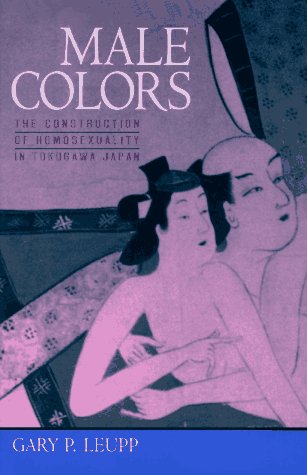
Male Colors: The Construction of Homosexuality in Tokugawa Japan - Hardcover

Leupp, Gary

  • 4.09 out of 5 stars
    186 ratings by Goodreads
 
9780520086272: Male Colors: The Construction of Homosexuality in Tokugawa Japan

Synopsis

Tokugawa Japan ranks with ancient Athens as a society that not only tolerated, but celebrated, male homosexual behavior. Few scholars have seriously studied the subject, and until now none have satisfactorily explained the origins of the tradition or elucidated how its conventions reflected class structure and gender roles. Gary P. Leupp fills the gap with a dynamic examination of the origins and nature of the tradition. Based on a wealth of literary and historical documentation, this study places Tokugawa homosexuality in a global context, exploring its implications for contemporary debates on the historical construction of sexual desire.

Combing through popular fiction, law codes, religious works, medical treatises, biographical material, and artistic treatments, Leupp traces the origins of pre-Tokugawa homosexual traditions among monks and samurai, then describes the emergence of homosexual practices among commoners in Tokugawa cities. He argues that it was "nurture" rather than "nature" that accounted for such conspicuous male/male sexuality and that bisexuality was more prevalent than homosexuality. Detailed, thorough, and very readable, this study is the first in English or Japanese to address so comprehensively one of the most complex and intriguing aspects of Japanese history.

"synopsis" may belong to another edition of this title.

About the Author

Gary P. Leupp is Associate Professor of History at Tufts University and the author of Servants, Shophands, and Laborers in the Cities of Tokugawa Japan (1992).

From the Back Cover

"An invaluable resource for anyone seeking a history of the representation of homosexuality in Japan."―Sandra Buckley, author of Broken Silence: Voices of Japanese Feminism

"Opens a window on the complex and varied patterns of sexual relations between males in early modern Japan. Imperative reading for anyone concerned with human sexual expression in social context."―David F. Greenberg, author of The Construction of Homosexuality

"Nanshoku―male colors―as male same-sex eroticism and sexuality were known in early modern Japan, enjoyed an honored place in the life and mythology of the age, celebrated in art and literature with as much energy and enthusiasm as male-female eroticism. Unfettered by the moral opporbium that constrained―or concealed―male-male eroticism in Europe, male colors flew brightly in the public culture of urban Japan. Gary Leupp explores the practices and the cultural celebration of the Edo-era nanshoku tradition in this exuberant, sensitive, and yet dispassionate social and cultural history of male homoeroticism, the best modern scholarly study in English to date. Leupp ranges widely in a vast array of original literary, dramatic, and visual sources, which he brings to life with a finely textured use of comparative material from other traditions of male-male love both in East Asia and across the premodern world. Highly original and insightful, it will be standard reading for years to come."―Ronald P. Toby, author of State and Diplomacy in Early Modern Japan: Asia in the Development of the Tokugawa Bakufu

From the Inside Flap

"An invaluable resource for anyone seeking a history of the representation of homosexuality in Japan."—Sandra Buckley, author of Broken Silence: Voices of Japanese Feminism

"Opens a window on the complex and varied patterns of sexual relations between males in early modern Japan. Imperative reading for anyone concerned with human sexual expression in social context."—David F. Greenberg, author of The Construction of Homosexuality

"Nanshoku—male colors—as male same-sex eroticism and sexuality were known in early modern Japan, enjoyed an honored place in the life and mythology of the age, celebrated in art and literature with as much energy and enthusiasm as male-female eroticism. Unfettered by the moral opporbium that constrained—or concealed—male-male eroticism in Europe, male colors flew brightly in the public culture of urban Japan. Gary Leupp explores the practices and the cultural celebration of the Edo-era nanshoku tradition in this exuberant, sensitive, and yet dispassionate social and cultural history of male homoeroticism, the best modern scholarly study in English to date. Leupp ranges widely in a vast array of original literary, dramatic, and visual sources, which he brings to life with a finely textured use of comparative material from other traditions of male-male love both in East Asia and across the premodern world. Highly original and insightful, it will be standard reading for years to come."—Ronald P. Toby, author of State and Diplomacy in Early Modern Japan: Asia in the Development of the Tokugawa Bakufu

Excerpt. © Reprinted by permission. All rights reserved.

Male Colors: The Construction of Homosexuality in Tokugawa Japan

By Gary Leupp

University of California Press

Copyright © 1997 Gary Leupp
All right reserved.

ISBN: 0520086279


Introduction

It is no secret to any careful student of Japanese society in the Tokugawa period (1603-1868) that during these two and a half centuries male homosexual behavior was extremely common, at least in towns and cities. Sex between males was not only widely tolerated among the articulate classes but positively celebrated in popular art and literature. Homosexual behavior was formally organized in such institutions as samurai mansions, Buddhist monasteries, and male brothels linked to the kabuki theater. It was, indeed, a salient feature of mainstream culture.

The generous vocabulary of terms relating to male-male sex in early modern Japanese reflects a society at ease with the phenomenon. Anyone perusing the abundant primary and secondary sources will encounter numerous allusions to the "male eros" (nanshoku ); "the way of youths" (wakashudo , often abbreviated as jakudo or shudo );a the "way of men" (nando ); "the beautiful way" (bido ); and the "secret way" (hido ). All these are euphemisms for male-male sex, conforming to certain specific conventions.

Such references occur not only in places one would most expect to find them—works on the "history of sex life,"b the "history of manners,"c and the history of prostitution, as well as in com-

This term may also be pronounced shudo .

sei seikatsu shi

fuzoku shi


pilations of erotic prints—but also in local histories, works of art history, studies of the popular theater, biographies, diaries, law codes, personal testaments, medical treatises, popular fiction, travelogues, humorous anecdotes, and satirical poetry. The ubiquity of such allusions confirms that homosexuality was more than a marginal phenomenon in Tokugawa Japan; rather, it was a highly conspicuous, central, institutionalized element of social life.

Thus, just as one cannot understand the aesthetics, erotics, poetics, morals, even politics of ancient Greece without discussing the nature of Greek homosexuality, one cannot grasp many aspects of Tokugawa society and culture without understanding the specific construction of male-male sexual relationships during this era.1 Even so, although an increasing number of scholars have addressed questions of gender and sexuality in Japanese history, few have seriously studied the homosexual tradition.2

The hesitation to do so is understandable. The topic of same-sex relations remains controversial, both in Japan and in the West, despite the advent of the "Queer Studies" field in recent years. Scholars who are not gay, nor inclined to identify with much of the Queer Studies scholarship, may have avoided it, fearing that even to broach the subject might lead to assumptions about their own sexuality within a still rather homophobic academe.3 This consideration aside, the Japanese sources are often difficult. Addressing the subject properly, moreover, inevitably means dealing with a formidably substantial, evolving discourse on sexuality elsewhere in world history—particularly in Western classical antiquity. Debates within the field of the history of sexuality are often intense; one who casually begins a paper on some aspect of this history may, in soliciting colleagues' feedback, come to regret having strayed into a minefield.

I myself have not entered this minefield without some hesitation. My training as a social historian specializing in Tokugawa Japan has allowed me to study the sources and draw some conclusions about the nature of Tokugawa sexuality. It has not, however, obliged me to engage the huge literature on homosexuality produced by historians of other eras and societies, to say nothing


of works by scholars in such fields as psychology, anthropology, sociology, and literature. In connection with the present work—the first in-depth examination of male homosexuality in the Tokugawa period in any language—I have familiarized myself with some of this material. But I write primarily as an historian addressing students of Japanese history, not as an authority on the world history of sex.

The idea for this study took shape while I researched a doctoral dissertation on the topic of servants, shophands, and casual laborers in Tokugawa cities.4 At that time my problematic had more to do with incipient capitalism than with issues of sexuality. But in studying class relations—specifically employer-employee relationships in Tokugawa urban households—I encountered numerous references to sexual involvements between masters and their manservants, especially in samurai mansions, and was struck by various data that cropped up in my reading.5 I learned, for example, that at least fourteen wardsd in the metropolis of Edo (modern Tokyo) in the mid-eighteenth century specialized in "male sex teahouses,"e that nearly six hundred extant literary works of the period dealt with homoerotic topics, and that at least seven of the fifteen Tokugawa shoguns (military rulers) had well-documented, sometimes very conspicuous, homosexual involvements.6

The more I read, the more I became persuaded that homosexual behavior was not merely common in Tokugawa society—at least urban society—but normative : the sources express the prevalent assumption that at least urban males were, in general , inclined toward sexual involvements with other males and that such involvements met with widespread tolerance. In particular, the literature candidly acknowledges men's passion for boys or female-role actors. This is not to say that most men in Tokugawa society lacked sexual interest in women; rather, the sources suggest that heterosexual relationships, including marriage, were widely viewed as compatible, even complementary, with male-

machi or cho

nanshoku jaya


male sexual activity. There is some evidence for exclusive homosexuality in Tokugawa society, but male bisexuality appears to have been the rule.

Such hypotheses were not entirely new, but they seemed dramatic enough to warrant a major study.7 This book is the result. My discussion is limited, for the most part, to male homosexuality. Nevertheless, this question itself cannot be separated from broader questions of the social construction of gender nor, therefore, from the gamut of female sexual experience. I will thus also have occasion to touch upon Tokugawa lesbianism, though I concede that this topic deserves separate treatment.

In Chapter 1 I review the ancient Chinese homosexual tradition that influenced Japanese ideas and institutions, examine some of the earliest references to homosexuality in Japan, and describe the emergence of monastic and samurai homosexual traditions in the ancient and medieval periods. I observe that these traditions are to be explained largely by the absence of women in priestly and martial society. In Chapter 2 I discuss how the profound social changes accompanying the establishment of the Tokugawa order facilitated the emergence of a new, uniquely bourgeois homosexual culture centering around male teahouses and the kabuki theater. This homosexuality also resulted in part from a lack of women in early Tokugawa cities, but the tradition remained strong even as the urban sex ratio became more balanced.

In Chapter 3 I discuss the nature of homosexual life and suggest that, though there is some evidence for exclusively homosexual men, bisexuality was far more common. I also examine the role of class, status, and age in the construction of male-male relationships. In Chapter 4 I examine popular attitudes toward homosexuality, noting how an overall climate of social tolerance did not preclude the expression of ambivalent feelings toward it. Here I also examine ruling-class views as reflected in law and the writings of shogunate officials. The relationships between the homosexual tradition, the status of women. the Tokugawa fascination with androgyny, and heterosexual romance are examined in Chapter 5, where I also make some comparisons between the Jap-


anese and other homosexual traditions. In my afterword I summarize my argument and discuss the decline of the homosexual tradition following Japan's modern opening to the West.

In writing a study of this kind, one is constantly reminded of the inadequacy of traditional English vocabulary to discuss the history of sexuality. The term "homosexuality" itself, which has been with us barely a century, initially referred to a posited psychological condition in which the sexual instinct becomes focused primarily upon members of one's own sex.8 But in various historical situations, men who preferred or enjoyed heterosexual intercourse also engaged in sex with other males—for ritualistic reasons (such as the male cult prostitution of the ancient Near East), for reasons of deprivation (as among the Caribbean pirates of the seventeenth century), or (particularly in cultures lacking a homophobic tradition) simply because male-male sex was a physically possible and potentially pleasurable option.9 The same motivations exist today.

No single form of sexual desire necessarily underlies the "ho mosexuality" of such situations. In some societies, a male's wish to engage in a particular act (such as oral or anal sex) or to have sex with a partner of a particular age, ethnicity, or body type may be as important as the issue of the partner's gender. Historians must therefore initially apprehend homosexuality not as an ahistorical psychological condition but as behavior —a range of acts that may, in different contexts, signify significantly different constructions of sexual desire.

Sigmund Freud regarded the "sexual impulse" or instinct as a force independent of any given sexual object. Though he attempted to explain modern forms of homosexuality ("inversion") in culturally specific terms (a childhood fixation of the male upon his mother, followed by self-identification with the mother and narcissism), he also noted that "all men are capable of homosexual object selection."10 He observed that male-male sex "was an institution endowed with important functions" in classical (Euro-


pean) cultures and hinted that, if the topic were studied in historical context , "the pathological features" might be "separated from the anthropological."11 This amounts to a suggestion that what is pathological (i.e., relating to disease or abnormality) in some cultures might in others represent no such abnormality but indeed might be produced and encouraged by the dominant culture. Even so, rather than invoking the posited classical, non-pathological homosexuality in support of a value-neutral "anthropological" approach to modern "inversion," Freud and some of his disciples assumed that the latter was a psychological condition to be treated and, if possible, cured.12

Even neo-Freudians such as Jacques Lacan, who would not regard homosexual desire as pathological, nevertheless explain it through reference to the Oedipus complex, conceptualized as a universal stage in the development of the individual. However, as French anti-psychiatry-movement theorists Gilles Deleuze and Felix Guattari emphasize, this complex itself is unique to modern capitalist society and the patriarchal family system underlying it.13 We have learned a great deal since Freud's day about homosexual behavior in both past and present societies, and we now more clearly understand that the sexual impulse evolves according to different rules in these different societies. As Maurice Godelier wrote, "It is not sexuality which haunts society, but society which haunts the body's sexuality."14

One might add, with Karl Marx and Friedrich Engels, that "life is not determined by consciousness, but consciousness by life." Study of the "real life-process" of human beings allows us to "demonstrate the development of the ideological reflexes and echoes of this life-process."15 Social structures such as family, class, and state shape sexual feelings, and in any class society the ruling elite determine what attitudes toward, and analyses of, sexual feelings and behavior will be widely articulated and promoted. Thus, in studying male-male sex in any historical context, we must examine how class-bound social structures, as well as ruling-class ideology, encourage particular forms of sexual desire and influence sexual behavior.16 We must attempt to explain the meaning of the specific construction of homosexual behavior in given past:


societies and contribute to the emergence of what David Halperin calls a "radical, historical sociology of psychology."17

Rejecting, then, any depiction of homosexuality as a specific, ahistorical psychological condition, I nevertheless find it difficult to abandon the term "homosexuality" itself. There are no particularly attractive substitutes, although I will also use the recently popular if inelegant term "male-male sex." In this work, both words should be understood to refer to some kind of sexual attraction or sexual intercourse between males. And, because I am writing in English and wish to avoid monotony, I find myself obliged to employ some other terms that, although somewhat tendentious, would be difficult to avoid without constructing a forbiddingly technical new lexicon. Rather than overusing such unwieldy expressions as "transgenerational homosexuality," I employ words such as "pederasty" and "catamite" when they seem applicable. I use "sodomy" only when quoting hostile (e.g., Jesuit) sources or when translating the similarly derogatory Sino-Japanese term keikan .

I will frequently use the Japanese term nanshoku to refer to the specifically constructed homosexuality of premodern Japan. of the terms for male-male sex cited earlier, this one was probably used most widely in the Tokugawa period. It is written with the characters for "male" and "color." Since ancient times in China, possibly as a result of the association between women's cosmetics and eroticism, the latter character has been understood as a euphemism for sex. (Mishima Yukio exploited this association in entitling his novel about modern gay life in Japan Forbidden Colors [Kinjiki ]).18 Chinese and Japanese dictionaries include "sensual pleasure" as one of the definitions of the character, and so, although I have chosen to entitle this study Male Colors , I acknowledge that this may in fact be a rather misleading, too literal translation of nanshoku .

The difficulty in rendering Japanese terms for male-male sex into English is illustrated by the definitions for nanshoku found in standard Japanese-English dictionaries. Kenkyusha's New Japanese-English Dictionary defines it as follows:


n. sodomy; pederasty; buggery; a crime against nature; an unnatural act. ———ka : a sodomite; a pederast; a bugger; (vulgar) a homo; (vulgar) a fairy. ———o okonau : practice sodomy; go after strange flesh.19

Nelson's authoritative Japanese-English Character Dictionary , meanwhile, renders nanshoku simply as "sodomy."20

One is struck by the fact that homosexuality does not appear as an equivalent for nanshoku in these reference works, perhaps to convey the archaic quality of the Japanese word. In any case, the definitions given above do more than indicate the dictionary editors' homophobia; they suggest the problems of political consciousness, accuracy, and style that accompany any effort to describe nanshoku in English.

Of the terms given in the Kenkyusha dictionary, "sodomy" is inappropriate, partly because its very derivation associates male-male sex with damnation and death. Reflecting a generally homophobic Judeo-Christian tradition, it is offensive to many people, and it would in any case be an inaccurate substitute for nanshoku . Although, unlike "homosexuality," it refers only to physical actions and in the context of an historical discussion may conjure up fewer anachronistic images than "homosexuality," "sodomy" can also refer to bestiality or to certain heterosexual acts.

"Pederasty," meanwhile, is at least etymologically inoffensive, and is a roughly apt description of many nanshoku relationships.21 It can serve as an equivalent for other Japanese terms. such as shudo .22 But since nanshoku relationships between adult-males separated by only a few years were not uncommon, pederasty is not an accurate translation of nanshoku . Although nearly all references to male-male sex in Japan involve anal intercourse, the term "buggery" is also unsuitable as an equivalent for nanshoku not only because many find the word offensive but also because it refers only to a physical act.23 Japanese terms such as nanshoku , by contrast, sometimes connote an emotional condition, or an etiquette, and stress the refinement and dignity of male-male sex. One need say nothing about the other dictionary definitions.

There simply is no ideal English rendering of nanshoku , and so


in this work I will often use the Japanese term and its various synonyms without attempting to translate them. I hope the reader will garner some sense of their nuances through the contexts in which they occur.

Aside from the problems posed by terms for "homosexuality" in the broadest sense, there are problems in conceptualizing and describing specific sexual acts. Although I recognize that some dispute the accuracy of reference to "passive" and "active" roles in homosexual (or heterosexual) intercourse, I find them as appropriate to nanshoku as the more precise dichotomies "inserter" and "insertee" or "penetrator" and "penetrated." I therefore use all these sets of terms. The latter may be more suitable than "passive" and "active" in describing oral sex, but in Tokugawa Japan the only homosexual act commonly referred to is role-structured anal sex.

For such terms as onnagata, oyama, kagema , and kage-ko , I use "cross-dressing actor" or "cross-dressing male prostitute" but also such phrases as "female-role actor-prostitute."

Historians traditionally justify their calling by arguing that study of the past helps us to understand and improve the present world. In studying the history of sexuality, we may come to understand how contingent our sexual practices and prejudices are upon transient social institutions. Such an understanding may help, at least in some small way, to dissolve biases and phobias rooted in religious myth and encourage fair-minded people to tolerate sexual diversity in the contemporary world. I have in any ease written this book in that hope.

This study has benefited enormously from comments, suggestions, leads, criticisms and shared research from many friends and colleagues, including Sandra Buckley, Margaret Childs, David Greenberg, Bret Hinsch, Earl Jackson, Jr., William Johnston, Neil Miller, Stephen O. Murray, Greg Pflugfelder, Paul Schalow, Laurence Senelick, Howard Solomon, John Solt, Taira Masayuki, Tao Demin, Tono Haruyuki, and Walter Williams. I alone, of course, am responsible for the contents.


I would also like to express my thanks to Sheila Levine, Laura Driussi, Scott Norton, and all at University of California Press, who have been wonderfully supportive throughout this project; to Christine Cavalier, for her expert photographic work; and to the students who have studied in my various Japanese history courses at Tufts University, especially my seminar on gender and sexuality in Japanese history. Their broad minds, hard work, and enthusiasm are a constant inspiration. Most of all, I thank my wife Marl for her encouragement and Sophie and Erik just for being themselves. May they inherit a more tolerant and rational world.


Continues...
Excerpted from Male Colors: The Construction of Homosexuality in Tokugawa Japanby Gary Leupp Copyright © 1997 by Gary Leupp. Excerpted by permission.
All rights reserved. No part of this excerpt may be reproduced or reprinted without permission in writing from the publisher.
Excerpts are provided by Dial-A-Book Inc. solely for the personal use of visitors to this web site.

"About this title" may belong to another edition of this title.

Other Popular Editions of the Same Title

9780520209008: Male Colors: The Construction of Homosexuality in Tokugawa Japan

Featured Edition

ISBN 10:  0520209001 ISBN 13:  9780520209008
Publisher: University of California Press, 1997
Softcover