
Items related to Dust: A History of the Small and the Invisible
Synopsis
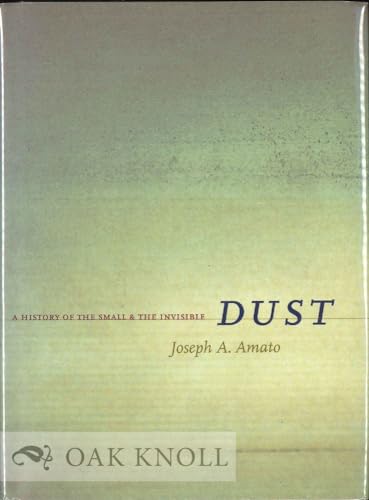
While the story of the big has often been told, the story of the small has not yet even been outlined. With Dust, Joseph Amato enthralls the reader with the first history of the small and the invisible. Dust is a poetic meditation on how dust has been experienced and the small has been imagined across the ages. Examining a thousand years of Western civilization―from the naturalism of medieval philosophy, to the artistry of the Renaissance, to the scientific and industrial revolutions, to the modern worlds of nanotechnology and viral diseases―Dust offers a savvy story of the genesis of the microcosm.
Dust, which fills the deepest recesses of space, pervades all earthly things. Throughout the ages it has been the smallest yet the most common element of everyday life. Of all small things, dust has been the most minute particulate the eye sees and the hand touches. Indeed, until this century, dust was simply accepted as a fundamental condition of life; like darkness, it marked the boundary between the seen and the unseen.
With the full advent of scientific discovery, technological innovation, and social control, dust has been partitioned, dissected, manipulated, and even invented. In place of traditional and generic dust, a highly diverse particulate has been discovered and examined. Like so much else that was once considered minute, dust has been magnified by the twentieth-century transformations of our conception of the small. These transformations―which took form in the laboratory through images of atoms, molecules, cells, and microbes―defined anew not only dust and the physical world but also the human body and mind. Amato dazzles the reader with his account of how this powerful microcosm challenges the imagination to grasp the magnitude of the small, and the infinity of the finite.
Los Angeles Times Best Nonfiction Book of 2000
"synopsis" may belong to another edition of this title.
About the Author
Joseph A. Amato is Dean of Rural and Regional Studies at Southwest State University in Marshall, Minnesota. Some of his most recent titles include Golf Beats Us All (So We Love It) (1997); The Decline of Rural Minnesota (1993); The Great Jerusalem Artichoke Circus: The Buying and Selling of the American Rural Dream (1993); and Victims and Values: A History and Theory of Suffering (1990).
Reviews
"A brisk social, medical and philosophical overview of humanity's relationship to the small and invisible."
Until this century, dust and dirtAmotes, mites, flea parts, skin flecks, pollen, garden dirtAwere the smallest things most people thought about. They seemed omnipresent and ineradicable. Now we vacuum our kitchens, take showers, study quarks and give most dust the brush-off. Speaking up for the little things, Amato (The Great Jerusalem Artichoke Circus), professor of intellectual and cultural history at Minnesota's Southwest State University, offers a book-length meditation on the importance and symbolism of particulate matter in Europe and America. Anthropologist Mary Douglas; medieval historians like Lucien Febvre and Carlo Ginzburg; Renaissance sculptors, glassblowers and alchemists; microscope pioneers Leeuwenhoek and Hooke; and Dolly the cloned sheep all figure in Amato's speedy cultural history. Medieval French folk frequently deloused each other and called their thumbs "louse-killers." Early Victorian urbanization brought Britain filthy slums, along with reformers who tried to clean them up: later on, lightbulbs banished indoor soot. The Dust Bowl years of 1932-1938 darkened the skies of the American Midwest and caused more than half its residents to move away. Amato aims at a broad literary readership, not at historians of science; his synthetic, essayistic bent can make for glib and predictable generalizations ("Until the Industrial Revolution, humanity accepted the cyclical nature of life"). In our century, Amato writes, "smallness and dust have diverged"; by now dust is neither our metaphor for littleness, nor our constant companion. Instead "contemporary people are married to a new microcosm" consisting of things (like viruses) too small to see. Readers who find such a thesis small potatoes may still find themselves enticed by Amato's accounts of the minuscule. 30 line illus. by Abigail Rorer. (Jan.)
Copyright 1999 Reed Business Information, Inc.
Never favored with a great press (except when made of gold or spices), dust finally gets the full social, scientific, and historical treatment. Cultural historian Amato (Southwest State Univ., Minnesota) chooses what lies at the limits of visibility to the naked eye as a cultural turning point. Before Leeuwenhoek, humans accepted dust as the ultimate smallness, an inevitable, sometimes potent, and often inimical presence. Noting distinctions between airborne dust and earthy, excremental dirt, Amato provides memorable descriptions of just how much of both formed the environment of the average medieval peasant, king, or queen. Meanwhile, scholars pondered what lay beyond the visible and speculated on the ultimate constituents of matter, be they Democritus' atoms or the four humors. With the microscope came revelations of a hitherto invisible world. But it was not until the industrial revolution that society began ``the great cleanup'' and medicine discovered the germ theory of disease. Herein lies a paradox dear to Amato: The very inventions that brought light, heat, running water, and sanitation to society created new miasmas and particulate matter to darken and poison the earth. Today we live suspended between an ever-enlarging macrocosm and physicists increasing focus on the smallest of the small. Yet we still fear viruses and prions, toxic waste and radioactive fallout. This fear has inspired an ecological quasi-religion Amato treats with some contempt, observing that believers have redefined contamination and pollution as inorganic, synthetic, and artificial, forgetting that nature is not intrinsically benign. Despite our enlightenment, Amato finds human beings still ``mired'' in bodies and belief systems that defy the new microcosmic reality in favor of myths and magic and the belief in ourselves as the measure of all things. Readers may not agree with Amato's pessimism, but there's no denying he has forcefully underscored just how much humankind has both suffered and feared, celebrated and revered, the visible world of dust. -- Copyright ©1999, Kirkus Associates, LP. All rights reserved.
To call something "dry as dust" is to suggest that it is dull and insignificant. Thus, one might wonder why anybody would write a book about dust. Amato (The Decline of Rural Minnesota), a cultural historian, gives it a noble effort, but, in doing so, stretches his resources. It's not that dust is entirely devoid of interestAit has had a profound effect on human health and hygiene, and you might say that the ultimate fate of the universe depends on how much dust resides unseen in the cosmos. Still, because the topic itself is hardly riveting, Amato places it within the broader context of the history of human understanding of the microcosmos. That's a much bigger subject than the title suggests, and it deserves a more comprehensive treatment than this book attempts. An optional purchase.AGregg Sapp, Univ. of Miami Lib., Coral Gables, FL
Copyright 1999 Reed Business Information, Inc.
Excerpt. © Reprinted by permission. All rights reserved.
FROM THE FIRST CHAPTER: Mothered by the same earth, dust and dirt have different fathers. Dust--finer and more discrete--belongs as much to air as to earth. Dirt--bigger and clumsier--is identified with soil. When wet, dirt reveals a closer kinship to water than to dust. But dirt's real father, which vouches for its closer affinity to the soil, is muck or, to be more precise, excrement. this book is much more about dust than dirt; it is about dust's role as a condition of life and as a measure of the small until the start of the century. Once, not so long ago, dust constituted the finest thing the human eye could see. In the form of gold dust or pollen, as light filaments that covered the skin, or as individual particles that spun int he sunlight, dust was the most minuscule thing people encountered. Like darkness and skin, dust was an omnipresent boundary, in this case between the visible and the invisible. In advanced twentieth-century society, visible dust has been removed from the surface of most things, and the kingdom of dust has been opened to examination by scientific instruments. it has been studied, regulated in industry and society, and controlled in dwellings, in public buildings, and on the streets. Dust, always varied in composition, is now seen as a highly diverse particulate and a matter of sub-microscopic exactness. Along with so many other minute things of the preindustrial world, dust has been swept to the edges of contemporary society and, thus, to the margins of contemporary consciousness. As with all that was once considered really small, dust has been redefined by a great twentieth-century revolution--a revolution of the minuscule. Denied the intellectual fanfare of the astronomical revolution, which removed the earth from the center of the universe and declared the universe infinite, this revolution of the petite declared the infinity of the infinitesimal. It has forced humans to recognize the immensity and might of the small. For the first time ever, at least for those with inquisitive minds, the world below became as vast, fascinating, and powerful as the heavens above. The roots of this revolution lie in early modern history, with the development of finely made human goods and the first microscopic perceptions of reality. It has been sustained with the discovery of microbes and the diagnosis and cure of viral and bacterial diseases; the reading of DNA and the deciphering of genes; and the division and fusion of atoms. Among its consequences was the end of the perennial identification of dust and smallness.
"About this title" may belong to another edition of this title.
Search results for Dust: A History of the Small and the Invisible

Stock Image
Dust: A History of the Small and the Invisible
Published by
University of California Press, 2000
ISBN 10: 0520218752
ISBN 13: 9780520218758
Used
Hardcover
Seller: World of Books (was SecondSale), Montgomery, IL, U.S.A.
Seller rating 5 out of 5 stars

Condition: Good. Rorer, Abigail (illustrator). Item in good condition. Textbooks may not include supplemental items i.e. CDs, access codes etc. Seller Inventory # 00109808310
Stock Image
Dust: A History of the Small and the Invisible
Published by
University of California Press, 2000
ISBN 10: 0520218752
ISBN 13: 9780520218758
Used
Hardcover
Seller: More Than Words, Waltham, MA, U.S.A.
Seller rating 5 out of 5 stars
Condition: Good. Rorer, Abigail (illustrator). A sound copy with only light wear. Overall a solid copy at a great price! Seller Inventory # BOS-N-03g-01888
Stock Image
Dust: A History of the Small and the Invisible
Published by
University of California Press, 2000
ISBN 10: 0520218752
ISBN 13: 9780520218758
Used
Hardcover
Seller: ThriftBooks-Dallas, Dallas, TX, U.S.A.
Seller rating 5 out of 5 stars
Hardcover. Condition: As New. No Jacket. Rorer, Abigail (illustrator). Pages are clean and are not marred by notes or folds of any kind. ~ ThriftBooks: Read More, Spend Less. Seller Inventory # G0520218752I2N00
Stock Image
Dust: A History of the Small and the Invisible
Published by
University of California Press, 2000
ISBN 10: 0520218752
ISBN 13: 9780520218758
Used
Hardcover
Seller: ThriftBooks-Dallas, Dallas, TX, U.S.A.
Seller rating 5 out of 5 stars
Hardcover. Condition: Very Good. No Jacket. Rorer, Abigail (illustrator). Former library book; May have limited writing in cover pages. Pages are unmarked. ~ ThriftBooks: Read More, Spend Less. Seller Inventory # G0520218752I4N10
Seller Image
Dust: A History of the Small and the Invisible
Published by
University of California Press, 2000
ISBN 10: 0520218752
ISBN 13: 9780520218758
Used
Hardcover
Seller: -OnTimeBooks-, Phoenix, AZ, U.S.A.
Seller rating 5 out of 5 stars
Condition: good. Rorer, Abigail (illustrator). A copy that has been read, remains in good condition. All pages are intact, and the cover is intact. The spine and cover show signs of wear. Pages can include notes and highlighting and show signs of wear, and the copy can include "From the library of" labels or previous owner inscriptions. 100% GUARANTEE! Shipped with delivery confirmation, if you're not satisfied with purchase please return item! Ships via media mail. Seller Inventory # OTV.0520218752.G
Stock Image
Dust: A History of the Small and the Invisible
Published by
University of California Press, 2000
ISBN 10: 0520218752
ISBN 13: 9780520218758
Used
Hardcover
Seller: St Vincent de Paul of Lane County, Eugene, OR, U.S.A.
Seller rating 5 out of 5 stars
Condition: Acceptable. Rorer, Abigail (illustrator). BOOK EDGES AND/OR PAGES ARE SHOWING COMMON YELLOWING DUE TO AGE WITH POS.FOXING hardcover 100% of proceeds go to charity! Acceptable reading copy with obvious signs of use, wear, and/or cosmetic issues. Item is complete and remains readable despite notable condition issues. Seller Inventory # 2BB-02-3643
Stock Image
Dust : A History of the Small and the Invisible
Published by
University of California Press, 2000
ISBN 10: 0520218752
ISBN 13: 9780520218758
Used
Hardcover
First Edition
Seller: Better World Books, Mishawaka, IN, U.S.A.
Seller rating 5 out of 5 stars
Condition: Good. Rorer, Abigail (illustrator). 1st Edition. Former library copy. Pages intact with minimal writing/highlighting. The binding may be loose and creased. Dust jackets/supplements are not included. Includes library markings. Stock photo provided. Product includes identifying sticker. Better World Books: Buy Books. Do Good. Seller Inventory # GRP76400893
Stock Image
Dust: A History of the Small and the Invisible
Published by
University of California Press, 2000
ISBN 10: 0520218752
ISBN 13: 9780520218758
Used
Hardcover
Seller: HPB Inc., Dallas, TX, U.S.A.
Seller rating 5 out of 5 stars
hardcover. Condition: Very Good. Rorer, Abigail (illustrator). Connecting readers with great books since 1972! Used books may not include companion materials, and may have some shelf wear or limited writing. We ship orders daily and Customer Service is our top priority! Seller Inventory # S_466356528
Stock Image
Dust: A History of the Small and the Invisible
Published by
University of California Press, 2000
ISBN 10: 0520218752
ISBN 13: 9780520218758
Used
Hardcover
Seller: Midtown Scholar Bookstore, Harrisburg, PA, U.S.A.
Seller rating 5 out of 5 stars
hardcover. Condition: Good. Rorer, Abigail (illustrator). Torn/worn dj. Good hardcover with some shelfwear; may have previous owner's name inside. Standard-sized. Seller Inventory # mon0000356971
Stock Image
Dust : A History of the Small and the Invisible
Published by
University of California Press, 2000
ISBN 10: 0520218752
ISBN 13: 9780520218758
Used
Hardcover
First Edition
Seller: Better World Books Ltd, Dunfermline, United Kingdom
Seller rating 5 out of 5 stars
Condition: Good. Rorer, Abigail (illustrator). 1st Edition. Former library copy. Pages intact with minimal writing/highlighting. The binding may be loose and creased. Dust jackets/supplements are not included. Includes library markings. Stock photo provided. Product includes identifying sticker. Better World Books: Buy Books. Do Good. Seller Inventory # GRP76400893
Buy Used
US$ 6.65
US$ 6.69 shipping
Ships from United Kingdom to U.S.A.
Ships from United Kingdom to U.S.A.
Quantity: 1 available