
Items related to Discovering Dinosaurs: Evolution, Extinction, and the...
Discovering Dinosaurs: Evolution, Extinction, and the Lessons of Prehistory, Expanded and Updated - Softcover
Synopsis
Expanded and updated
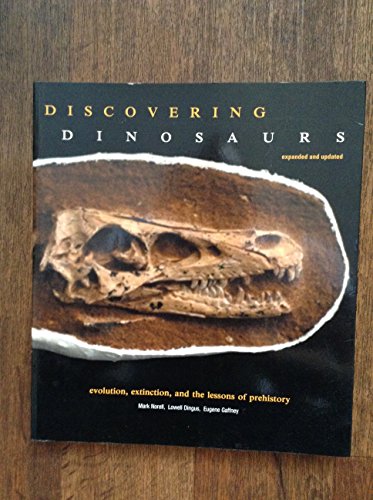
This handsome book addresses the questions of what the fossil record tells us about the evolution and extinction of dinosaurs, what their relationship to the rest of the organic world was, and what we can learn from them about our own place in the history of life on our planet. This edition has been updated throughout, with a new final chapter that details exciting recent discoveries such as the feathered dinosaur fossils in China.
ALERT: ONE LINE IS MISSING FROM PAGE XIII OF THIS BOOK. THE COMPLETE LINE SHOULD READ:
"We hope that the following pages will introduce you to some of these questions."
This error will be corrected in future editions of the book.
This handsome book addresses the questions of what the fossil record tells us about the evolution and extinction of dinosaurs, what their relationship to the rest of the organic world was, and what we can learn from them about our own place in the history of life on our planet. This edition has been updated throughout, with a new final chapter that details exciting recent discoveries such as the feathered dinosaur fossils in China.
ALERT: ONE LINE IS MISSING FROM PAGE XIII OF THIS BOOK. THE COMPLETE LINE SHOULD READ:
"We hope that the following pages will introduce you to some of these questions."
This error will be corrected in future editions of the book.
"synopsis" may belong to another edition of this title.
About the Author
Mark A. Norell, Chairman of the Department of Vertebrate Paleontology at the Museum of Natural History, has been co-leader of the Museum's Gobi Desert yearly expeditions since 1990, in the course of which he has discovered fossil remains of a number of new species of dinosaurs, a dinosaur nesting its eggs, and a unique dinosaur embryo. Eugene S. Gaffney is Curator of Vertebrate Paleontology at the Museum. He is one of the world's leading specialists on fossil turtles. Lowell Dingus is director of the Museum's Fossil Halls renovation. He has served as head geologist on the Gobi Desert expeditions.
Reviews
"Plenty of fine pictures of fossils, tracks, casts, and older graphics fill the well-written, well-designed volume. . . . The authors, three New York paleontologists, offer fresh, compelling arguments that dinosaurs include both Tyrannosaurus rex and modern birds. Birds retained dinosaur forelimb structures, but at last they invented feathers. Our ostriches and canaries are the last dinosaurs."
"About this title" may belong to another edition of this title.
Search results for Discovering Dinosaurs: Evolution, Extinction, and the...

Stock Image
Discovering Dinosaurs: Evolution, Extinction, and the Lessons of Prehistory, Expanded and Updated
Published by
University of California Press, 2000
ISBN 10: 0520225015
ISBN 13: 9780520225015
Used
Paperback
Seller: World of Books (was SecondSale), Montgomery, IL, U.S.A.
Seller rating 5 out of 5 stars

Paperback. Condition: Good. This study addresses the questions of what the fossil record tells us about the evolution and extinction of dinosaurs, what their relationship to the rest of the organic world was, and what we can learn from them about our own place in the history of life on our planet. Seller Inventory # CIN0520225015G
Stock Image
Discovering Dinosaurs : Evolution, Extinction, and the Lessons of Prehistory, Expanded and Updated
Published by
University of California Press, 2000
ISBN 10: 0520225015
ISBN 13: 9780520225015
Used
Softcover
Seller: Better World Books, Mishawaka, IN, U.S.A.
Seller rating 5 out of 5 stars
Condition: Very Good. Exp Upd. Former library copy. Pages intact with possible writing/highlighting. Binding strong with minor wear. Dust jackets/supplements may not be included. Includes library markings. Stock photo provided. Product includes identifying sticker. Better World Books: Buy Books. Do Good. Seller Inventory # 14456015-6
Stock Image
Discovering Dinosaurs : Evolution, Extinction, and the Lessons of Prehistory, Expanded and Updated
Published by
University of California Press, 2000
ISBN 10: 0520225015
ISBN 13: 9780520225015
Used
Softcover
Seller: Better World Books, Mishawaka, IN, U.S.A.
Seller rating 5 out of 5 stars
Condition: Good. Exp Upd. Pages intact with minimal writing/highlighting. The binding may be loose and creased. Dust jackets/supplements are not included. Stock photo provided. Product includes identifying sticker. Better World Books: Buy Books. Do Good. Seller Inventory # 3969609-6
Stock Image
Discovering Dinosaurs: Evolution, Extinction, and the Lessons of Prehistory, Expanded and Updated
Published by
University of California Press (edition Expanded,Updated), 2000
ISBN 10: 0520225015
ISBN 13: 9780520225015
Used
Paperback
Seller: BooksRun, Philadelphia, PA, U.S.A.
Seller rating 5 out of 5 stars
Paperback. Condition: Very Good. Expanded,Updated. It's a well-cared-for item that has seen limited use. The item may show minor signs of wear. All the text is legible, with all pages included. It may have slight markings and/or highlighting. Seller Inventory # 0520225015-11-1
Stock Image
Discovering Dinosaurs: Evolution, Extinction, and the Lessons of Prehistory, Expanded and Updated
Published by
University of California Press, 2000
ISBN 10: 0520225015
ISBN 13: 9780520225015
Used
Paperback
Seller: World of Books Inc, Montgomery, IL, U.S.A.
Seller rating 4 out of 5 stars

Paperback. Condition: Good. This study addresses the questions of what the fossil record tells us about the evolution and extinction of dinosaurs, what their relationship to the rest of the organic world was, and what we can learn from them about our own place in the history of life on our planet. Seller Inventory # CIN0520225015G
Stock Image
Discovering Dinosaurs: Evolution, Extinction, and the Lessons of Prehistory, Expanded and Updated
Published by
University of California Press, 2000
ISBN 10: 0520225015
ISBN 13: 9780520225015
Used
Paperback
Seller: ThriftBooks-Atlanta, AUSTELL, GA, U.S.A.
Seller rating 5 out of 5 stars
Paperback. Condition: Good. No Jacket. Former library book; Pages can have notes/highlighting. Spine may show signs of wear. ~ ThriftBooks: Read More, Spend Less. Seller Inventory # G0520225015I3N10
Stock Image
Discovering Dinosaurs: Evolution, Extinction, and the Lessons of Prehistory, Expanded and Updated
Published by
University of California Press, 2000
ISBN 10: 0520225015
ISBN 13: 9780520225015
Used
Paperback
Seller: ThriftBooks-Dallas, Dallas, TX, U.S.A.
Seller rating 5 out of 5 stars
Paperback. Condition: Good. No Jacket. Former library book; Pages can have notes/highlighting. Spine may show signs of wear. ~ ThriftBooks: Read More, Spend Less. Seller Inventory # G0520225015I3N10
Stock Image
Discovering Dinosaurs: Evolution, Extinction, and the Lessons of Prehistory, Expanded and Updated
Published by
University of California Press, 2000
ISBN 10: 0520225015
ISBN 13: 9780520225015
Used
Paperback
Seller: ThriftBooks-Dallas, Dallas, TX, U.S.A.
Seller rating 5 out of 5 stars
Paperback. Condition: Fair. No Jacket. Former library book; Readable copy. Pages may have considerable notes/highlighting. ~ ThriftBooks: Read More, Spend Less. Seller Inventory # G0520225015I5N10
Stock Image
Discovering Dinosaurs: Evolution, Extinction, and the Lessons of Prehistory, Expanded and Updated
Published by
University of California Press, 2000
ISBN 10: 0520225015
ISBN 13: 9780520225015
Used
Paperback
Seller: ThriftBooks-Atlanta, AUSTELL, GA, U.S.A.
Seller rating 5 out of 5 stars
Paperback. Condition: Good. No Jacket. Pages can have notes/highlighting. Spine may show signs of wear. ~ ThriftBooks: Read More, Spend Less. Seller Inventory # G0520225015I3N00
Stock Image
Discovering Dinosaurs: Evolution, Extinction, and the Lessons of Prehistory, Expanded and Updated
Published by
University of California Press, 2000
ISBN 10: 0520225015
ISBN 13: 9780520225015
Used
Paperback
Seller: ThriftBooks-Phoenix, Phoenix, AZ, U.S.A.
Seller rating 5 out of 5 stars
Paperback. Condition: Good. No Jacket. Pages can have notes/highlighting. Spine may show signs of wear. ~ ThriftBooks: Read More, Spend Less. Seller Inventory # G0520225015I3N00