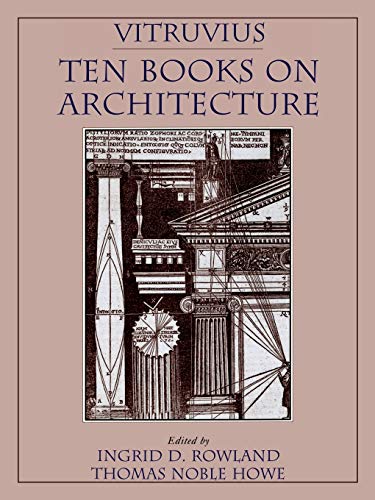
Synopsis
For the first time in more than half a century, Vitruvius' Ten Books on Architecture is being published in English. The only full treatise on architecture and its related arts to survive from classical antiquity, the Architecture libri decem (Ten Books on Architecture) is the single most important work of architectural history in the Western world, having shaped architecture and the image of the architect from the Renaissance to the present. Demonstrating the range of Vitruvius' style, this new edition includes examples from archaeological sites discovered since World War II and not previously published in English language translations. Rowland's new translation and Howe's critical commentary and illustrations provide a new image of Vitruvius, who emerges as an inventive and creative thinker, rather than the normative summarizer, as he was characterized in the Middle Ages and Renaissance. Ingrid D. Rowland is an associate professor of Art History at the University of Chicago. Thomas Noble Howe is a professor in the Department of Art at Southwestern University in Georgetown, Texas.
"synopsis" may belong to another edition of this title.
Book Description
The only full treatise on architecture and its related arts to survive from classical antiquity, the Architectura libri decem (Ten Books on Architecture) is the single most important work of architectural history in the Western world, having shaped humanist architecture and the image of the architect from the Renaissance to the present. This new, critical edition is the first to be published for an English-language audience in more than half a century. Expressing the range of Vitruvius' style, the translation, along with the critical commentary and illustrations, aim to shape a new image of the Vitruvius who emerges as an inventive and creative thinker, rather than the normative summarizer, as he was characterized in the Middle Ages and Renaissance.
Language Notes
Text: English (translation)
Original Language: Latin
"About this title" may belong to another edition of this title.
Other Popular Editions of the Same Title

Search results for Vitruvius: 'Ten Books on Architecture'

Seller Image
Vitruvius: 'Ten Books on Architecture'
Published by
Cambridge University Press, 2001
ISBN 10: 0521002923
ISBN 13: 9780521002929
Used
Softcover
Seller: Goodwill Southern California, Los Angeles, CA, U.S.A.
Seller rating 5 out of 5 stars

Condition: good. Seller Inventory # LACV.0521002923.G
Stock Image
Vitruvius: 'Ten Books on Architecture'
Published by
Cambridge University Press, 2001
ISBN 10: 0521002923
ISBN 13: 9780521002929
Used
Softcover
Seller: Marlton Books, Bridgeton, NJ, U.S.A.
Seller rating 5 out of 5 stars
Condition: Acceptable. Readable, but has significant damage / tears. Has a remainder mark. paperback Used - Acceptable 2001. Seller Inventory # AB-004133
Stock Image
Vitruvius Ten Books on Archite
Published by
Cambridge University Press, 2001
ISBN 10: 0521002923
ISBN 13: 9780521002929
Used
Softcover
Seller: World of Books (was SecondSale), Montgomery, IL, U.S.A.
Seller rating 5 out of 5 stars
Condition: Good. Item in good condition and has highlighting/writing on text. Used texts may not contain supplemental items such as CDs, info-trac etc. Seller Inventory # 00095834412
Stock Image
Vitruvius: 'Ten Books on Architecture'
Published by
Cambridge University Press, 2001
ISBN 10: 0521002923
ISBN 13: 9780521002929
Used
Paperback
Seller: MyLibraryMarket, Waynesville, OH, U.S.A.
Seller rating 5 out of 5 stars
Paperback. Condition: Very Good. ***Please Read*** Name written inside cover - No marks on text - My shelf location - gk-1-a*. Seller Inventory # 250128039
Seller Image
Vitruvius: 'Ten Books on Architecture' (Paperback or Softback)
Published by
Cambridge University Press 1/15/2001, 2001
ISBN 10: 0521002923
ISBN 13: 9780521002929
New
Paperback or Softback
Seller: BargainBookStores, Grand Rapids, MI, U.S.A.
Seller rating 5 out of 5 stars
Paperback or Softback. Condition: New. Vitruvius: 'Ten Books on Architecture'. Book. Seller Inventory # BBS-9780521002929
Seller Image
Vitruvius Ten Books on Architecture
Published by
Cambridge University Press, 2001
ISBN 10: 0521002923
ISBN 13: 9780521002929
New
Softcover
Seller: GreatBookPrices, Columbia, MD, U.S.A.
Seller rating 5 out of 5 stars
Condition: New. Seller Inventory # 694124-n
Stock Image
Vitruvius Ten Books on Architecture: UK & DE sales discount to load
Published by
Cambridge University Press, 2001
ISBN 10: 0521002923
ISBN 13: 9780521002929
New
Softcover
Seller: Lakeside Books, Benton Harbor, MI, U.S.A.
Seller rating 5 out of 5 stars
Condition: New. Brand New! Not Overstocks or Low Quality Book Club Editions! Direct From the Publisher! We're not a giant, faceless warehouse organization! We're a small town bookstore that loves books and loves it's customers! Buy from Lakeside Books! Seller Inventory # OTF-S-9780521002929
Stock Image
Vitruvius: 'Ten Books on Architecture'
Published by
Cambridge University Press, 2001
ISBN 10: 0521002923
ISBN 13: 9780521002929
New
Softcover
Seller: Lucky's Textbooks, Dallas, TX, U.S.A.
Seller rating 5 out of 5 stars
Condition: New. Seller Inventory # ABLIING23Feb2215580238039
Stock Image
Vitruvius: 'Ten Books on Architecture'
Published by
Cambridge University Press, 2001
ISBN 10: 0521002923
ISBN 13: 9780521002929
New
Softcover
Seller: California Books, Miami, FL, U.S.A.
Seller rating 5 out of 5 stars
Condition: New. Seller Inventory # I-9780521002929
Seller Image
Vitruvius Ten Books on Architecture
Published by
Cambridge University Press, 2001
ISBN 10: 0521002923
ISBN 13: 9780521002929
Used
Softcover
Seller: GreatBookPrices, Columbia, MD, U.S.A.
Seller rating 5 out of 5 stars
Condition: As New. Unread book in perfect condition. Seller Inventory # 694124