
Items related to The General History of Astronomy: Volume 2, Planetary...
The General History of Astronomy: Volume 2, Planetary Astronomy from the Renaissance to the Rise of Astrophysics - Hardcover
Synopsis
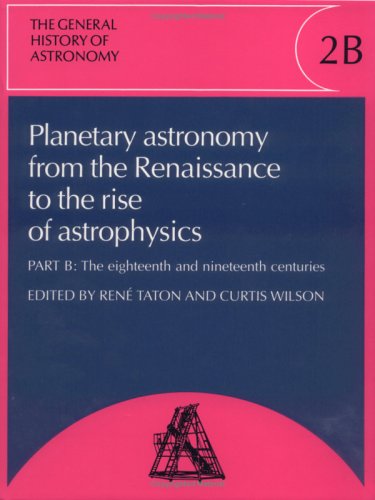
Part B of Planetary Astronomy from the Renaissance to the Rise of Astrophysics continues the history of celestial mechanics and observational discovery through the eighteenth and nineteenth centuries. It provides a synoptic view of the main developments and furnishes details about the lives, ideas, and interactions of the various astronomers involved. Twelve different authors have contributed their expertise to this book that begins with the reception of Newton's inverse-square law. In the remainder, a large place is given to the development of the mathematical theory of celestial mechanics from Clairaut and Euler to LeVerrier, Newcomb, Hill, and Poincaré. This emphasis is balanced by other chapters on observational discoveries and the rapprochement of observation and theory (for instance, the discovery of Uranus and the asteroids, use of Venus transits to refine solar parallax, introduction of the method of least squares, and the development of planetary and satellite ephemerides). Lists of "Further Reading" provide entrée to the literature of the several topics. This book will be of great interest to historians of science and astronomers.
"synopsis" may belong to another edition of this title.
Book Description
Part B of Planetary astronomy from the Renaissance to the rise of astrophysics is the sequel to part A (Tycho Brahe to Newton), and continues the history of celestial mechanics and observational discovery through the eighteenth and nineteenth centuries. Twelve different authors (astronomers, historians of astronomy, celestial mechanists and a statistician) have contributed their expertise in some 18 chapters, each of them intended to be accessible to the interested layman. An initial section deals with stages in the reception of Newton's inverse-square law as exact. In the remainder of the book a large place is given to the development of the mathematical theory of celestial mechanics from Clairaut and Euler to LeVerrier, Newcomb, Hill, and Poincaré - a topic rarely treated at once synoptically and in some detail. This emphasis is balanced by other chapters on observational discoveries and the rapprochement of observation and theory (forinstance, the discovery of Uranus and the asteroids,use of Venus transists to refine solar parallax, introduction of the method of least squares, and the development of planetary and satellite ephemerides). Lists of "Further Reading' provide entrée to the literature of the several topics.
Review
"The editors and authors have succeeded wonderfully in bringing the roots of early planetary astronomy to a wide readership." Sky & Telescope
"...tremendously valuable collection of essays on the history of astronomy by noted scholars." Mercury
"Each of the the 13 chapters (by 11 experts) is a model of concise erudition....summarizes and compares the mathematical methods and empirical results (in the form of astronomical tables) of a lengthy list of astronomers (including Hortensius, Van Lansberge, Horrocks, Wendlin, Boulliau, Shakerly, Wing, Streete, Mercator, the Cassinis, Richer, Picard, De La Hire, Flamsteed, Halley, and Lacaille), who were of considerable significance in their own times but whose contributions have long been ignored by historians too ready to leap from the radical innovations of Kepler at the beginning of the 17th century to those of Newton at the end. Not that Kepler and Newton are absent in this book, for there are, in fact, excellent accounts of the astronomical work of Kepler...and of Newton...." Choice
"...an extremely well-organized account of the development of astronomy in the melting pot during the fertile 17th century....The percentage of technical material, diagrams, tables, and mathematical formulas is large enough to be informative for the astronomer, and small enough--one hopes--not to discourage the general reader from skipping now and then half a column and continue his reading." Kristian Peder Moesgaard, Mathematical Reviews
"...an excellent example of the usefulness of collaboration by experts in presenting material that has been dispersed in a multitude of learned articles and monographs....I can commend his volume to those who seek a well-rounded portrait of a mojor scientific discipline in a crucial transition period." Bernard R. Goldstein, Philosophy of Science
"Together the articles in Volume 2 comprise the best history of celestial mechanics yet written....these books will constitute a substantial contribution to the history of astronomy. The original vision of the project remains intact, and like all good history, this one raises further questions that future astronomers and historians will want to address." Steven J. Dick, Sky & Telescope
"About this title" may belong to another edition of this title.
Search results for The General History of Astronomy: Volume 2, Planetary...

Seller Image
The General History of Astronomy. Volume 2B. Planetary Astronomy from the Renaissance to the Rise of Astrophysics.
Published by
Cambridge University Press, 1995., Cambridge:, 1995
ISBN 10: 0521351685
ISBN 13: 9780521351683
Used
Hardcover
Seller: Jeff Weber Rare Books, Neuchatel, NEUCH, Switzerland
Seller rating 5 out of 5 stars

Royal 8vo. xiii, [1], 281, [1] pp. Illus., index. Black gilt-stamped cloth, dust-jacket. Near fine. ISBN: 0521351685 Hardcover issue. Part B of Planetary Astronomy from the Renaissance to the Rise of Astrophysics continues the history of celestial mechanics and observational discovery through the eighteenth and nineteenth centuries. It provides a synoptic view of the main developments and furnishes details about the lives, ideas, and interactions of the various astronomers involved. Twelve different authors have contributed their expertise to this book that begins with the reception of Newton's inverse-square law. In the remainder, a large place is given to the development of the mathematical theory of celestial mechanics from Clairaut and Euler to LeVerrier, Newcomb, Hill, and Poincare. This emphasis is balanced by other chapters on observational discoveries and the rapprochement of observation and theory (for instance, the discovery of Uranus and the asteroids, use of Venus transits to refine solar parallax, introduction of the method of least squares, and the development of planetary and satellite ephemerides). Lists of "Further Reading" provide entry to the literature of the several topics. This book will be of great interest to historians of science and astronomers." TABLE OF CONTENTS: Part V. Early Phases in the Reception of Newton's Theory: 14. The vortex theory in competition with Newtonian celestial dynamics Eric J. Aiton / 15. The shape of the Earth Seymour L. Chapin / 16. Clairaut and the motion of the lunar apse: The inverse-square law undergoes a test Craig B. Waff / 17. The precession of the equinoxes from Newton to d'Alembert and Euler Curtis Wilson / 18. The solar tables of Lacaille and the lunar tables of Mayer Eric G. Forbes and Curtis Wilson / 19. Predicting the mid-eighteenth-century return of Halley's Comet Craig B. Waff. Part VI. Celestial Mechanics During the Eighteenth Century: 20. The problem of perturbation analytically treated: Euler, Clairaut, d'Alembert Curtis Wilson / 21. The work of Lagrange in celestial mechanics Curtis Wilson / 22. Laplace Bruno Morando. Part VII. Observational Astronomy and the Application of Theory in the Late Eighteenth and Early Nineteenth Century: / 23. Measuring solar parallax: The Venus transits of 1761 and 1769 and their nineteenthâ"century sequels Albert Van Helden / 24. The discovery of Uranus, the Titius-Bode and the asteroids Michael Hoskin / 25. Eighteenthâ"and nineteenth century developments in the theory and practice of orbit determination Brian G. Marsden / 26. The introduction of statistical reasoning into astronomy: from Newton to Poincare Oscar Sheynin / 27. Astronomy and the theory of errors: from the method of averages to the method of least squares F. Schmeidler. Part VIII. The Development of Theory During the Nineteenth Century: / 28. The golden age of celestial mechanics Bruno Morando. Part IX. The Application of Celestial Mechanics to the Solar System to the End of the Nineteenth Century: / 29. Three centuries of lunar and planetary ephemerides and tables Bruno Morando / 30. Satellite ephemerides to 1900 Yoshihide Kozai. Seller Inventory # S13588
Buy Used
US$ 45.00
US$ 28.10 shipping
Ships from Switzerland to U.S.A.
Ships from Switzerland to U.S.A.
Quantity: 1 available
Stock Image
The General History of Astronomy: Volume 2, Planetary Astronomy from the Renaissance to the Rise of Astrophysics
Published by
Cambridge University Press, 1995
ISBN 10: 0521351685
ISBN 13: 9780521351683
New
Hardcover
First Edition
Seller: Mythos Center Books, Frontenac, MN, U.S.A.
Seller rating 5 out of 5 stars
Hardcover. Condition: New. First Edition. Cambridge University Press, 1995. First edition. New, unread copy. From the library of Prof. Roger Stuewer, historian of physics, UMN. Due to size or weight, this item may require additional postage for international or priority shipping. Seller Inventory # 13995
Stock Image
The General History of Astronomy: Planetary Astronomy from the Renaissance to the Rise of Astrophysics (complete in 2 volumes) Part 2A Tycho Brahe to Newton and Part 2B The Eighteenth and Nineteenth Centuries (1st edition hardbacks in very good dust jackets) edited by Rene Taton and Curtis Wilson
Published by
Cambridge University Press, 1995
ISBN 10: 0521351685
ISBN 13: 9780521351683
Used
Hardcover
First Edition
Seller: The Spoken Word, Oxfordshire, United Kingdom
Seller rating 5 out of 5 stars
Hardcover. Condition: Very Good. Dust Jacket Condition: Near Fine. 1st Edition. Published by Cambridge University Press in 1989 and 1995 respectively, here are the first hardback printings of Planetary Astronomy from the Renaissance to the Rise of Astrophysics (The General History of Astronomy Series)complete in 2 volumes edited by Rene Taton and Curtis Wilson. Volume 1 Part 2A Tycho Brahe to Newton Published 1989. Black cloth binding, gilt spine lettering, 274 superbly illustrated pages plus a glossary of technical terms and an index the book is in very good plus condition with the merest hint of a spine slant. The dust jacket is in near fine condition. Volume 2: Part 2B The Eighteenth and Nineteenth Centuries. Published 195. Black cloth binding, gilt spine lettering, 269 superbly illustrated pages, sources plus an additional combined index for both volumes, the book is in very good condition with a spine slant to the top of the spine. The dust jacket is near fine. Both volumes together weigh in excess of 2 kgs when properly wrapped and therefore additional postage MUST be applied to areas OUTSIDE the UK as follows: Europe £5, Rest of the World £8. UK postage is as quoted. Seller Inventory # 13488
Buy Used
US$ 102.95
US$ 58.62 shipping
Ships from United Kingdom to U.S.A.
Ships from United Kingdom to U.S.A.
Quantity: 1 available