
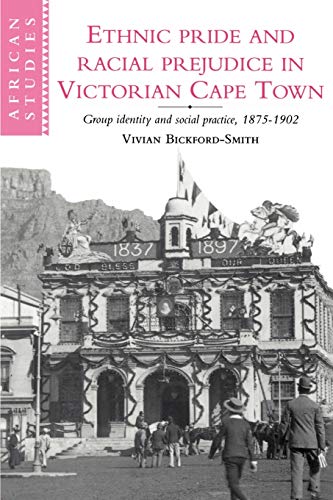
Ethnic Pride and Racial Prejudice in Victorian Cape Town (African Studies, Series Number 81) - Softcover
Synopsis
Nineteenth-century Cape Town, the capital of the British Cape Colony, was conventionally regarded as a liberal oasis in an otherwise racist South Africa. Longstanding British influence was thought to mitigate the racism of the Dutch settlers and foster the development of a sophisticated and colour-blind English merchant class. Vivian Bickford-Smith skilfully interweaves political, economic and social analysis to show that the English merchant class, far from being liberal, were generally as racist as Afrikaner farmers. Theirs was, however, a peculiarly English discourse of race, mobilised around a 'Clean Party' obsessed with sanitation and the dangers posed by 'un-English' Capetonians in a period of rapid urbanisation brought about by the discovery of diamonds and gold in the interior. This original contribution to South African urban history draws on comparative material from other colonial port towns and on relevant studies of the Victorian city.
"synopsis" may belong to another edition of this title.
Book Description
Nineteenth-century Cape Town, the capital of the British Cape Colony, was conventionally regarded as a liberal oasis in an otherwise racist South Africa. Vivian Bickford-Smith skilfully interweaves political, economic and social analysis to show that the English merchant class, far from being liberal, were generally as racist as Afrikaner farmers.
Review
"Bickford-Smith's book is essential reading for any researcher interested in Urban segregation, especially in South African variety. It is throroughly researched, very readable and his arguments have to be yaken seriously. As a first book on this subject, he succeeds in tying many of the threads left loose by earlier historians and he exposes 'liberal' Cape Town of the late nineteenth century in a way never before seen." Keith Tankard, H-Net Reviews
"About this title" may belong to another edition of this title.
Other Popular Editions of the Same Title

Search results for Ethnic Pride and Racial Prejudice in Victorian Cape...

Stock Image
Ethnic Pride and Racial Prejudice in Victorian Cape Town (Paperback)
Published by
Cambridge University Press, Cambridge, 2003
ISBN 10: 0521526396
ISBN 13: 9780521526395
New
Paperback
Seller: Grand Eagle Retail, Bensenville, IL, U.S.A.
Seller rating 5 out of 5 stars

Paperback. Condition: new. Paperback. Nineteenth-century Cape Town, the capital of the British Cape Colony, was conventionally regarded as a liberal oasis in an otherwise racist South Africa. Longstanding British influence was thought to mitigate the racism of the Dutch settlers and foster the development of a sophisticated and colour-blind English merchant class. Vivian Bickford-Smith skilfully interweaves political, economic and social analysis to show that the English merchant class, far from being liberal, were generally as racist as Afrikaner farmers. Theirs was, however, a peculiarly English discourse of race, mobilised around a 'Clean Party' obsessed with sanitation and the dangers posed by 'un-English' Capetonians in a period of rapid urbanisation brought about by the discovery of diamonds and gold in the interior. This original contribution to South African urban history draws on comparative material from other colonial port towns and on relevant studies of the Victorian city. A contribution to South African urban history, focusing on the English merchant class. This item is printed on demand. Shipping may be from multiple locations in the US or from the UK, depending on stock availability. Seller Inventory # 9780521526395
Stock Image
Ethnic Pride and Racial Prejudice in Victorian Cape Town: Group Identity and Social Practice, 1875-1902
Print on DemandSeller: Revaluation Books, Exeter, United Kingdom
Seller rating 5 out of 5 stars
Paperback. Condition: Brand New. 310 pages. 9.00x6.25x0.75 inches. In Stock. This item is printed on demand. Seller Inventory # __0521526396
Buy New
US$ 47.60
US$ 13.30 shipping
Ships from United Kingdom to U.S.A.
Ships from United Kingdom to U.S.A.
Quantity: 1 available
Stock Image
Ethn Pride Racial Prej Vic Cape Twn (African Studies)
Published by
Cambridge University Press 2008-08-21, 2008
ISBN 10: 0521526396
ISBN 13: 9780521526395
New
Paperback
Seller: Chiron Media, Wallingford, United Kingdom
Seller rating 5 out of 5 stars
Paperback. Condition: New. Seller Inventory # 6666-IUK-9780521526395
Buy New
US$ 46.91
US$ 20.61 shipping
Ships from United Kingdom to U.S.A.
Ships from United Kingdom to U.S.A.
Quantity: 10 available
Stock Image
Ethnic Pride and Racial Prejudice in Victorian Cape Town
Published by
Cambridge University Press, 2003
ISBN 10: 0521526396
ISBN 13: 9780521526395
New
Paperback / softback
Seller: THE SAINT BOOKSTORE, Southport, United Kingdom
Seller rating 5 out of 5 stars
Paperback / softback. Condition: New. This item is printed on demand. New copy - Usually dispatched within 5-9 working days. Seller Inventory # C9780521526395
Buy New
US$ 52.85
US$ 20.82 shipping
Ships from United Kingdom to U.S.A.
Ships from United Kingdom to U.S.A.
Quantity: Over 20 available
Stock Image
Ethnic Pride and Racial Prejudice in Victorian Cape Town
Published by
Cambridge University Press CUP, 2003
ISBN 10: 0521526396
ISBN 13: 9780521526395
New
Softcover
Seller: Books Puddle, New York, NY, U.S.A.
Seller rating 4 out of 5 stars

Condition: New. pp. 312 Index. Seller Inventory # 26517669
Stock Image
Ethnic Pride and Racial Prejudice in Victorian Cape Town
Published by
Cambridge University Press, 2003
ISBN 10: 0521526396
ISBN 13: 9780521526395
New
Softcover
Seller: Majestic Books, Hounslow, United Kingdom
Seller rating 4 out of 5 stars
Condition: New. Print on Demand pp. 312 Illus. Seller Inventory # 7363066
Buy New
US$ 70.17
US$ 8.65 shipping
Ships from United Kingdom to U.S.A.
Ships from United Kingdom to U.S.A.
Quantity: 4 available
Seller Image
ETHNIC PRIDE AND RACIAL PREJUDICE IN VICTORIAN CAPE TOWN: Group Identity and Social Practice, 1875-1902 (Signed, Presentation Copy)
Published by
Cambridge Cambridge University Press 2002, 2003
ISBN 10: 0521526396
ISBN 13: 9780521526395
Used
Softcover
First Edition
Signed
Seller: Chaucer Bookshop ABA ILAB, Canterbury, United Kingdom
Seller rating 5 out of 5 stars
FIRST PAPERBACK EDITION, SIGNED, PRESENTATION COPY. Softback with illustrated card covers. 281pp., Indexed, illustrated in b/w. Presentation inscription from Author to half title reads 'To Mark, Forever blowing bubbles while reading this I hope. Warm regards, Vivian'. No other markings or inscriptions. A VERY GOOD COPY. (Shelf 101) ISBN: 0521526396 PLEASE NOTE: Buyer is responsible for any additional duties, taxes, or fees required by recipient's country.** Pictures available upon request.** Visit our homepage for our shop opening hours. Over 20,000 books in stock - come and browse. PayPal, credit and most debit cards welcome. Books posted worldwide. For any queries please contact us direct. Seller Inventory # 60955
Buy Used
US$ 47.96
US$ 33.26 shipping
Ships from United Kingdom to U.S.A.
Ships from United Kingdom to U.S.A.
Quantity: 1 available
Stock Image
Ethnic Pride and Racial Prejudice in Victorian Cape Town
Published by
Cambridge University Press, 2003
ISBN 10: 0521526396
ISBN 13: 9780521526395
New
Softcover
Seller: Biblios, Frankfurt am main, HESSE, Germany
Seller rating 4 out of 5 stars
Condition: New. PRINT ON DEMAND pp. 312, Abbreviations Acknowledgements. Seller Inventory # 18517679
Buy New
US$ 75.22
US$ 11.53 shipping
Ships from Germany to U.S.A.
Ships from Germany to U.S.A.
Quantity: 4 available
Stock Image
Ethnic Pride and Racial Prejudice in Victorian Cape Town (African Studies, Series Number 81)
Published by
Cambridge University Press, 2003
ISBN 10: 0521526396
ISBN 13: 9780521526395
New
paperback
Seller: BennettBooksLtd, Los Angeles, CA, U.S.A.
Seller rating 5 out of 5 stars
paperback. Condition: New. In shrink wrap. Looks like an interesting title! Seller Inventory # Q-0521526396
Stock Image
Ethnic Pride and Racial Prejudice in Victorian Cape Town (Paperback)
Published by
Cambridge University Press, Cambridge, 2003
ISBN 10: 0521526396
ISBN 13: 9780521526395
New
Paperback
Seller: CitiRetail, Stevenage, United Kingdom
Seller rating 5 out of 5 stars
Paperback. Condition: new. Paperback. Nineteenth-century Cape Town, the capital of the British Cape Colony, was conventionally regarded as a liberal oasis in an otherwise racist South Africa. Longstanding British influence was thought to mitigate the racism of the Dutch settlers and foster the development of a sophisticated and colour-blind English merchant class. Vivian Bickford-Smith skilfully interweaves political, economic and social analysis to show that the English merchant class, far from being liberal, were generally as racist as Afrikaner farmers. Theirs was, however, a peculiarly English discourse of race, mobilised around a 'Clean Party' obsessed with sanitation and the dangers posed by 'un-English' Capetonians in a period of rapid urbanisation brought about by the discovery of diamonds and gold in the interior. This original contribution to South African urban history draws on comparative material from other colonial port towns and on relevant studies of the Victorian city. Nineteenth-century Cape Town, the capital of the British Cape Colony, was conventionally regarded as a liberal oasis in an otherwise racist South Africa. Longstanding British influence was thought to mitigate the racism of the Dutch settlers and foster the development of a sophisticated and colour-blind English merchant class. Vivian Bickford-Smith skilfully interweaves political, economic and social analysis to show that the English merchant class, far from being liberal, were generally as racist as Afrikaner farmers. Theirs was, however, a peculiarly English discourse of race, mobilised around a ???Clean Party??? obsessed with sanitation and the dangers posed by ???un-English??? Capetonians in a period of rapid urbanisation brought about by the discovery of diamonds and gold in the interior. This original contribution to South African urban history draws on comparative material from other colonial port towns and on relevant studies of the Victorian city. This item is printed on demand. Shipping may be from our UK warehouse or from our Australian or US warehouses, depending on stock availability. Seller Inventory # 9780521526395
Buy New
US$ 56.84
US$ 49.22 shipping
Ships from United Kingdom to U.S.A.
Ships from United Kingdom to U.S.A.
Quantity: 1 available