
Insurance and Behavioral Economics: Improving Decisions in the Most Misunderstood Industry - Softcover
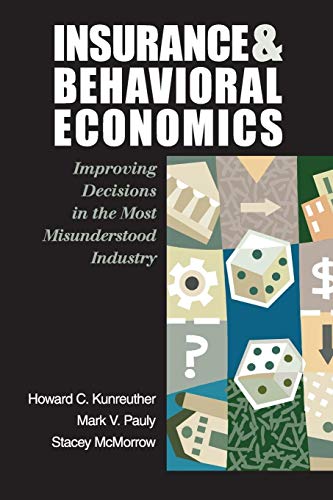
Synopsis
Insurance is an extraordinarily useful tool to manage risk. When it works as intended, it provides financial protection to individuals and a profitable business model for insurance firms and their investors. But it is broadly misunderstood by consumers, regulators, and insurance executives. This book looks at the behavior of individuals at risk, insurance industry decision makers, and policy makers at the local, state, and federal level involved in the selling, buying, and regulating of insurance. It compares their actions to those predicted by benchmark models of choice derived from classical economic theory. When actual choices stray from predictions, the behavior is considered to be anomalous. With considerable sums of money at stake, both in consumer premiums and insurance company payouts, it is important to understand the reasons for anomalous behavior. Howard Kunreuther, Mark Pauly, and Stacey McMorrow examine these anomalies through the lens of behavioral economics, which takes into account emotions, biases, and simplified decision rules. The authors then consider if and how such behavioral anomalies could be modified to improve individual and social welfare. This book is neither a defense of the insurance industry nor an attack on it. Neither is it a consumer guide to purchasing insurance, although the authors believe that consumers will benefit from the insights it contains. Rather, this book describes situations in which both public policy and the insurance industry’s collective posture need to change. This may require incentives, rules, and institutions to help reduce both inefficient and anomalous behavior, thereby encouraging behavior that will improve individual and social welfare.
"synopsis" may belong to another edition of this title.
About the Authors
Howard Kunreuther is the James G. Dinan Professor of Decision Sciences and Business and Public Policy at the Wharton School, University of Pennsylvania and co-director of the Wharton Risk Management and Decision Processes Center. He has a long-standing interest in ways that society can better manage low-probability, high-consequence events. Dr Kunreuther is a member of the World Economic Forum's Global Agenda Council on Insurance and Asset Management for 2011–12 and in 2009–10 served as co-chair of the Forum's Global Agenda Council on Leadership and Innovation for Reducing Risks from Natural Disasters. He is a Fellow of the American Association for the Advancement of Science and a Distinguished Fellow of the Society for Risk Analysis, which honored him with a Distinguished Achievement Award in 2001. Dr Kunreuther also received the 2015 Shin Research Excellence Award from the Geneva Association and the International Insurance Society (IIS), in recognition of his work on the role of public-private partnerships in mitigating and managing risks.
Mark Pauly is the Bendheim Professor in the Department of Health Care Management at the Wharton School of the University of Pennsylvania. One of the leading health economists of the United States, he is a former commissioner on the Physician Payment Review Commission and is a co-editor-in-chief of the International Journal of Health Care Finance and Economics and an associate editor of the Journal of Risk and Uncertainty. Professor Pauly has served on Institute of Medicine panels on public accountability for health insurers under Medicare and on improving the financing of vaccines. He is a former member of the advisory committee to the Agency for Health Care Research and Quality and the Medicare Technical Advisory Panel.
Stacey McMorrow is a research associate in the Health Policy Center at the Urban Institute, Washington, DC. She is currently leading a study of the effects of increased federal funding for community health centers on access to care for low-income individuals and has analyzed the potential impacts of the Affordable Care Act on small employers, individuals and families. Dr McMorrow's PhD dissertation at the University of Pennsylvania explored the market-level effects of health insurance, specifically examining the impact of a large uninsured population on the availability of specialized hospital services as well as on utilization and outcomes for Medicare beneficiaries.
"About this title" may belong to another edition of this title.
Other Popular Editions of the Same Title

Search results for Insurance and Behavioral Economics: Improving Decisions...

Seller Image
Insurance and Behavioral Economics: Improving Decisions in the Most Misunderstood Industry
Published by
Cambridge University Press, 2013
ISBN 10: 0521608260
ISBN 13: 9780521608268
Used
Softcover
Seller: Used Book Company, Egg Harbor Township, NJ, U.S.A.
Seller rating 4 out of 5 stars

Condition: very_good. Shows minimal signs of wear and previous use. Can include notes highlighting. A portion of your purchase benefits nonprofits! - Note: Edition & format may differ from what is shown in stock photo & item details. May not include supplementary material such as toys, access code, dvds, etc. Seller Inventory # 584XQ4000A43_ns
Stock Image
Insurance and Behavioral Economics
Published by
Cambridge University Press, 2013
ISBN 10: 0521608260
ISBN 13: 9780521608268
Used
Paperback
Seller: ThriftBooks-Atlanta, AUSTELL, GA, U.S.A.
Seller rating 5 out of 5 stars

Paperback. Condition: Very Good. No Jacket. May have limited writing in cover pages. Pages are unmarked. ~ ThriftBooks: Read More, Spend Less. Seller Inventory # G0521608260I4N00
Stock Image
Insurance and Behavioral Economics
Published by
Cambridge University Press, 2013
ISBN 10: 0521608260
ISBN 13: 9780521608268
Used
Paperback
Seller: ThriftBooks-Dallas, Dallas, TX, U.S.A.
Seller rating 5 out of 5 stars
Paperback. Condition: Good. No Jacket. Pages can have notes/highlighting. Spine may show signs of wear. ~ ThriftBooks: Read More, Spend Less. Seller Inventory # G0521608260I3N00
Stock Image
Bubbles (Cambridge Reading)
Published by
Cambridge University Press, 2012
ISBN 10: 0521608260
ISBN 13: 9780521608268
Used
Softcover
Seller: Ammareal, Morangis, France
Seller rating 5 out of 5 stars
Softcover. Condition: Très bon. Edition 2012. Ammareal reverse jusqu'à 15% du prix net de cet article à des organisations caritatives. ENGLISH DESCRIPTION Book Condition: Used, Very good. Edition 2012. Ammareal gives back up to 15% of this item's net price to charity organizations. Seller Inventory # F-863-691
Buy Used
US$ 6.73
US$ 19.33 shipping
Ships from France to U.S.A.
Ships from France to U.S.A.
Quantity: 1 available
Stock Image
Insurance and Behavioral Economics: Improving Decisions in the Most Misunderstood Industry
Published by
Cambridge University Press, 2013
ISBN 10: 0521608260
ISBN 13: 9780521608268
Used
Soft cover
Seller: Book Dispensary, Concord, ON, Canada
Seller rating 5 out of 5 stars
Soft cover. Condition: Very Good. VERY GOOD softcover, no marks in text; a very clean, gently used copy. Book. Seller Inventory # 148214
Buy Used
US$ 25.00
US$ 6.99 shipping
Ships from Canada to U.S.A.
Ships from Canada to U.S.A.
Quantity: 1 available
Seller Image
Insurance and Behavioral Economics : Improving Decisions in the Most Misunderstood Industry
Published by
Cambridge University Press, 2013
ISBN 10: 0521608260
ISBN 13: 9780521608268
New
Softcover
Seller: GreatBookPrices, Columbia, MD, U.S.A.
Seller rating 5 out of 5 stars
Condition: New. Seller Inventory # 15948442-n
Seller Image
INSURANCE AND BEHAVIORAL ECONOMICS: IMPROVING DECISIONS IN THE MOST MISUNDERSTOOD INDUSTRY
Published by
CAMBRIDGE U.P., CAMBRIDGE, 2013
ISBN 10: 0521608260
ISBN 13: 9780521608268
New
Rustica (tapa blanda)
Seller: Antártica, Madrid, M, Spain
Seller rating 5 out of 5 stars
Rustica (tapa blanda). Condition: New. Dust Jacket Condition: Nuevo. 01. This book examines the behavior of individuals at risk and insurance industry decision makers involved in selling, buying and regulation. It compares their actions to those predicted by benchmark models of choice derived from classical economic theory. Where actual choices stray from predictions, the behavior is considered to be anomalous. Howard C. Kunreuther, Mark Pauly and Stacey McMorrow attempt to understand why these anomalies occur, in many cases using insights from behavioral economics. The authors then consider if and how such behavioral anomalies could be modified to improve individual and social welfare. This book describes situations in which both public policy and the insurance industrys collective posture need to change. This may require incentives, rules and institutions to help reduce both inefficient and anomalous behavior, thereby encouraging behavior that will improve individual and social welfare. LIBRO. Seller Inventory # 481837
Stock Image
Insurance and Behavioral Economics: Improving Decisions in the Most Misunderstood Industry
Published by
Cambridge University Press, 2013
ISBN 10: 0521608260
ISBN 13: 9780521608268
Used
Paperback
Seller: WorldofBooks, Goring-By-Sea, WS, United Kingdom
Seller rating 5 out of 5 stars
Paperback. Condition: Good. The book has been read but remains in clean condition. All pages are intact and the cover is intact. Some minor wear to the spine. Seller Inventory # GOR014893454
Buy Used
US$ 35.66
US$ 7.84 shipping
Ships from United Kingdom to U.S.A.
Ships from United Kingdom to U.S.A.
Quantity: 1 available
Seller Image
Insurance and Behavioral Economics : Improving Decisions in the Most Misunderstood Industry
Published by
Cambridge University Press, 2013
ISBN 10: 0521608260
ISBN 13: 9780521608268
Used
Softcover
Seller: GreatBookPrices, Columbia, MD, U.S.A.
Seller rating 5 out of 5 stars
Condition: As New. Unread book in perfect condition. Seller Inventory # 15948442
Stock Image
Insurance and Behavioral Economics: Improving Decisions in the Most Misunderstood Industry
Print on DemandSeller: Revaluation Books, Exeter, United Kingdom
Seller rating 5 out of 5 stars
Paperback. Condition: Brand New. 1st edition. 244 pages. 9.00x1.00x6.00 inches. In Stock. This item is printed on demand. Seller Inventory # __0521608260
Buy New
US$ 39.38
US$ 13.52 shipping
Ships from United Kingdom to U.S.A.
Ships from United Kingdom to U.S.A.
Quantity: 1 available