
Items related to Propositional Logic: Deduction and Algorithms (Cambridge...
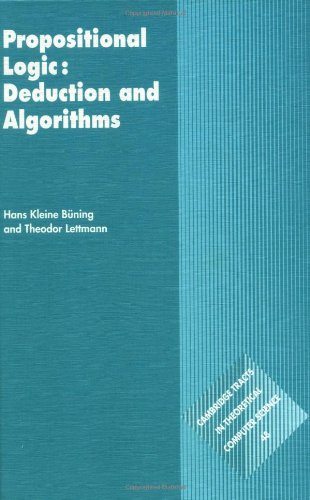
Propositional Logic: Deduction and Algorithms (Cambridge Tracts in Theoretical Computer Science, Series Number 48) - Hardcover
Synopsis
Here is an excellent introduction to classical logic, emphasizing the computational aspects. It addresses the question of whether or not one logical statement follows from another by examining algorithms that test this question in practice. The book moves into issues of complexity and algorithmic analysis that have traditionally not been considered the realm of mathematical logic, but which are vital in areas such as automated reasoning, knowledge engineering, logic programming and AI. These application areas are reflected in the two central themes of the book: satisfiability and derivability. To make the book suitable for teaching and for self-study, the authors provide a systematic account of theoretical results, as well as an exposition of those appropriate algorithms that incorporate them. The algorithms are illustrated with examples drawn from automatic theorem proving.
"synopsis" may belong to another edition of this title.
Book Description
This introduction to classical logic emphasises computational aspects. The authors treat issues of complexity and algorithmic analysis that have traditionally not been considered the realm of mathematical logic, but which are vital in areas such as automated reasoning, knowledge engineering, logic programming and AI.In order to make the book suited for teaching and for self-study, the book includes a systematic account of theoretical results, as well as an exposition of those appropriate algorithms which incorporate them.
"About this title" may belong to another edition of this title.
Search results for Propositional Logic: Deduction and Algorithms (Cambridge...

Seller Image
Propositional Logic: Deduction and Algorithms (Cambridge Tracts in Theoretical Computer Science, Series Number 48)
Published by
Cambridge University Press, 1999
ISBN 10: 0521630177
ISBN 13: 9780521630177
Used
Hardcover
Seller: -OnTimeBooks-, Phoenix, AZ, U.S.A.
Seller rating 5 out of 5 stars

Condition: very_good. Gently read. May have name of previous ownership, or ex-library edition. Binding tight; spine straight and smooth, with no creasing; covers clean and crisp. Minimal signs of handling or shelving. 100% GUARANTEE! Shipped with delivery confirmation, if you're not satisfied with purchase please return item! Ships USPS Media Mail. Seller Inventory # OTV.0521630177.VG