
Items related to What They Did to Princess Paragon
Synopsis
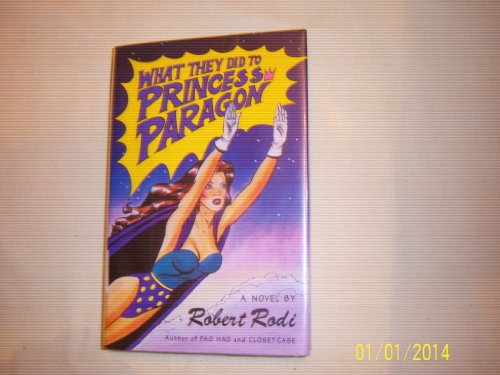
An uproarious novel from a popular gay satirist involves comic book writer-artist Brian Parrish's decision to boost the waning popularity of comicdom's Princess Paragon by making her come out as a lesbian, a decision that sparks hilarious chaos. 10,000 first printing.
"synopsis" may belong to another edition of this title.
Reviews
How the world's greatest comic-book artist, Brian Parrish, a 38-year-old gay man from Manhattan, ends up trapped in a food plant "in the middle of some piddly little college town two hours outside Chicago" is part of the delight of Rodi's new novel. Brian's scheme is to rejuvenate the faltering sales of American comic-book icon Princess Paragon by turning her into the first gay super-hero. His design is modified at every turn by a cast of outrageous characters: Perpetrial Cotton, an African American feminist lesbian whose favorite T-shirt reads "Ferraro for Veep"; Jerome T. Kornacker, a deranged fan upset at what is happening to his longtime fantasy girlfriend; and Heloise Freitag, Brian's chain-smoking publisher. Tightly plotted and consistently amusing, the novel is more farce than satire: Rodi's characters are as cartoonish as his superheroine. "This is real life," Brian says to Jerome as Rodi attempts to inject some pathos into the dialogue. Nothing about the book suggests real life, however, which is exactly the point. Real life is seldom this funny. This is another campy, breezy read from a gay comic writer ( Fag Hag ; Closet Case ) who is quickly developing his own cult following.
Copyright 1994 Reed Business Information, Inc.
Rodi (Closet Case, 1993), the '90s answer to Armistead Maupin and his Tales of the City, provides more frothy entertainment, but his formula is wearing thin. Brian Parrish is a comic-book artist and writer who eagerly accepts the chance to work for Bang, a company that is revitalizing its old superheroes through controversy. His choice to remake Princess Paragon--a wondrous woman who originally came to earth from another planet to battle the evil forces of Hitler and Mussolini--into a lesbian irks many fans, but also draws the attention that chain-smoking Bang publisher Heloise Freitag needs to keep her company afloat. When rabid comic-book aficionado Jerome T. Kornacker, who has considered Princess Paragon his quasi- girlfriend for years, hears of Parrish's plans for his sweetheart, he first writes angry letters, then attends a comic-book convention in order to confront Parrish and force him to change direction. As usual, plot organization is Rodi's strongest skill: Even minor characters have specific problems, and the outcome of those affects the struggle between Parrish and Kornacker. On the repetitive side, this is the third of Rodi's three novels to involve an unforced kidnapping. Characterization is weak, and many attempts at satire fall closer to stereotyping. Kornacker is an overweight loser who lives with his shrewish mother and wears polyester pants; he is such a nonentity that a machine is about to replace him in his job as warehouse night watchman. Perpetrial Cotton, an African-American feminist lesbian hired to edit Parrish's work, is drowning in her own exaggerated attempts at political correctness and urges Parrish to redraw Princess Paragon so that she looks less like Heather Locklear and more like ``a young Vanessa Redgrave.'' A competent and often funny storyteller in need of fresh material. -- Copyright ©1994, Kirkus Associates, LP. All rights reserved.
When gay comic strip artist Brian Parrish is hired to take over "Princess Paragon," an old and fading strip, word soon leaks that he intends to turn her into the first lesbian heroine. Fanatic fan Jerome goes to a convention to confront Parrish. After a series of wild incidents, Parrish holes up in Jerome's home, where he writes one script and Jerome writes another. Meanwhile, Parrish's boss and a black lesbian assistant take over the strip. The characters are zany and the situations zanier as comic strip creators and consumers clash in some very funny scenes. With crisp, naughty dialog and colorful supporting characters, the author of Fag Hag (Dutton, 1992) delivers a rowdy and witty comedy.
Robert H. Donahugh, formerly with Youngstown & Mahoning Cty. P.L., Ohio
Copyright 1994 Reed Business Information, Inc.
The author of Fag Hag (1992) and Closet Case gives us another off-the-wall comic novel that works perfectly because he develops his characters perfectly. Meet fat, reclusive night security guard Jerome T. Komacker, who lives with his mother, Peachy, and for Thursdays, when the new comic books arrive at the town's specialty comics store. Jerome is obsessed with comics, and his favorite character for two decades has been Princess Paragon, a superhero who's a virginal, uh . . . paragon of goodness. Jerome has all but four PP issues. Enter gay comics writer Brian Parrish, who has just signed a lucrative contract with Bang Comics to revitalize the princess' sales, which have slipped into the cellar. Brian intends to fulfill his promise by turning PP into a lesbian. Needless to say, that sets Jerome off a bit, and writer and obsessive reader meet. Jerome's mom, Peachy, is a wonderful minor character, and Brian's colleagues also lend great support. Rodi's third romp will most likely appeal to a much larger audience than the first two because its action is much less gay oriented. Charles Harmon
"About this title" may belong to another edition of this title.
Search results for What They Did to Princess Paragon

Stock Image
What They Did to Princess Paragon
Seller: HPB-Emerald, Dallas, TX, U.S.A.
Seller rating 5 out of 5 stars

hardcover. Condition: Very Good. Connecting readers with great books since 1972! Used books may not include companion materials, and may have some shelf wear or limited writing. We ship orders daily and Customer Service is our top priority! Seller Inventory # S_472027875
Stock Image
What They Did to Princess Paragon
Seller: ThriftBooks-Atlanta, AUSTELL, GA, U.S.A.
Seller rating 5 out of 5 stars
Hardcover. Condition: Good. No Jacket. Pages can have notes/highlighting. Spine may show signs of wear. ~ ThriftBooks: Read More, Spend Less. Seller Inventory # G0525937722I3N00
Stock Image
What They Did to Princess Paragon
Published by
Dutton Adult, 1994
ISBN 10: 0525937722
ISBN 13: 9780525937722
Used
Hardcover
First Edition
Seller: Colewood Books, San Francisco, CA, U.S.A.
Seller rating 5 out of 5 stars
Hardcover. Condition: Like New. 1st Edition. Nearly pristine 1st edition, 1st printing E. P. Dutton hardcover w/ DJ, 1994. Book & DJ as new, unmarked except remainder mark on bottom edge. Free delivery confirmation. Seller Inventory # SKU1006758
Stock Image
What They Did to Princess Paragon
Published by
E P Dutton, New York, New York, U.S.A., 1994
ISBN 10: 0525937722
ISBN 13: 9780525937722
Used
Hardcover
First Edition
Seller: Jen's Books, Douglas, WY, U.S.A.
Seller rating 4 out of 5 stars

Hardcover. Condition: Very Good. Dust Jacket Condition: Very Good. First Edition. Clean, Tight, Square, No markings, Light shelf wear, DJ in protective Mylar. Seller Inventory # 027487
Stock Image
WHAT THEY DID TO PRINCESS PARAGON
Published by
E.P. Dutton & Co. Inc, New York, NY, 1994
ISBN 10: 0525937722
ISBN 13: 9780525937722
Used
Hardcover
Seller: Falls Bookstore, Readsboro, VT, U.S.A.
Seller rating 4 out of 5 stars
Hardcover. Condition: Very Good. Dust Jacket Condition: Very Good. First Edition, First Printing. Blue boards with white cloth spine and gold colored print on spine. Very light rubwear at tips and spine ends. Sound and unmarked. 281 pages. Pictoral dust jacket with purple and black print on front cover and spine. Dj not price clipped. Dj in mylar. Seller Inventory # 008936
Stock Image
What They Did to Princess Paragon
Seller: Willis Monie-Books, ABAA, Cooperstown, NY, U.S.A.
Seller rating 5 out of 5 stars
Hardcover. Condition: Very Good. Dust Jacket Condition: Very Good. First Printing. Seller Inventory # 51499
Stock Image
What They Did to Princess Paragon
Seller: Glands of Destiny First Edition Books, Sedro Woolley, WA, U.S.A.
Seller rating 5 out of 5 stars
Hardcover. Condition: Very Good. Publisher: Dutton, NY, 1994. First Edition, First Printing. FINE- hardcover book in FINE- dust-jacket. Remainder marked. Shelf rub. Not price-clipped. Not a book club edition. Not an ex-library copy. All of our books with dust-jackets are shipped in fresh, archival-safe mylar protective sleeves. Seller Inventory # SKU1023887
Seller Image
What They Did To Princess Paragon
Seller: zenosbooks, San Francisco, CA, U.S.A.
Seller rating 4 out of 5 stars
hardcover. Dust Jacket Condition: Very Good. First Edition. New York. 1994. May 1994. Dutton. 1st Edition. Very Good in Dustjacket.Remainder Mark On Bottom Edge. 0525937722. 281 pages. hardcover. Jacket illustration by Mary Wilshire. keywords: Literature Comics America. DESCRIPTION - The relentlessly irreverent author of FAG HAG and CLOSET CASE is back with a new novel that asks the burning question: Is the world ready for its first lesbian superhero? Brian Parrish, a brash gay cartoonist, is charged with updating the image of Princess Paragon, a creaky and virtuous heroine whose market share is expressed in decimals. His solution: change her hairdo, streamline her Spandex, and haul her out of the closet. It's a blockbuster idea sure to make Brian famous and attract a whole new readership. But for one devoted fan, it's an abomination. Jerome T. Kornacker worships the princess; his bedroom is her shrine. And for Jerome, the only way to save her from sapphic scandal is to put an end to Brian Parrish's career. With this in mind, he stalks Brian at a Chicago comic-book convention, where the cartoonist is scheduled to unveil his princess-cum-dyke. But when the outraged fan confronts his quarry, the result is an odd alliance that neither could have predicted - and that plunks their heroine into a creative Mixmaster. As if Jerome weren't enough to deal with, Brian also must contend with an editor who has her own plans for a politically correct princess; a lover who's absent without leave; and Jerome's mother, a malaprop-spouting demoness in peach. And only when it's too late does Brian understand what he's really done to Princess Paragon. Abounding in high camp, low farce, ferocious wit, and a perversely insistent morality, WHAT THEY DID TO PRINCESS PARAGON further establishes Robert Rodi as one of the most blistering and brilliant satirists of his day. inventory #23889 Very Good in Dustjacket.Remainder Mark On Bottom Edge. Seller Inventory # z23889
Seller Image
What They Did to Princess Paragon a novel
Published by
Dutton, New York, 1994
ISBN 10: 0525937722
ISBN 13: 9780525937722
Used
Hardcover
First Edition
Seller: Bolerium Books Inc., San Francisco, CA, U.S.A.
Seller rating 5 out of 5 stars
Hardcover. 281p., light foxing to cloth spine else good first printing stated in quarter-cloth boards and unclipped dj. Novel featuring a gay cartoonist. Seller Inventory # 36075
Stock Image
What They Did to Princess Paragon
Published by
Dutton, New York, 1994
ISBN 10: 0525937722
ISBN 13: 9780525937722
Used
Hardcover
First Edition
Seller: Michael J. Toth, Bookseller, ABAA, Springtown, PA, U.S.A.
Seller rating 5 out of 5 stars
Hard Cover. Condition: Near Fine. Dust Jacket Condition: Near Fine. First Edition. Authors third book; remainder mark on bottom edge; 281pp. Seller Inventory # 912690