
Items related to Human Evolution (Single Title: Science: Genetics and...
Synopsis
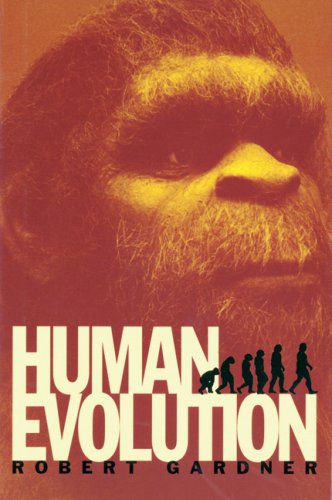
Where do scientists think human beings came from, and how did they come to those conclusions? Find out in this detailed account of the history and findings of paleoanthropology.
"synopsis" may belong to another edition of this title.
About the Author
Robert Gardner is an award-winning author of science books. He is a retired high school teacher of physics, chemistry, and physical sience. He lives with his wife, natalie, and enjoys writing, biking, and doing volunteer work.
Reviews
Gr 7 Up-Gardner sorts out the subtle but significant differences between humans and their fellow primates. Historical charts show what is known of hominid lineage, geologic periods, and human cultural development. Early chapters describe eight different methods used to date fossils, Darwin's and Lamarck's evolution theories, genetic structures, functions and mutations, and how fossil bones are judged to be ape or hominid. Descriptions of significant hominid fossil finds, who made them, and where and when they were found lead to questions concerning the age of humans. Two theories of human population spread are compared. The text, though broken into small sections occasionally relieved by black-and-white illustrations and photographs, can be tedious in its detail. Yet persistence to the end leads to exciting news of another significant fossil discovery made in April of 1999. Analysis of this find may help clarify the picture, which seems to become more complicated with each bit of evidence. A generous list of books, magazine articles, and Web sites encourages additional exploration. While this is a fine overview, other excellent treatments offer more numerous and colorful illustrations. Rod Caird's Ape Man (Macmillan, 1994) and Ian Tattersall's The Human Odyssey (Prentice Hall, 1993; o.p.), while not able to include the very latest data, present much of the same information in a more appealing format. They are as likely to be read for enjoyment as for information while Gardner's work is, comparatively, all business.-Ann G. Brouse, Big Flats Branch Library, NY
Copyright 2000 Cahners Business Information, Inc.
"About this title" may belong to another edition of this title.
Search results for Human Evolution (Single Title: Science: Genetics and...

Stock Image
Human Evolution
Published by
Franklin Watts, NY, 1999
ISBN 10: 0531115283
ISBN 13: 9780531115282
Used
Hardcover
First Edition
Seller: UHR Books, Hollis Center, ME, U.S.A.
Seller rating 5 out of 5 stars

Hardcover. Condition: Very Good +. Dust Jacket Condition: Very Good +. First Edition. A young reader's book on human evolution - discussion geology and culture, Darwin's theory, language, human lineage, etc. Illustrated. Ex-Library. Seller Inventory # 090311
Stock Image
Human Evolution
Seller: Better World Books, Mishawaka, IN, U.S.A.
Seller rating 5 out of 5 stars
Condition: Good. Former library copy. Pages intact with minimal writing/highlighting. The binding may be loose and creased. Dust jackets/supplements are not included. Includes library markings. Stock photo provided. Product includes identifying sticker. Better World Books: Buy Books. Do Good. Seller Inventory # 9285221-75
Stock Image
Human Evolution
Seller: Better World Books, Mishawaka, IN, U.S.A.
Seller rating 5 out of 5 stars
Condition: Good. Pages intact with minimal writing/highlighting. The binding may be loose and creased. Dust jackets/supplements are not included. Stock photo provided. Product includes identifying sticker. Better World Books: Buy Books. Do Good. Seller Inventory # 19014349-75
Stock Image
Human Evolution (Single Title: Science: Genetics and Evolution)
Seller: Robinson Street Books, IOBA, Binghamton, NY, U.S.A.
Seller rating 4 out of 5 stars

Hardcover wit. Condition: Good. Prompt Shipment, shipped in Boxes, Tracking PROVIDEDJuvenile Nonfiction: Good Ex- library Hardcover with Dust Jacket taped to boards, labels, stamps, Pocket, and library notations, minor creasing to dust jacket. Seller Inventory # BING444JM009
Stock Image
Human Evolution (Single Title: Science: Genetics and Evolution)
Seller: The Good Books Store, Chicago, IL, U.S.A.
Seller rating 2 out of 5 stars

Hardcover. Condition: Near Fine. Dust Jacket Condition: Very Good. ex-library book. Archival cover over dust jacket. Seller Inventory # 041999221