
Items related to Development Through Life: A PSYCHOSOCIAL APPROACH
Synopsis
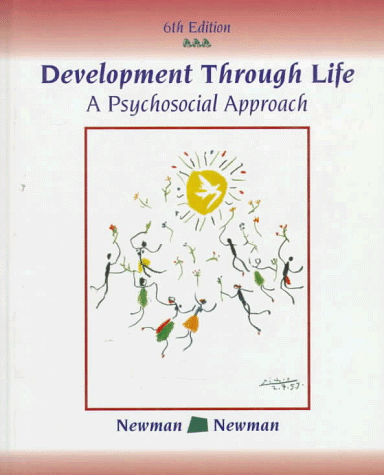
Covering human development in eleven stages (from pregnancy and prenatal development through old age to death), Newman and Newman discuss physical, intellectual, emotional, and social development, addressing themes of continuity and change at each of the life stages. The text contrasts internal (self-directed) and external influences on growth, change, and continuity, and presents the whole person, with extensive consideration given to the family and social environment as important factors in shaping development. Throughout, the authors encourage readers to explore personal questions about development within a framework of scientific knowledge, with particular emphasis on Erik Eriksons model of psychosocial development..Psychosocial theory (used in this text as a guide to organizing information, not as dogma) proposes that cognitive, emotional, and social growth are the result of the interaction between the societal expectations of the individual at each life stage and the competency of the individual to meet each life challenge. A psychosocial crisis is a predictable life tension resulting from the conflict people experience between their own competence and the expectations of society. The psychosocial theoretical framework for studying human development makes Newman and Newman uniquely suited for courses in which social development, family, and environment are considered important in the study of human development.
"synopsis" may belong to another edition of this title.
About the Authors
Barbara M. Newman (Ph.D., University of Michigan) is a professor in the Department of Human Development and Family Studies at the University of Rhode Island. She has also been on the faculty at Russell Sage College and The Ohio State University, where she served as department chair in Human Development and Family Science and as associate provost for Faculty Recruitment and Development. She teaches courses in life-span development, adolescence, family theories, and the research process. Also an active researcher, Dr. Newman's interests focus on parent-child relationships in early adolescence, factors that promote success in the transition to high school, and the use of the cohort sequential design as an approach to the study of development. Her research includes an analysis of the role of family, peer, and school support in the transition to high school (funded by the University of Rhode Island's Research Foundation). For fun, Newman enjoys reading, making up projects with her grandchildren, taking walks along Narragansett Bay and Block Island Sound, and spending time with her family.
Philip R. Newman (Ph.D., University of Michigan) is involved in research on the transition to high school as well as on group identity and alienation. His projects include an analysis of issues related to disrupted transitions in adolescence and early adulthood, and a book about how high schools can meet the psychosocial needs of adolescents. He has taught courses in introductory psychology, adolescence, social psychology, developmental psychology, counseling, and family, school, and community contexts for development. He served as the director for Research and Evaluation of the Young Scholars Program at The Ohio State University and as the director of the Human Behavior Curriculum Project for the American Psychological Association. He is a fellow of the American Psychological Association, the Society for the Psychological Study of Social Issues (SPSSI), and the American Orthopsychiatric Association. For fun, Newman enjoys photography, reading mysteries, attending concerts and Broadway plays, and watching baseball. He home schooled his three children through elementary and middle school. Together, the Newmans have worked on programs to bring low-income minority youths to college and to study the processes involved in their academic success. They are coauthors of 13 books, including a book on theories of human development, and numerous articles in the field of human development.
"About this title" may belong to another edition of this title.
Search results for Development Through Life: A PSYCHOSOCIAL APPROACH

Stock Image
Development Through Life: A Psychosocial Approach
Seller: World of Books (was SecondSale), Montgomery, IL, U.S.A.
Seller rating 5 out of 5 stars

Condition: Good. Item in very good condition! Textbooks may not include supplemental items i.e. CDs, access codes etc. Seller Inventory # 00072469842
Stock Image
Development Through Life: A PSYCHOSOCIAL APPROACH
Seller: Greenworld Books, Arlington, TX, U.S.A.
Seller rating 5 out of 5 stars
Condition: good. Fast Free Shipping â" Good condition. It may show normal signs of use, such as light writing, highlighting, or library markings, but all pages are intact and the book is fully readable. A solid, complete copy that's ready to enjoy. Seller Inventory # GWV.0534233341.G
Stock Image
Development Through Life: A PSYCHOSOCIAL APPROACH
Seller: ThriftBooks-Dallas, Dallas, TX, U.S.A.
Seller rating 5 out of 5 stars
Hardcover. Condition: Good. No Jacket. Pages can have notes/highlighting. Spine may show signs of wear. ~ ThriftBooks: Read More, Spend Less. Seller Inventory # G0534233341I3N00
Stock Image
Development Through Life: A PSYCHOSOCIAL APPROACH
Seller: HPB-Emerald, Dallas, TX, U.S.A.
Seller rating 5 out of 5 stars
hardcover. Condition: Very Good. Connecting readers with great books since 1972! Used books may not include companion materials, and may have some shelf wear or limited writing. We ship orders daily and Customer Service is our top priority! Seller Inventory # S_474013690
Stock Image
Development Through Life: A Psychosocial Approach
Seller: World of Books Inc, Montgomery, IL, U.S.A.
Seller rating 4 out of 5 stars

Hardback. Condition: Good. Covering human development in 11 stages (from pregnancy and prenatal development through old age to death), Newman and Newman discuss physical, intellectual, emotional and social development, addressing themes of continuity and change at each of the life stages. The text contrasts internal (self-directed) and external influences on growth, change and continuity, and presents the whole person, with extensive consideration given to the family and social environment as important factors in shaping development. Throughout, the authors encourage readers to explore personal questions about development within a framework of scientific knowledge, with particular emphasis on Erik Erikson's model of psychosocial development. Seller Inventory # CIN0534233341G
Stock Image
Development Through Life : A Psychosocial Approach
Seller: Better World Books, Mishawaka, IN, U.S.A.
Seller rating 5 out of 5 stars
Condition: Good. 6th Edition. Pages intact with minimal writing/highlighting. The binding may be loose and creased. Dust jackets/supplements are not included. Stock photo provided. Product includes identifying sticker. Better World Books: Buy Books. Do Good. Seller Inventory # 634072-6
Stock Image
Development Through Life: A Psychosocial Approach
Seller: medimops, Berlin, Germany
Seller rating 5 out of 5 stars
Condition: good. Befriedigend/Good: Durchschnittlich erhaltenes Buch bzw. Schutzumschlag mit Gebrauchsspuren, aber vollständigen Seiten. / Describes the average WORN book or dust jacket that has all the pages present. Seller Inventory # M00534233341-G
Buy Used
US$ 5.88
US$ 11.21 shipping
Ships from Germany to U.S.A.
Ships from Germany to U.S.A.
Quantity: 1 available