
Items related to How to Study for Success in Science, Math and Engineering...
Synopsis
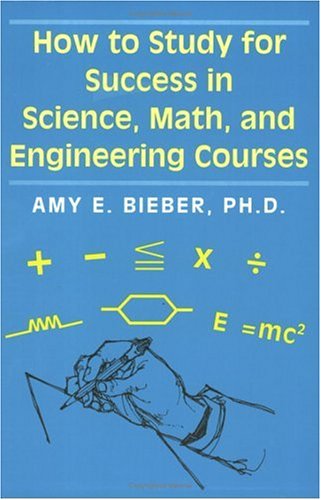
This book is designed to help all students, be they high school or college students, in all classes, but especially those that are the hardest and scariest - the science and math classes. No matter where you or your student are in their academic journey, this book can help them improve their skills and reach their full potential as a student. There are many study guides out their, but not like this one, specifically written to deal with the most difficult part of college academic life. Whether they are heading to community college or the best schools in the country, they can still improve. Go for it! Makes a great gift for any high school or college student.
"synopsis" may belong to another edition of this title.
About the Author
The author is a physics professor and the Director of the Laser and Fiber Optics Technology Program at The City University of New York, Queensborough Community College. She also teaches physics part-time at other institutions. She has worked in the aerospace, laser, semiconductor, and intellectual property industries. She has an A.A.S degree in Music Electronic Technology from Queensborough Community College, where she had a 4.0 average and was inducted into Phi Theta Kappa National Honor Society. She is currently working on the A.S. in Performing Arts/Music. She has a B.S. in Electrical Engineering from The Johns Hopkins University, where she graduated with full honors, was inducted into Eta Kappa Nu, the National Electrical Engineering Honor Society, and was an engineering scholarship recipient. The author has a Ph.D. in Optics from the Institute of Optics at The University of Rochester, where she was a National Science Foundation Graduate Fellowship recipient.
From the Back Cover
This book is intended for college students at all levels who are taking science, math, or engineering courses at all levels. It covers note-taking, problem-solving, exam strategies, study methods, laboratory exercises, technical writing, dealing with math anxiety, how to interact positively with professors, special situations like summer sessions, and positive attitude. This book is intended for students with a wide variety of backgrounds, studying at any institution from community college to the most competitive schools in the country. The techniques and methods described in this book are applicable to the difficult challenges of technical courses at all levels and in all disciplines because they are practices which facilitate learning in general and are not limited to or described in the context of just one scientific area of study. How to Study for Success in Science, Math, and Engineering Courses can help students who are majoring in technical fields or students who need to take a few technical courses for their major. It is written to have a broad-based appeal to a diverse student population. It addresses the problems that come up time and time again, among students at all types of schools: "How do I study for this test? Should I emphasize the notes or the homeworks? How do I go about solving these word problems? How do I know if my answer is right? How do I write a good lab report? I can't "do" math. These equations are so scary!" It was these sorts of questions and comments heard over and over that motivated me to write this book; I know there are many students out there who can benefit from its contents.
Excerpt. © Reprinted by permission. All rights reserved.
Introduction:
This book is intended for college students of all levels and of all majors who are taking technical courses. This includes science, engineering, and math courses, both introductory and advanced. Whether you are a freshman or senior, it is not too late to learn to succeed in technical courses. Whether you have always had trouble with math and science or you did very well in high school and are now being seriously challenged for the first time in college, this book will have something to offer you. I am a physics professor and have taught courses in lasers and optics, acoustics, general physics, and astronomy. I have a Ph.D. in Optics from the University of Rochester Institute of Optics and a Bachelor's Degree in Electrical Engineering from The Johns Hopkins University, as well as several years of industrial engineering/science experience. As a student, I had to develop good study methods in order to do well at these extremely competitive schools. As a professor, my experience with students at different levels of expertise is diverse. I have worked with engineering and science majors in my specialty courses who have taken several semesters of calculus and who plan to go to grad school, and I have worked with arts and marketing majors in my astronomy courses who don't have any college-level math skills and not much of an interest in science. I have learned a lot from my experiences as a student and as a professor dealing with a diverse student population; I wrote this book because students are always asking me how they should study for physics courses. Also, I so often see students struggling and making things difficult for themselves because they don't know how to plan ahead and study properly - I wanted to try to help.
Some people take technical courses because it will become part of their career, and some take them because it is a graduation requirement for their major. Some people are extremely enthusiastic about the courses and some go into the courses assuming that they will hate it and it will be impossible to understand it. The study methods and practices described in this book can be beneficial to all of these kinds of students. Having a good attitude and disciplined study methods are the key to success in college; specific methods for dealing with the special issues which arise in technical courses are described in detail in this book.
"About this title" may belong to another edition of this title.
Search results for How to Study for Success in Science, Math and Engineering...

Stock Image
How to Study for Success in Science, Math and Engineering Courses
Published by
Pearson Learning Solutions, 2005
ISBN 10: 0536943222
ISBN 13: 9780536943224
Used
Paperback
Seller: ThriftBooks-Atlanta, AUSTELL, GA, U.S.A.
Seller rating 5 out of 5 stars

Paperback. Condition: Good. No Jacket. Pages can have notes/highlighting. Spine may show signs of wear. ~ ThriftBooks: Read More, Spend Less. Seller Inventory # G0536943222I3N00