
Items related to Nemesis
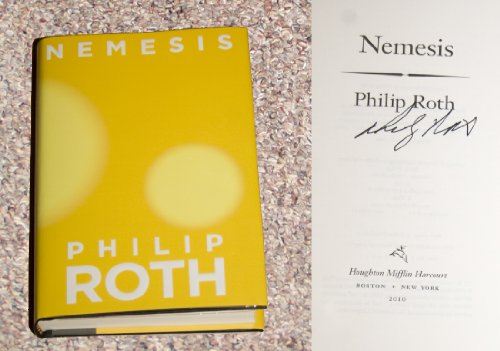
Synopsis
In the "stifling heat of equatorial Newark," a terrifying epidemic is raging, threatening the children of the New Jersey city with maiming, paralysis, lifelong disability, and even death. This is the startling theme of Philip Roth’s wrenching new book: a wartime polio epidemic in the summer of 1944 and the effect it has on a closely knit, family-oriented Newark community and its children.
At the center of Nemesis is a vigorous, dutiful twenty-three-year-old playground director, Bucky Cantor, a javelin thrower and weightlifter, who is devoted to his charges and disappointed with himself because his weak eyes have excluded him from serving in the war alongside his contemporaries. Focusing on Cantor’s dilemmas as polio begins to ravage his playground—and on the everyday realities he faces—Roth leads us through every inch of emotion such a pestilence can breed: the fear, the panic, the anger, the bewilderment, the suffering, and the pain.Moving between the smoldering, malodorous streets of besieged Newark and Indian Hill, a pristine children’s summer camp high in the Poconos—whose "mountain air was purified of all contaminants"—Roth depicts a decent, energetic man with the best intentions struggling in his own private war against the epidemic. Roth is tenderly exact at every point about Cantor’s passage into personal disaster, and no less exact about the condition of childhood.Through this story runs the dark questions that haunt all four of Roth’s late short novels, Everyman, Indignation, The Humbling, and now Nemesis: What kind of accidental choices fatally shape a life? How does the individual withstand the onslaught of circumstance?"synopsis" may belong to another edition of this title.
About the Author
PHILIP ROTH (1933–2018) won the Pulitzer Prize for American Pastoral in 1997. In 1998 he received the National Medal of Arts at the White House and in 2002 the highest award of the American Academy of Arts and Letters, the Gold Medal in Fiction, previously awarded to John Dos Passos, William Faulkner and Saul Bellow, among others. He twice won the National Book Award, the PEN/Faulkner Award, and the National Book Critics Circle Award. In 2005 The Plot Against America received the Society of American Historians’ prize for “the outstanding historical novel on an American theme for 2003–2004” and the W.H. Smith Award for the Best Book of the Year, making Roth the first writer in the forty-six-year history of the prize to win it twice.
In 2005 Roth became the third living American writer to have his works published in a comprehensive, definitive edition by the Library of America. In 2011 he received the National Humanities Medal at the White House, and was later named the fourth recipient of the Man Booker International Prize. In 2012 he won Spain’s highest honor, the Prince of Asturias Award, and in 2013 he received France’s highest honor, Commander of the Legion of Honor.
Reviews
Roth continues his string of small, anti–Horatio Alger novels (The Humbling; etc.) with this underwhelming account of Bucky Cantor, the young playground director of the Chancellor Avenue playground in 1944 Newark. When a polio outbreak ravages the kids at the playground, Bucky, a hero to the boys, becomes spooked and gives in to the wishes of his fiancée, who wants him to take a job at the Pocono summer camp where she works. But this being a Roth novel, Bucky can't hide from his fate. Fast-forward to 1971, when Arnie Mesnikoff, the subtle narrator and one of the boys from Chancellor, runs into Bucky, now a shambles, and hears the rest of his story of piercing if needless guilt, bad luck, and poor decisions. Unfortunately, Bucky's too simple a character to drive the novel, and the traits that make him a good playground director--not very bright, quite polite, beloved, straight thinking--make him a lackluster protagonist. For Roth, it's surprisingly timid.
Copyright © Reed Business Information, a division of Reed Elsevier Inc. All rights reserved.
*Starred Review* The fourth in the great and undiminished Roth’s recent cycle of short novels follows Everyman (2006), Indignation (2008), and The Humbug (2009), and as exceptional as those novels are, this latest in the series far exceeds its predecessors in both emotion and intellect. In general terms, the novel is a staggering visit to a time and place when a monumental health crisis dominated the way people led their day-to-day lives. Newark, New Jersey, in the early 1940s (a common setting for this author) experienced, as the war in Europe was looking better for the Allies, a scare as deadly as warfare. The city has been hit by an epidemic of polio. Of course, at that time, how the disease spread and its cure were unknown. The city is in a panic, with residents so suspicious of other individuals and ethnic groups that emotions quickly escalate into hostility and even rage. Our hero, and he proves truly heroic, is Bucky Canter, playground director in the Jewish neighborhood of Newark. As the summer progresses, Bucky sees more and more of his teenage charges succumb to the disease. When an opportunity presents itself to leave the city for work in a Catskills summer camp, Bucky is torn between personal safety and personal duty. What happens is heartbreaking, but the joy of having met Bucky redeems any residual sadness. --Brad Hooper
"About this title" may belong to another edition of this title.
Search results for Nemesis

Stock Image
Nemesis
Seller: World of Books (was SecondSale), Montgomery, IL, U.S.A.
Seller rating 5 out of 5 stars

Hardback. Condition: Good. NATIONAL BESTSELLER - Set in a close-knit Newark neighborhood during a terrifying polio outbreak in 1944, a book that] has the elegance of a fable and the tragic inevitability of a Greek drama (The New Yorker)--from the Pulitzer Prize-winning author of American Pastoral. Bucky Cantor is a vigorous, dutiful twenty-three-year-old playground director during the summer of 1944. A javelin thrower and weightlifter, he is disappointed with himself because his weak eyes have excluded him from serving in the war alongside his contemporaries. As the devastating disease begins to ravage Bucky's playground, Roth leads us through every inch of emotion such a pestilence can breed: fear, panic, anger, bewilderment, suffering, and pain. Moving between the streets of Newark and a pristine summer camp high in the Poconos, Nemesis tenderly and startlingly depicts Cantor's passage into personal disaster, the condition of childhood, and the painful effect that the wartime polio epidemic has on a closely-knit, family-oriented Newark community and its children. Seller Inventory # 00089134930
Stock Image
Nemesis
Published by
Houghton Mifflin Harcourt, 2010
ISBN 10: 0547318359
ISBN 13: 9780547318356
Used
Hardcover
Seller: Used Book Company, Egg Harbor Township, NJ, U.S.A.
Seller rating 5 out of 5 stars
Condition: Fair. Former library copy. Shows considerable signs of wear and previous use. Can include notes/highlighting. A portion of your purchase benefits nonprofits! - Note: Edition & format may differ from what is shown in stock photo & item details. May not include supplementary material (toys, access code, dvds, etc). Seller Inventory # ubc.0547318359.ACC
Stock Image
Nemesis
Published by
Houghton Mifflin Harcourt, 2010
ISBN 10: 0547318359
ISBN 13: 9780547318356
Used
Hardcover
Seller: More Than Words, Waltham, MA, U.S.A.
Seller rating 5 out of 5 stars
Condition: Good. . Good. All orders guaranteed and ship within 24 hours. Before placing your order for please contact us for confirmation on the book's binding. Check out our other listings to add to your order for discounted shipping. Seller Inventory # WAL-A-4f-002240
Stock Image
Nemesis
Published by
Houghton Mifflin Harcourt, 2010
ISBN 10: 0547318359
ISBN 13: 9780547318356
Used
Hardcover
Seller: More Than Words, Waltham, MA, U.S.A.
Seller rating 5 out of 5 stars
Condition: Very Good. . . All orders guaranteed and ship within 24 hours. Before placing your order for please contact us for confirmation on the book's binding. Check out our other listings to add to your order for discounted shipping. Seller Inventory # WAL-D-5h-002021
Stock Image
Nemesis
Published by
Houghton Mifflin Harcourt (edition 1), 2010
ISBN 10: 0547318359
ISBN 13: 9780547318356
Used
Hardcover
Seller: BooksRun, Philadelphia, PA, U.S.A.
Seller rating 5 out of 5 stars
Hardcover. Condition: Fair. 1. With dust jacket. The item might be beaten up but readable. May contain markings or highlighting, as well as stains, bent corners, or any other major defect, but the text is not obscured in any way. Seller Inventory # 0547318359-7-1-29
Stock Image
Nemesis
Published by
Houghton Mifflin Harcourt, 2010
ISBN 10: 0547318359
ISBN 13: 9780547318356
Used
Hardcover
First Edition
Seller: The Maryland Book Bank, Baltimore, MD, U.S.A.
Seller rating 5 out of 5 stars
hardcover. Condition: Very Good. First Edition. Used - Very Good. Seller Inventory # 11-M-2-0217
Stock Image
Nemesis
Published by
Houghton Mifflin Harcourt, 2010
ISBN 10: 0547318359
ISBN 13: 9780547318356
Used
Hardcover
Seller: ThriftBooks-Atlanta, AUSTELL, GA, U.S.A.
Seller rating 5 out of 5 stars
Hardcover. Condition: Very Good. No Jacket. Former library book; May have limited writing in cover pages. Pages are unmarked. ~ ThriftBooks: Read More, Spend Less. Seller Inventory # G0547318359I4N10
Stock Image
Nemesis
Published by
Houghton Mifflin Harcourt, 2010
ISBN 10: 0547318359
ISBN 13: 9780547318356
Used
Hardcover
Seller: ThriftBooks-Dallas, Dallas, TX, U.S.A.
Seller rating 5 out of 5 stars
Hardcover. Condition: Very Good. No Jacket. Former library book; May have limited writing in cover pages. Pages are unmarked. ~ ThriftBooks: Read More, Spend Less. Seller Inventory # G0547318359I4N10
Stock Image
Nemesis
Seller: World of Books Inc, Montgomery, IL, U.S.A.
Seller rating 4 out of 5 stars

Hardback. Condition: Good. NATIONAL BESTSELLER - Set in a close-knit Newark neighborhood during a terrifying polio outbreak in 1944, a book that] has the elegance of a fable and the tragic inevitability of a Greek drama (The New Yorker)--from the Pulitzer Prize-winning author of American Pastoral. Bucky Cantor is a vigorous, dutiful twenty-three-year-old playground director during the summer of 1944. A javelin thrower and weightlifter, he is disappointed with himself because his weak eyes have excluded him from serving in the war alongside his contemporaries. As the devastating disease begins to ravage Bucky's playground, Roth leads us through every inch of emotion such a pestilence can breed: fear, panic, anger, bewilderment, suffering, and pain. Moving between the streets of Newark and a pristine summer camp high in the Poconos, Nemesis tenderly and startlingly depicts Cantor's passage into personal disaster, the condition of childhood, and the painful effect that the wartime polio epidemic has on a closely-knit, family-oriented Newark community and its children. Seller Inventory # CIN0547318359G
Stock Image
Nemesis
Published by
Houghton Mifflin Harcourt Publishing Company, 2010
ISBN 10: 0547318359
ISBN 13: 9780547318356
Used
Hardcover
Seller: Better World Books, Mishawaka, IN, U.S.A.
Seller rating 5 out of 5 stars
Condition: Good. First. Former library copy. Pages intact with minimal writing/highlighting. The binding may be loose and creased. Dust jackets/supplements are not included. Includes library markings. Stock photo provided. Product includes identifying sticker. Better World Books: Buy Books. Do Good. Seller Inventory # GRP37874605