Items related to Night of the Republic
Synopsis
An urgent and timely collection by one of America’s most inventive and accessible poets
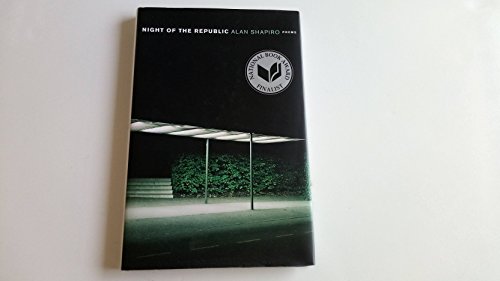
In Night of the Republic, Alan Shapiro takes us on an unsettling night tour of America’s public places—a gas station restroom, shoe store, convention hall, and race track among others—and in stark Edward Hopper–like imagery reveals the surreal and dreamlike features of these familiar but empty night spaces. Shapiro finds in them not the expected alienation but rather an odd, companionable solitude rising up from the quiet emptiness.
In other poems, Shapiro writes movingly of his 1950s and 60s childhood in Brookline, Massachusetts, with special focus on the house he grew up in. These meditations, always inflected with Shapiro’s quick wit and humor, lead to recollections of tragic and haunting events such as the Cuban missile crisis and the assassination of JFK. While Night of the Republic is Shapiro’s most ambitious work to date, it is also his most timely and urgent for the acute way it illuminates the mingling of private obsessions with public space.
"synopsis" may belong to another edition of this title.
From the Back Cover
Praise for Alan Shapiro
“What makes Shapiro so important to American poetry right now is the success with which he’s taken over the territory of fiction writers. While his poems maintain the compression and intensity of lyric, they also open to the twists and bursts of colloquial American speech, that mongrel medium with which we craft our lives together . . . His poems are both artful and unpretentious.”—Boston Review
[Shapiro] seeks what lies at the deepest level of the human heart.”—Chicago Tribune Books
“Mr. Shapiro is a shrewd and sympathetic moralist. He never trivializes his subjects with high-minded flourishes or stylistic gimmicks . . . [H]is seriousness is admirable . . . [and his] poems are not likely to be forgotten.”—New York Times
“[In Shapiro’s poems], the intensity of love at its height—love of another person, love of life itself—is what stays with the reader, with a depth and density that [is] one of Shapiro’s more outstanding achievements.”—Tikkun
“[Shapiro holds] fast to love and joy in an often unjust, brutal world.”—Washington Post
About the Author
ALAN SHAPIRO is the William R. Kenan Jr. Distinguished Professor of English and Creative Writing at the University of North Carolina, Chapel Hill. He is a former recipient of the Kingsley Tufts Award and the Los Angeles Book Prize, was a finalist for the National Book Critics Circle Award, and is a fellow in the American Academy of Arts and Sciences.
"About this title" may belong to another edition of this title.
- PublisherHoughton Mifflin Harcourt
- Publication date2012
- ISBN 10 0547329709
- ISBN 13 9780547329703
- BindingHardcover
- LanguageEnglish
- Edition number1
- Number of pages80
- Rating
Buy New
Learn more about this copy
US$ 19.67
Shipping:
FREE
Within U.S.A.
Top Search Results from the AbeBooks Marketplace
Stock Image
Night of the Republic
Published by
Houghton Mifflin Harcourt, 2012
ISBN 10: 0547329709
ISBN 13: 9780547329703
Used
Hardcover
Seller: Gulf Coast Books, Memphis, TN, U.S.A.
Seller rating 5 out of 5 stars

hardcover. Condition: Fair. Seller Inventory # 0547329709-4-32585857
Quantity: 1 available
Stock Image
Night of the Republic
Published by
Houghton Mifflin Harcourt Publishing Company, 2012
ISBN 10: 0547329709
ISBN 13: 9780547329703
Used
Hardcover
Seller: Better World Books: West, Reno, NV, U.S.A.
Seller rating 5 out of 5 stars
Condition: Good. Former library book; may include library markings. Used book that is in clean, average condition without any missing pages. Seller Inventory # GRP98545929
Quantity: 1 available
Stock Image
Night of the Republic
Published by
Houghton Mifflin Harcourt Publishing Company, 2012
ISBN 10: 0547329709
ISBN 13: 9780547329703
Used
Hardcover
Seller: Better World Books, Mishawaka, IN, U.S.A.
Seller rating 5 out of 5 stars
Condition: Very Good. Former library book; may include library markings. Used book that is in excellent condition. May show signs of wear or have minor defects. Seller Inventory # 4029024-75
Quantity: 1 available
Stock Image
Night of the Republic
Published by
Houghton Mifflin Harcourt Publishing Company, 2012
ISBN 10: 0547329709
ISBN 13: 9780547329703
Used
Hardcover
Seller: Better World Books, Mishawaka, IN, U.S.A.
Seller rating 5 out of 5 stars
Condition: Good. Former library book; may include library markings. Used book that is in clean, average condition without any missing pages. Seller Inventory # GRP98545929
Quantity: 2 available
Stock Image
Night of the Republic
Published by
Houghton Mifflin Harcourt, 2012
ISBN 10: 0547329709
ISBN 13: 9780547329703
Used
Hardcover
Seller: Wonder Book, Frederick, MD, U.S.A.
Seller rating 5 out of 5 stars
Condition: Very Good. Very Good condition. Very Good dust jacket. A copy that may have a few cosmetic defects. May also contain light spine creasing or a few markings such as an owner's name, short gifter's inscription or light stamp. Seller Inventory # N02N-00410
Quantity: 1 available
Stock Image
Night of the Republic
Seller: ThriftBooks-Dallas, Dallas, TX, U.S.A.
Seller rating 5 out of 5 stars
Hardcover. Condition: Very Good. No Jacket. May have limited writing in cover pages. Pages are unmarked. ~ ThriftBooks: Read More, Spend Less 1. Seller Inventory # G0547329709I4N00
Quantity: 1 available
Stock Image
Night of the Republic
Seller: ThriftBooks-Dallas, Dallas, TX, U.S.A.
Seller rating 5 out of 5 stars
Hardcover. Condition: Good. No Jacket. Former library book; Pages can have notes/highlighting. Spine may show signs of wear. ~ ThriftBooks: Read More, Spend Less 1. Seller Inventory # G0547329709I3N10
Quantity: 1 available
Stock Image
Night of the Republic
Seller: ThriftBooks-Atlanta, AUSTELL, GA, U.S.A.
Seller rating 5 out of 5 stars
Hardcover. Condition: Very Good. No Jacket. May have limited writing in cover pages. Pages are unmarked. ~ ThriftBooks: Read More, Spend Less 1. Seller Inventory # G0547329709I4N00
Quantity: 1 available
Stock Image
Night of the Republic
Published by
Houghton Mifflin Harcourt, 2012
ISBN 10: 0547329709
ISBN 13: 9780547329703
Used
Hardcover
Seller: St Vincent de Paul of Lane County, Eugene, OR, U.S.A.
Seller rating 5 out of 5 stars
Condition: Good. THIS IS A DONATED EX LIBRARY BOOK THAT REMAINS IN COMPLETE AND GREAT CONDITION FOR YOUR ENJOYMENT. THERE MAY ALSO BE AN IDENTIFIENG STICKER ON IT. Former Library book. hardcover 100% of proceeds go to charity! Good condition with all pages in tact. Item shows signs of use and may have cosmetic defects. Seller Inventory # A-04-4722
Quantity: 1 available
Stock Image
Night of the Republic
Published by
Houghton Mifflin Harcourt, 2012
ISBN 10: 0547329709
ISBN 13: 9780547329703
Used
Hardcover
Seller: Powell's Bookstores Chicago, ABAA, Chicago, IL, U.S.A.
Seller rating 5 out of 5 stars
Condition: Used - Like New. 2012. Hardcover. Small remainder mark. Fine. Dust Jacket is Fine. Seller Inventory # C37424
Quantity: 7 available