
Items related to Solo
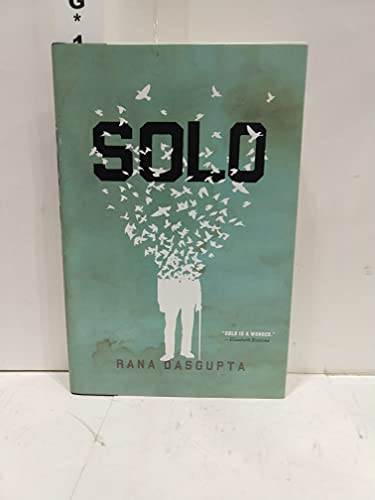
Synopsis
With an imaginative audacity and lyrical brilliance that puts him in the company of David Mitchell and Aleksandar Hemon, Rana Dasgupta paints a portrait of a century though the story of a hundred-year-old blind Bulgarian man in a first novel that announces the arrival of an exhilarating new voice in fiction.
In the first movement of Solo we meet Ulrich, the son of a railroad engineer, who has two great passions: the violin and chemistry. Denied the first by his father, he leaves for the Berlin of Einstein and Fritz Haber to study the latter. His studies are cut short when his father’s fortune evaporates, and he must return to Sofia to look after his parents. He never leaves Bulgaria again. Except in his daydreams—and it is those dreams we enter in the volatile second half of the book. In a radical leap from past to present, from life lived to life imagined, Dasgupta follows Ulrich’s fantasy children, born of communism but making their way into a post-communist world of celebrity and violence.
Intertwining science and heartbreak, the old world and the new, the real and imagined, Solo is a virtuoso work.
“Utterly unforgettable in its humanity.” —The Guardian
"synopsis" may belong to another edition of this title.
From the Inside Flap
With imaginative audacity and lyrical brilliance, Rana Dasgupta paints a portrait of a century through the story of a hundred-yearold blind Bulgarian man in a first novel that confirms the arrival of an exhilarating new voice in fiction.
In the first movement of Solo we meet Ulrich, the son of a railroad engineer, who has two great passions: the violin and chemistry. Denied the first by his father, he leaves for the Berlin of Einstein and Fritz Haber to study the latter. His studies are cut short when his father s fortune evaporates, and he must return to Sofia to look after his parents. He never leaves Bulgaria again. Except in his daydreams and it is those dreams we enter in the volatile second half of the book. In a radical leap from past to present, from life lived to life imagined, Dasgupta follows Ulrich s fantasy children, born of communism but making their way into a post-communist world of celebrity and violence.
Intertwining science and heartbreak, the old world and the new, the real and the imagined, Solo is a virtuoso work.
In the first movement of Solo we meet Ulrich, the son of a railroad engineer, who has two great passions: the violin and chemistry. Denied the first by his father, he leaves for the Berlin of Einstein and Fritz Haber to study the latter. His studies are cut short when his father s fortune evaporates, and he must return to Sofia to look after his parents. He never leaves Bulgaria again. Except in his daydreams and it is those dreams we enter in the volatile second half of the book. In a radical leap from past to present, from life lived to life imagined, Dasgupta follows Ulrich s fantasy children, born of communism but making their way into a post-communist world of celebrity and violence.
Intertwining science and heartbreak, the old world and the new, the real and the imagined, Solo is a virtuoso work.
Reviews
Starred Review. Winner of the U.K.'s Commonwealth Prize, Dasgupta's second book (after Tokyo Canceled) is bold, enigmatic, and thought-provoking. After his pragmatic father crushes Ulrich's passion for music, he turns to chemistry, a subject that takes him to Berlin, "the capital of world science," during the ebb of the Ottoman Empire. He works alongside researchers on the forefront of discovery and shares the halls with Albert Einstein. But WWI forces him back home to Bulgaria and into a bookkeeping job at a chemical plant, where years of political upheavals leading to communism drive Ulrich into a private world of experimentation that ends decades later when he's blinded in an accident. Yet his mind remains very much alive, and the "second movement" of the book reveals a richly imagined world involving a Bulgarian musical prodigy, an American executive, and Georgian siblings whose lives all intersect in New York. With this ambitious structure, Dasgupta's subtle architecture gives rise to questions of modernity, memory, and human failures. Lucid prose and a narrative scheme both demanding and inchoate reveal a writer beginning to deploy his considerable powers. (Feb.)
(c) Copyright PWxyz, LLC. All rights reserved.
Following his critically acclaimed debut, Tokyo Cancelled (2005), Dasgupta presents two loosely connected novels. The first, set in Bulgaria, follows Ulrich, from privileged boyhood at the dawn of the last century to destitute old age. As decades evaporate in a whirl of revolution, war, and political upheaval, Ulrich’s possibilities shrink and his life grows increasingly narrow. Yet the meagerness of his circumstances belies the richness of his inner daydreams, which form the second half of the novel. A new set of characters, vividly imagined by Ulrich, ultimately collide in modern-day New York. (One is a writer, allowing Dasgupta to flex his considerable poetic talent.) The first half moves at a stately pace, while the second throbs to a twenty-first-century beat, with pieces of Ulrich’s real life cleverly repurposed to create an echo effect. With an intriguing bifurcated storytelling device, this is a novel of dazzling ideas and emotion in which Dasgupta comes to astonishingly beautiful and original conclusions about love, loss, and aging, and his protagonist realizes “There is far more to us than what we live.” --Patty Wetli
"About this title" may belong to another edition of this title.
Search results for Solo

Stock Image
Solo
Published by
Houghton Mifflin Harcourt, 2011
ISBN 10: 0547397089
ISBN 13: 9780547397085
Used
Hardcover
Seller: World of Books (was SecondSale), Montgomery, IL, U.S.A.
Seller rating 5 out of 5 stars

Condition: Good. Item in good condition. Textbooks may not include supplemental items i.e. CDs, access codes etc. Seller Inventory # 00101103632
Stock Image
Solo
Published by
Houghton Mifflin Harcourt Publishing Company, 2011
ISBN 10: 0547397089
ISBN 13: 9780547397085
Used
Hardcover
First Edition
Seller: Better World Books, Mishawaka, IN, U.S.A.
Seller rating 5 out of 5 stars
Condition: Fine. 1st Edition. Used book that is in almost brand-new condition. May contain a remainder mark. Better World Books: Buy Books. Do Good. Seller Inventory # 50542487-6
Stock Image
Solo
Published by
Houghton Mifflin Harcourt Publishing Company, 2011
ISBN 10: 0547397089
ISBN 13: 9780547397085
Used
Hardcover
First Edition
Seller: Better World Books, Mishawaka, IN, U.S.A.
Seller rating 5 out of 5 stars
Condition: Good. 1st Edition. Former library copy. Pages intact with minimal writing/highlighting. The binding may be loose and creased. Dust jackets/supplements are not included. Includes library markings. Stock photo provided. Product includes identifying sticker. Better World Books: Buy Books. Do Good. Seller Inventory # 8219852-6
Stock Image
Solo
Published by
Houghton Mifflin Harcourt, 2011
ISBN 10: 0547397089
ISBN 13: 9780547397085
Used
Hardcover
Seller: Wonder Book, Frederick, MD, U.S.A.
Seller rating 5 out of 5 stars
Condition: Good. Good condition. Very Good dust jacket. A copy that has been read but remains intact. May contain markings such as bookplates, stamps, limited notes and highlighting, or a few light stains. Seller Inventory # H07O-00580
Stock Image
Solo
Published by
Houghton Mifflin Harcourt, 2011
ISBN 10: 0547397089
ISBN 13: 9780547397085
Used
Hardcover
Seller: Wonder Book, Frederick, MD, U.S.A.
Seller rating 5 out of 5 stars
Condition: Very Good. Very Good condition. Good dust jacket. A copy that may have a few cosmetic defects. May also contain light spine creasing or a few markings such as an owner's name, short gifter's inscription or light stamp. Seller Inventory # K13A-01935
Stock Image
Solo
Published by
Houghton Mifflin Harcourt, 2011
ISBN 10: 0547397089
ISBN 13: 9780547397085
Used
Hardcover
Seller: ThriftBooks-Dallas, Dallas, TX, U.S.A.
Seller rating 5 out of 5 stars
Hardcover. Condition: Very Good. No Jacket. Missing dust jacket; May have limited writing in cover pages. Pages are unmarked. ~ ThriftBooks: Read More, Spend Less. Seller Inventory # G0547397089I4N01
Stock Image
Solo
Published by
Houghton Mifflin Harcourt, 2011
ISBN 10: 0547397089
ISBN 13: 9780547397085
Used
Hardcover
Seller: ThriftBooks-Atlanta, AUSTELL, GA, U.S.A.
Seller rating 5 out of 5 stars
Hardcover. Condition: Fair. No Jacket. Former library book; Readable copy. Pages may have considerable notes/highlighting. ~ ThriftBooks: Read More, Spend Less. Seller Inventory # G0547397089I5N10
Stock Image
Solo
Seller: World of Books Inc, Montgomery, IL, U.S.A.
Seller rating 4 out of 5 stars

Hardback. Condition: Good. Seller Inventory # CIN0547397089G
Stock Image
Solo
Published by
Houghton Mifflin Harcourt, 2011
ISBN 10: 0547397089
ISBN 13: 9780547397085
Used
Hardcover
First Edition
Seller: R Bookmark, Youngtown, AZ, U.S.A.
Seller rating 5 out of 5 stars
Hardcover. Condition: Collectible-Good. Dust Jacket Condition: Fair. First Edition. Dust jacket has shelf wear with some warping to front. First edition by number code. Seller Inventory # 237975
Stock Image
Solo
Published by
Houghton Mifflin February 2011, 2011
ISBN 10: 0547397089
ISBN 13: 9780547397085
Used
Hardcover
Seller: Inquiring Minds, Saugerties, NY, U.S.A.
Seller rating 4 out of 5 stars
Hardcover. Condition: Used - Very Good. Seller Inventory # 608006