
Items related to SEX, POWER, AND BOUNDARIES
Synopsis
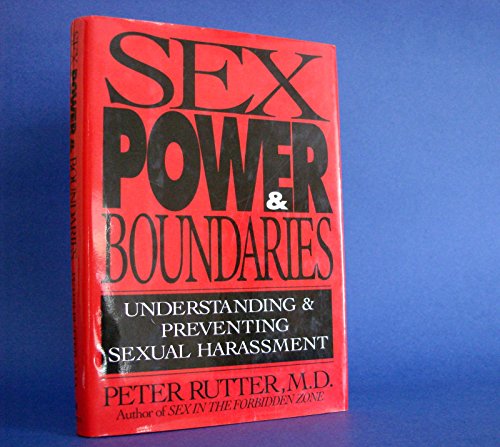
Drawing on actual incidents and extensive research, a guide to sexual harassment analyzes the differences between the sexes, the myths that surround sexuality, current laws, and the Reasonable Woman/Reasonable Man concept. 25,000 first printing. $25,000 ad/promo.
"synopsis" may belong to another edition of this title.
About the Author
Peter Rutter, M.D., is an associate clinical professor of psychiatry at the University of California Medical School, San Francisco.
Reviews
As women have increasingly moved into the workplace and into higher-level positions, the consciousness of sexual harassment has grown, as have legal sanctions against it. Ritter (Sex in the Forbidden Zone), on the faculty at UC-San Francisco, lays great stress on the subject of boundaries beyond which people should not go nor permit others to go. A term that recurs in his excellent study is unwelcome?applied to the unwanted boundary-crossings that constitute harassment. He examines the role of fantasy (more of a problem for males) and flirting, and always returns to the definition of the Reasonable Female and the Reasonable Male as individuals who do not misinterpret a collegial pat on the shoulder as an advance. He offers useful advice for women (and occasionally men) who are sexually harassed, especially in situations of unequal power, and for organizations that want to avoid the public embarrassment of harassment suits.
Copyright 1996 Reed Business Information, Inc.
A psychiatrist offers an encouraging and informative report on sexual harassment today, in a book suited to both male and female readers. All too often men try to act out their sexual fantasies at work; all too often women have been socialized not to protect themselves against these incursions. Sexual harassment policies, however, alert everyone to these issues. Rutter says: ``We are all inescapably involved in an unprecedented reconfiguring of the most important rules of daily social behavior--how we treat one another at our sexual boundaries.'' He offers helpful advice to men and women about getting along, being respectful, and above all, reasonable. And as in his previous book, Sex in the Forbidden Zone (1989), Rutter identifies common sexual boundary violations, discusses ways men can manage their sexual fantasies, and discourages relationships between people of unequal power. He maintains that the best way for workplaces and schools to stop sexual harassment is to establish and enforce clear policies. But the surest means of changing the sexist attitudes that lead to harassment is for other men to take the lead--condemning the old standards and engaging in new ethical and equitable behavior toward women. At the end of the book, Rutter presents a sample sexual harassment policy, several landmark legal decisions, and extensive lists of legal and psychological resources. His knowledge, first- hand counseling experience, and understanding of complex gender issues lend his book credibility. The weak spots stem from the author's overzealous support of his colleagues in the field, who he seems to believe can solve everything. The lay reader, however, may be skeptical when he suggests that employees involved in a workplace romance should inform the human resources officer so ``the officer can intervene more effectively should private tensions between the couple spill over,'' or when he recommends modified sexual harassment workshops for children, starting in the fourth grade. Nonetheless, a timely and thorough guide. -- Copyright ©1996, Kirkus Associates, LP. All rights reserved.
"About this title" may belong to another edition of this title.
Search results for SEX, POWER, AND BOUNDARIES

Stock Image
SEX, POWER, AND BOUNDARIES
Published by
Bantam (edition First Edition), 1996
ISBN 10: 055309954X
ISBN 13: 9780553099546
Used
Hardcover
First Edition
Seller: BooksRun, Philadelphia, PA, U.S.A.
Seller rating 5 out of 5 stars

Hardcover. Condition: Fair. First Edition. With dust jacket. The item might be beaten up but readable. May contain markings or highlighting, as well as stains, bent corners, or any other major defect, but the text is not obscured in any way. Seller Inventory # 055309954X-7-1-29
Stock Image
SEX, POWER, AND BOUNDARIES
Seller: ThriftBooks-Atlanta, AUSTELL, GA, U.S.A.
Seller rating 5 out of 5 stars
Hardcover. Condition: Very Good. No Jacket. May have limited writing in cover pages. Pages are unmarked. ~ ThriftBooks: Read More, Spend Less. Seller Inventory # G055309954XI4N00
Stock Image
SEX, POWER, AND BOUNDARIES
Seller: ThriftBooks-Reno, Reno, NV, U.S.A.
Seller rating 5 out of 5 stars
Hardcover. Condition: Very Good. No Jacket. May have limited writing in cover pages. Pages are unmarked. ~ ThriftBooks: Read More, Spend Less. Seller Inventory # G055309954XI4N00
Stock Image
SEX, POWER, AND BOUNDARIES
Seller: ThriftBooks-Dallas, Dallas, TX, U.S.A.
Seller rating 5 out of 5 stars
Hardcover. Condition: Very Good. No Jacket. May have limited writing in cover pages. Pages are unmarked. ~ ThriftBooks: Read More, Spend Less. Seller Inventory # G055309954XI4N00
Stock Image
Sex, Power and Boundaries : Understanding and Preventing Sexual Harassment
Published by
Bantam Doubleday Dell Publishing Group, 1996
ISBN 10: 055309954X
ISBN 13: 9780553099546
Used
Hardcover
First Edition
Seller: Better World Books, Mishawaka, IN, U.S.A.
Seller rating 5 out of 5 stars
Condition: Good. 1st. Pages intact with minimal writing/highlighting. The binding may be loose and creased. Dust jackets/supplements are not included. Stock photo provided. Product includes identifying sticker. Better World Books: Buy Books. Do Good. Seller Inventory # 17344433-75
Stock Image
SEX, POWER, AND BOUNDARIES
Seller: HPB-Diamond, Dallas, TX, U.S.A.
Seller rating 5 out of 5 stars
hardcover. Condition: Very Good. Connecting readers with great books since 1972! Used books may not include companion materials, and may have some shelf wear or limited writing. We ship orders daily and Customer Service is our top priority! Seller Inventory # S_467877125
Stock Image
SEX, POWER, AND BOUNDARIES
Seller: MERS Goodwill, Saint Louis, MO, U.S.A.
Seller rating 5 out of 5 stars
Condition: acceptable. Used - Acceptable: All pages and the cover are intact, but shrink wrap, dust covers, or boxed set case may be missing. Pages may include limited notes, highlighting, or minor water damage but the text is readable. Pages may include limited notes and highlighting, but the text cannot be obscured or unreadable. Any access codes or passwords originally included with the book may be expired, used or no longer valid. Image is stock photo and cover art edition may be different than pictured. Seller Inventory # MERV.055309954X.A
Stock Image
Sex, Power and Boundaries: Understanding and Preventing SexualHarassment
Published by
Bantam (1996) New York, 1996
ISBN 10: 055309954X
ISBN 13: 9780553099546
Used
Hardcover
First Edition
Seller: Prairie Archives, Springfield, IL, U.S.A.
Seller rating 4 out of 5 stars

Very good in lightly edgeworn, lightly rubbed dust jacket. First Printing hardbound 1" tear bottom back jacket. Seller Inventory # BOOKS013712
Stock Image
Sex, Power, and Boundaries: Understanding and Preventing Sexual Harassment
Published by
Bantam Books, New York, New York, U.S.A., 1996
ISBN 10: 055309954X
ISBN 13: 9780553099546
Used
Hardcover
First Edition
Seller: Granada Bookstore, IOBA, Woodlawn, IL, U.S.A.
Seller rating 5 out of 5 stars
Hardcover. Condition: Very Good. Dust Jacket Condition: Very Good. 1st Edition. First Edition (Number Line With The One Present). Includes Bibliographical References And Index. The Book Has A Small Ownership Stamp And Phone Number On The Ffep, Else Fine. The Jacket Has Light Rubbing With No Chips Or Tears. Seller Inventory # 029952
Seller Image
Sex, Power, and Boundaries: Understanding and Preventing Sexual Harassment
Published by
Bantam Books, NY 1996, 1996
ISBN 10: 055309954X
ISBN 13: 9780553099546
Used
Hardcover
First Edition
Seller: 2nd Hand Books, Kenner, LA, U.S.A.
Seller rating 4 out of 5 stars
Hardcover First Ed. Sexual Harassment, Sexual Differences, Psychology. By the author of Sex In the Forbidden Zone. (255 Pgs.) Pictorial DJ, VVG / VVG. Seller Inventory # AA-HC-9638