
Items related to Protein Power: The High-Protein/Low Carbohydrate Way...
Protein Power: The High-Protein/Low Carbohydrate Way to Lose Weight, Feel Fit, and Boost Your Health-in Just Weeks! - Hardcover
Synopsis
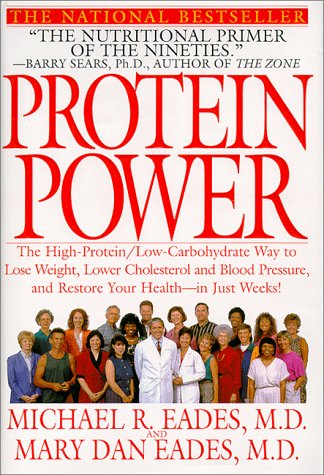
Lose weight, feel fitter, lower your cholesterol, and enjoy the foods you never thought you'd eat again! A rasher of bacon, a juicy steak, a wedge of cheese, a buttery omelet...Now, a team of pioneering doctors shows you how their groundbreaking, protein-rich eating plan succeeds where low-fat diets fail-- to help you take off the weight and achieve optimal health naturally, without counting fat grams, without worrying about fat percentages, and without going up the foods you love! Finally, a diet you can live with that works.
PROTEIN POWER
Based on cutting-edge research, this revolutionary, medically sound, deliciously satisfying plan has already helped thousands of patients lose weight and achieve other lifesaving health benefits, including lower cholesterol and blood pressure readings and an improvement or reversal of common disorders such as heart disease, adult-onset diabetes, and gout. Developed by Doctors Michael and Mary Dan Eades, the simple regimen calls for a new way of eating: a protein-rich, moderate-fat, low-carbohydrate diet that will have you feeling better and more energetic within a week, and correct blood sugar levels, high blood pressure, and elevated cholesterol within three weeks.
Here, the Eades show you why their plan is so potent: how it works with your body's metabolic biochemistry; how it brings powerful metabolic hormones, including insulin, into balance; and why this balance is necessary to achieve permanent weight loss and free you from reliance on costly and dangerous medications to control blood pressure and cholesterol.
Divided into two phases, one for those who need to lose 20 percent of their body weight or more, and the other for those closer to their ideal weight who simply wish to recompose their muscle-fat ratio and embark on a healthier lifestyle, the Eades' regimen relies on a tasty, filling, nutritionally complete diet that even allows for the consumption of alcohol-- in moderation. Their breakthrough system of counting carbohydrates gives you many more food options than other low-carbohydrate programs. And they accompany their diet with an invaluable program of strength-building exercises and tips for maintaining motivation. To help you put their plan into action, the Eades provide:
* complete, satisfying meal plans, suitable for family dinners or formalentertaining
* a Daily Meal Outline to keep track of your food selections
* tips on making the best selections at fine restaurants or fast food chains
* a minicookbook filled with nearly 100 easy-to-prepare and tasty recipes, from TexMex Cheese Flan with Chunky Salsa and Coconut Salmon to Irish Lace Cookie and Chocolate Chip Cheesecake
* ways to modify the foods you love the most to make them fit your diet plan
* recipes for snack foods that can actually improve your health
* supplements that will jump-start your metabolism to burn fat
* a rapid recovery program for planned celebrations or holiday overindulgence
If you've been living the low-fat, no-fat way and still haven't lost weight (or been able to maintain weight loss), still have elevated blood pressure and cholesterol still feel fatigued and bloated--stop blaming yourself! Instead, turn to the Eades' breakthrough eating plan and let them help you regain your health and vitality--and show you how to maintain these benefits for a lifetime.
"synopsis" may belong to another edition of this title.
About the Author
Michael R. Eades, M.D., author of Thin So Fast, and Mary Dan Eades, M.D., author of The Doctor's Complete Guide to Vitamins and Minerals, live in Little Rock, Arkansas, where they practice bariatric (weight loss) and general family medicine. They are the founders of Medi-Stat Medical Centers.
From the Trade Paperback edition.
From the Inside Flap
feel fitter, lower your cholesterol, and enjoy the foods you never thought you'd eat again! A rasher of bacon, a juicy steak, a wedge of cheese, a buttery omelet...Now, a team of pioneering doctors shows you how their groundbreaking, protein-rich eating plan succeeds where low-fat diets fail-- to help you take off the weight and achieve optimal health naturally, without counting fat grams, without worrying about fat percentages, and without going up the foods you love! Finally, a diet you can live with that works.
PROTEIN POWER
Based on cutting-edge research, this revolutionary, medically sound, deliciously satisfying plan has already helped thousands of patients lose weight and achieve other lifesaving health benefits, including lower cholesterol and blood pressure readings and an improvement or reversal of common disorders such as heart disease, adult-onset diabetes, and gout. Developed by Doctors Michael and Mary Dan Eades, the simple regimen calls for a new way of eating
Reviews
The Eades, who share a weight-loss and family-medicine practice in Arkansas, have each written a popular medical book?his is Thin So Fast; hers, The Doctor's Complete Guide to Vitamins and Minerals. In their first shared volume, they turn popular weight-management beliefs?and the latest FDA food-guide pyramid?upside down. For years, overweight Americans have been counseled to turn away from meat and fat and embrace a high-carbohydrate diet. Joining a growing band of researchers that includes Barry Sears (The Zone), the Eades discuss the biochemical roles of hormones in the metabolic process to demonstrate why low-fat, high-carb programs don't always result in weight loss and present a convincing case for their high-protein, low-carb alternative. The key is preventing, through diet, overproduction of insulin, which itself "controls the storage of fat" and is triggered by the ingestion of carbohydrates. Their eating plan?which is bolstered by lists of protein and carbohydrate counts for common foods, a collection of about 75 appealing recipes and discussion of the necessity of exercise?will lead, they aver, to the body's more efficent burning of fat, leading in turn to reduction in one's percentage of body fat. Cholesterol, vitamins, minerals and various risk factors are also discussed. Chapters end with fairly complete summaries that will be appreciated by readers who are not willing or able to work through the fairly extensive scientific data cited by the Eades in this iconoclastic program.
Copyright 1995 Reed Business Information, Inc.
Excerpt. © Reprinted by permission. All rights reserved.
You may be wondering how a couple of physicians who specialize in weight loss in a relatively small city in Middle America devised a nutritional program that works as well as this one does, while most of the scientists in the major universities are headed off in the opposite direction, puzzling over why their success with low-fat diet plans has been so minimal. In a nutshell, we lucked out. We lucked out because that's how science works. Science progresses because people continue to question why. Researchers propose hypotheses based on their understanding of the natural world and then test them--and most of the time these theories blow up in their faces. The lucky ones stumble onto the hypotheses that turn out to be valid. But of course there's more than luck involved because as Louis Pasteur said, "Chance favors the prepared mind," and in our case our minds were prepared by many years of clinical practice with patients suffering all the illnesses that are heir to disordered insulin metabolism as well as by our unique combination of medical interests. Mike is a collector of diet books and old medical texts and has a strong interest in paleopathology and biochemistry; Mary Dan is interested in anthropology and has published a book on eating disorders and the deranged metabolic status of eating-disordered patients.
We have a copy of the earliest diet book ever to sweep the nation, Banting's Letter on Corpulence, first printed in the middle 1800s. This restricted-carbohydrate diet worked like a charm for Banting and, if sales were any indication, many others. It has always intrigued us because it completely flies in the face of today's low-fat paradigm. At about the same time we ran across Banting we began attending paleopathology conferences and studying anthropology, where we learned what paleopathologists and anthropologists have known for years: the agricultural revolution and the increased consumption of carbohydrates it brought along with it played havoc with the health of early man. Mary Dan's extensive study of eating disorders and metabolic hormonal derangements combined with Mike's interest in biochemistry rounded out the "preparation" of our minds. We looked at Banting's success with carbohydrate restriction along with the paeopathological/anthropological data showing a decline in health acompanying an increase in carbohydrate intake and concluded that maybe the intake of large amounts of carbohydrates wasn't necessarily a good thing. That became our first mini-hypothesis: excess carbohydrate consumption isn't good. But why not?
We knew, as does every doctor, that the immediate effect of carbohydrate consumption is increased blood glucose, then an increased insulin level. We thought that perhaps the increased insulin levels might be to blame for part of the problem. As we studied the medical literature, we found that researchers the world over were finding elevated insulin levels associated with obesity, heart disease, high blood presure, and diabetes--the common diseases of modern man. We also found that the same researchers were for the most part trying to treat these patients by giving them more of the same thing we were begining to believe may have caused the problem in the first place: the high-carbohydrate, low-fat diet. It made more sense to us that if excess insulin indeed causes these disorders, or at the very least makes them worse, as the increasing mountain of research indicated, perhaps patients would be better off reducing their carbohydrate intake, not increasing it.
We took then as our working hypothesis that excess carbohydrate leads to excess insulin, which leads to obesity, high blood pressure, and all the rest. It fit with the anthropological and paleopathological data and, at least as far as obesity was concerned, with Banting's Dietary theory. We then began to examine this hypothesis from a basic biochemical perspective and found that it worked beautifully. From all perspectives our hypothesis looked good on paper, so we began to test it carefully, first on ourselves, then on patients in our practice. We found that the results were rapid, dramatic, and pretty much uniform--just what we expected based on the underlying science. As we worked with our patients, we continued to refine our techniques, expand our range of dietary choices, and in general collect those little tips and tricks that make the practice of medicine an art as well as a science. We are still learning and refining every day, and, as with any technique that works, more and more practitioners are beginning to use a restricted-carbohydrate diet for their patients and are adding their own unique refinements to the rapidly growing body of data.
This book is arranged in basically the sequence of our own development and refinement of our hypothesis. The first chapters give an overview and an explanation from a historical, anthropological, and biochemical perspective, which should give you the information and explanations you need to become comfortable with these seemingly radical ideas. If you don't care about the "why" of all this, just read "The Bottom Line," the summaries at the end of each chapter. The latter part of the book is a nuts-and-bolts primer on how to implement these nutritional strategies in your own health-preserving and rejuvenation program. (On the other hand, if you'd like to read more, please write to us in care of our publisher, and we'll send you a bibliography.)
You'll find the program in a nutshell on page 155, but please read all of Chapter 10, all about exercise in Chapter 12, and the essential list of vitamins at the end of Chapter 8, in addition to the Bottom Line Summaries.
Will this program work for you? In good conscience, we can only say probably. The reason we hedge a little is because of biochemical individuality--we are all as different biochemically as we are in appearance. Every doctor has encountered patients in whom medicines seem to work in an opposite fashion to that intended, patients who are kept awake by sleeping pills and pass out on stimulants. These and similar experiences keep practiced physicians from ever making blanket this-will-work-in-all-circumstances statements. AlI we can tell you is that in the almost ten years we have been treating patients with this program we have never had a negative outcome. If you're like the vast majority of our patients, you will find the results as striking and life changing as we have and will adopt this program, modified
"About this title" may belong to another edition of this title.
Search results for Protein Power: The High-Protein/Low Carbohydrate Way...

Stock Image
Protein Power
Seller: World of Books (was SecondSale), Montgomery, IL, U.S.A.
Seller rating 5 out of 5 stars

Condition: Acceptable. Item in acceptable condition! Textbooks may not include supplemental items i.e. CDs, access codes etc. Seller Inventory # 00095281489
Stock Image
Protein Power
Seller: World of Books (was SecondSale), Montgomery, IL, U.S.A.
Seller rating 5 out of 5 stars
Condition: Good. Item in good condition. Textbooks may not include supplemental items i.e. CDs, access codes etc. Seller Inventory # 00095394111
Seller Image
Protein Power: The High-Protein/Low Carbohydrate Way to Lose Weight, Feel Fit, and Boost Your Health-in Just Weeks!
Seller: 3Brothers Bookstore, Egg harbor township, NJ, U.S.A.
Seller rating 5 out of 5 stars
Condition: very_good. Cover may have light wear, pages in very good condition and binding is sturdy; may have other light shelf wear or creases. May have notes or highlighting. Seller Inventory # EVV.0553101838.VG
Seller Image
Protein Power: The High-Protein/Low Carbohydrate Way to Lose Weight, Feel Fit, and Boost Your Health-in Just Weeks!
Seller: Zoom Books Company, Lynden, WA, U.S.A.
Seller rating 5 out of 5 stars
Condition: very_good. Book is in very good condition and may include minimal underlining highlighting. The book can also include "From the library of" labels. May not contain miscellaneous items toys, dvds, etc. . We offer 100% money back guarantee and 24 7 customer service. Seller Inventory # ZBV.0553101838.VG
Seller Image
Protein Power: The High-Protein/Low Carbohydrate Way to Lose Weight, Feel Fit, and Boost Your Health-in Just Weeks!
Seller: Reliant Bookstore, El Dorado, KS, U.S.A.
Seller rating 5 out of 5 stars
Condition: acceptable. This book is a well used but readable copy. Integrity of the book is still intact with no missing pages. May have notes or highlighting. Cover image on the book may vary from photo. Ships out quickly in a secure plastic mailer. Seller Inventory # RDV.0553101838.A
Seller Image
Protein Power: The High-Protein/Low Carbohydrate Way to Lose Weight, Feel Fit, and Boost Your Health-in Just Weeks!
Seller: Greenworld Books, Arlington, TX, U.S.A.
Seller rating 5 out of 5 stars
Condition: very_good. Fast Free Shipping â" Very Good condition book with a firm cover and clean pages. Shows normal use and some light wear or limited notes markings. A solid, nice copy to enjoy. Seller Inventory # GWV.0553101838.VG
Seller Image
Protein Power: The High-Protein/Low Carbohydrate Way to Lose Weight, Feel Fit, and Boost Your Health-in Just Weeks!
Seller: Greenworld Books, Arlington, TX, U.S.A.
Seller rating 5 out of 5 stars
Condition: good. Fast Free Shipping â" Good condition. It may show normal signs of use, such as light writing, highlighting, or library markings, but all pages are intact and the book is fully readable. A solid, complete copy that's ready to enjoy. Seller Inventory # GWV.0553101838.G
Stock Image
Protein Power
Seller: Faith In Print, Cumming, GA, U.S.A.
Seller rating 5 out of 5 stars
Hard Back. Condition: Good. Dust Jacket Condition: Good. good clean tight hardback with some light general wear. small scuff on spine. pages clean and unmarked. dust jacket is good with some very light edge rubibng and one small tear on spine. nice copy! Seller Inventory # 007914
Stock Image
Protein Power: The High-Protein/Low Carbohydrate Way to Lose Weight, Feel Fit, and Boost Your Health-in Just Weeks!
Seller: BooksRun, Philadelphia, PA, U.S.A.
Seller rating 5 out of 5 stars
Hardcover. Condition: Fair. With dust jacket. The item might be beaten up but readable. May contain markings or highlighting, as well as stains, bent corners, or any other major defect, but the text is not obscured in any way. Seller Inventory # 0553101838-7-1-29
Stock Image
Protein Power: The High-Protein/Low Carbohydrate Way to Lose Weight, Feel Fit, and Boost Your Health-in Just Weeks!
Seller: Evergreen Goodwill, Seattle, WA, U.S.A.
Seller rating 5 out of 5 stars
hardcover. Condition: Acceptable. Pages include notes, underlining, or highlighting. Seller Inventory # mon0000775958