
Items related to A Free Man of Color (Benjamin January, Book 1)
A Free Man of Color (Benjamin January, Book 1) - Hardcover
Book 1 of 21: Benjamin January Historical Mysteries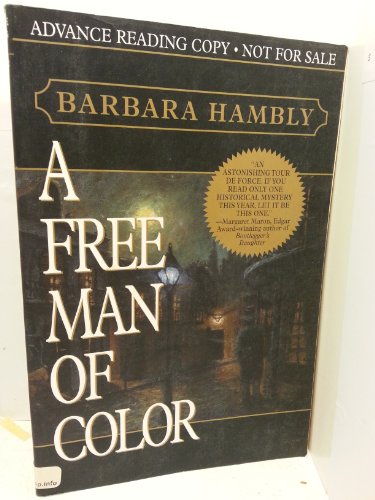
Synopsis
Benjamin January, a Creole physician and piano teacher who has known the glories of Paris as well as of his native New Orleans, is at the Blue Ribbon Ball during Mardi Gras. Near the ball, Angelique Crozat, an octoroon who travels in the city's finest company, is found murdered--and there is no shortage of suspects. This novel transports the reader to the center of the cosmopolitan South in an age when both its glories and the forces which would tear it apart are equally in evidence.
"synopsis" may belong to another edition of this title.
About the Author
Barbara Hambly is the author of The Emancipator’s Wife, a finalist for the Michael Shaara Award for Excellence in Civil War Fiction. She is also the author of Fever Season, a New York Times Notable Book of the Year, and seven acclaimed historical novels.
From the Paperback edition.
From the Inside Flap
uary, a Creole physician and piano teacher who has known the glories of Paris as well as of his native New Orleans, is at the Blue Ribbon Ball during Mardi Gras. Near the ball, Angelique Crozat, an octoroon who travels in the city's finest company, is found murdered--and there is no shortage of suspects. This novel transports the reader to the center of the cosmopolitan South in an age when both its glories and the forces which would tear it apart are equally in evidence.
Reviews
Once again exercising her talent for goldstained description, Hambly moves from a stylish fin de siŠcle tale of Continental vampirism (Traveling with the Dead, 1995) to an equally stylish romantic suspenser set in New Orleans. The author focuses on the delicate, twilit world of color in New Orleans in the 1830s, striving to capture both the city's exotic strangeness and an absolute sense of physical reality. Despite rapt storytelling, though, Hambly's prose shows less care than her research, being replete with tired phrases (``crimson with rage,'' etc.). After 16 years abroad, widower Benjamin January, a very dark Creole, returns from Paris having earned his degree as a physician and, for Carnival, takes up playing piano in the band for the Blue Ribbon Ball at the Salle d'Orleans. This is the ball at which white gentlemen meet their mistresses of various skin shades, having parked their wives at the nearby Th‚ƒtre d'Orleans. When Benjamin spots a former piano student, the virtuous, newly widowed, pure white Madame Madeleine Trepagier (n‚e Dubonnet), at the wrong ball, he tries to save her from disgrace. She's there to recover her family jewels from the city's worst, most malicious woman of color, Angelique Crozat, mistress of the late Armand Trepagier. But Angelique is strangled, robbed, and stuffed into a closet before Madeleine can talk with her. The murder investigation plunges us into the tangled nature of race relations in New Orleans, made even more complex by the fact that the free colored folk there now have to deal with the recently arrived imperial Americans, who don't recognize (as the French, the founders of the city, did) a colored entitlement to civil rights. What does it mean that the dead Angelique was wearing Madeleine's own handsewn white dress when she died? A sharp portrait of curiously nuanced class divisions transforms Hambly's latest into something far more than the modest melodrama it might otherwise have been. -- Copyright ©1997, Kirkus Associates, LP. All rights reserved.
Hambly, well known for her fine fantasies, applies her considerable talent for rich description to this period mystery set in nineteenth-century New Orleans. Recently returned from many years abroad, free man of color Ben January finds little has changed in his native city: discrimination still abounds; rich white men still keep women of color as mistresses (placees), while wives politely look the other way; and color is at the crux of social standing in both black and white communities. When a flirtatious placee is strangled during Mardi Gras revelry, January investigates--only to discover that some important people in the city seem anxious to have him take the blame for the crime. A few suspenseful moments notwithstanding, this isn't an action-packed or suspenseful whodunit. Rather, it's a richly detailed, telling portrait of an intricately structured racial hierarchy, which was to leave its mark on everyone--from Ben January to the white woman whose life he ultimately saves. Stephanie Zvirin
With this historical novel, Hambly departs from her usual work in the sf/fantasy genre (e.g., Traveling with the Dead, LJ 8/95). Her new work is set in 19th-century Louisiana Creole society, where it was customary for a man to have a wife and also to keep a mistress in her own house. Benjamin January, a free Creole with dark brown skin, has returned to this society after living in Paris for more than a decade. He is trained as a surgeon, but in Louisiana, he makes his living playing the piano. Soon he is the main suspect in the death of a wealthy man's young mistress, found murdered at a ball. January spends the rest of the book gathering evidence in his defense with the help of his sisters and a host of other colorful characters he encounters on the run. The result is a complicated mystery that could have used more romantic involvement. Recommended for larger libraries.?Shirley Coleman, Ann Arbor Dist. Lib., Mich.
Copyright 1997 Reed Business Information, Inc.
Excerpt. © Reprinted by permission. All rights reserved.
The ochre stucco cottage on Rue Burgundy was silent when January reached it. It was one of a row of four. He listened for a moment at the closed shutters of each of its two front rooms, then edged his way down the muddy slot between the closely set walls of the houses to the yard, where he had to turn sideways and duck to enter the gate. The shutters there were closed as well. The yard boasted a privy, a brick kitchen, and a garçonnière above it.
When first he had lived there, his sister had occupied the rear bedroom, his mother the front, the two parlors--one behind the other--being used for the entertainment of St.-Denis Janvier. Although he was only nine years old, Benjamin had slept from the first in the garçonnière, waiting until the house lights were put out and then climbing down the rickety twist of the outside stair to run with Olympe and Will Pavegeau and Nic Gignac on their midnight adventures. He smiled, recalling the white glint of Olympe's eyes as she dared them to follow her to the cemetery, or to the slave dances out on Bayou St. John.
His younger sister--his full sister--had been a skinny girl then, like a black spider in a raggedy blue-and-red skirt and a calico blouse a slave woman would have scorned to wear. Having a back room with access to the yard hadmade it easy for her to slip out, though he suspected that if she'd been locked in a dungeon, Olympe would still have managed to get free.
Olympe had been fifteen the year of Dominique's birth. The two girls had shared that rear chamber for only a year. Then Dominique had occupied it alone, a luxury for a little girl growing up. But then, Dominique had always been her mother's princess, her father's pride.
Presumably Dominique had occupied the room until Henri Viellard had come into her life when she was sixteen. By that time St.-Denis Janvier was dead, leaving his mistress comfortably off, and Livia Janvier had married a cabinetmaker, Christophe Levesque, who had died a few years ago. The rear room that had been Olympe's, then Dominique's, had been for a short spell Levesque's workshop. Now it was shut up, though Minou was of the opinion that her mother should take a lover.
January stepped to the long opening and drew back one leaf of the green shutters, listening at the slats of the jalousie for his mother's soft, even breath.
He heard nothing. Quietly, he lifted the latch, pushed the jalousie inward. The room was empty, ghostly with dust. He crossed to the door of his mother's bedroom, which stood half-slid back into its socket. Slatted light leaked through the louvers of the doors to the street. The gaily patterned coverlet was thrown back in a snowstorm of clean white sheets. Two butter-colored cats--Les Mesdames--dozed, paws tucked, on the end of the bed, opening their golden eyes only long enough to give him the sort of gaze high-bred Creole ladies generally reserved for drunken keelboat men sleeping in their own vomit in the gutters of the Rue Bourbon. There was water in the washbowl and a robe of heavy green chintz lay draped over the cane-bottomed chair. The smell of coffee hung in the air, a few hours old.
Euphrasie Dreuze, or one of her friends, he thought. They had come to her for comfort, and Livia Janvier Levesque had gone.
January crossed the yard again, his black leather music satchel under one arm. There was still fire in the kitchen stove, banked but emitting warmth. The big enamel coffeepot at the back contained several cups' worth. He poured himself some and carried it up the twisting steps and drank it as he changed his clothes and ate the beignets and pastry he'd cadged from the ballroom tables in the course of the night. Half his gleanings he'd left at Hannibal's narrow attic, stowed under a tin pot to keep the rats out of it, though he suspected the minute he was gone one or another of the girls who worked cribs in the building would steal it, as they stole Hannibal's medicine, his laudanum, and every cent he ever had in his pockets.
Before eating he knelt on the floor beside his bed and took from his pocket the rosary he'd had from his childhood--cheap blue glass beads, a crucifix of cut steel--and told over the swift decades of prayers for the soul of Angelique Crozat. She had been, by his own experience and that of everyone he'd talked to, a thoroughly detestable woman, but only God could know and judge. Wherever she was, she had died unconfessed and would need the prayers. They were little enough to give.
From the Paperback edition.
"About this title" may belong to another edition of this title.
Search results for A Free Man of Color (Benjamin January, Book 1)

Stock Image
A Free Man of Color
Seller: World of Books (was SecondSale), Montgomery, IL, U.S.A.
Seller rating 5 out of 5 stars

Condition: Very Good. Item in very good condition! Textbooks may not include supplemental items i.e. CDs, access codes etc. Seller Inventory # 00107945975
Stock Image
A Free Man of Color
Seller: World of Books (was SecondSale), Montgomery, IL, U.S.A.
Seller rating 5 out of 5 stars
Condition: Good. Item in good condition. Textbooks may not include supplemental items i.e. CDs, access codes etc. Seller Inventory # 00103193588
Stock Image
Free Man of Color
Published by
Transworld Publishers Ltd, 1997
ISBN 10: 0553102583
ISBN 13: 9780553102581
Used
Hardcover
Seller: World of Books (was SecondSale), Montgomery, IL, U.S.A.
Seller rating 5 out of 5 stars
Hardback. Condition: Fair. A lush and haunting novel of a city steeped in decadent pleasures . . . and of a man, proud and defiant, caught in a web of murder and betrayal. It is 1833. In the midst of Mardi Gras, Benjamin January, a Creole physician and music teacher, is playing piano at the Salle d'Orleans when the evenings festivities are interrupted--by murder. Ravishing Angelique Crozat, a notorious octoroon who travels in the city's finest company, has been strangled to death. With the authorities reluctant to become involved, Ben begins his own inquiry, which will take him through the seamy haunts of riverboatmen and into the huts of voodoo-worshipping slaves. But soon the eyes of suspicion turn toward Ben--for, black as the slave who fathered him, this free man of color is still the perfect scapegoat. . . . Praise for A Free Man of Color A smashing debut. Rich and exciting with both substance and spice.--Star Tribune, Minneapolis A sparkling gem.--King Features Syndicate An astonishing tour de force.--Margaret Maron Superb.--Drood Review of Mystery A darned good murder mystery.--USA Today. Seller Inventory # 00103131006
Stock Image
A Free Man of Color (Benjamin January, Book 1)
Seller: BooksRun, Philadelphia, PA, U.S.A.
Seller rating 5 out of 5 stars
Hardcover. Condition: Very Good. It's a well-cared-for item that has seen limited use. The item may show minor signs of wear. All the text is legible, with all pages included. It may have slight markings and/or highlighting. Seller Inventory # 0553102583-11-1
Stock Image
A Free Man of Color (Benjamin January, Book 1)
Seller: HPB-Emerald, Dallas, TX, U.S.A.
Seller rating 5 out of 5 stars
hardcover. Condition: Very Good. Connecting readers with great books since 1972! Used books may not include companion materials, and may have some shelf wear or limited writing. We ship orders daily and Customer Service is our top priority! Seller Inventory # S_475407412
Stock Image
A Free Man of Color (Benjamin January, Book 1)
Seller: HPB-Diamond, Dallas, TX, U.S.A.
Seller rating 5 out of 5 stars
hardcover. Condition: Very Good. Connecting readers with great books since 1972! Used books may not include companion materials, and may have some shelf wear or limited writing. We ship orders daily and Customer Service is our top priority! Seller Inventory # S_475146145
Stock Image
A Free Man of Color (Benjamin January, Book 1)
Seller: Evergreen Goodwill, Seattle, WA, U.S.A.
Seller rating 5 out of 5 stars
hardcover. Condition: Good. Seller Inventory # mon0000406928
Stock Image
A Free Man of Color (Benjamin January, Book 1)
Seller: Half Price Books Inc., Dallas, TX, U.S.A.
Seller rating 5 out of 5 stars
hardcover. Condition: Very Good. Connecting readers with great books since 1972! Used books may not include companion materials, and may have some shelf wear or limited writing. We ship orders daily and Customer Service is our top priority! Seller Inventory # S_482081212
Stock Image
A Free Man of Color (Benjamin January, Book 1)
Seller: ThriftBooks-Dallas, Dallas, TX, U.S.A.
Seller rating 5 out of 5 stars
Hardcover. Condition: Good. No Jacket. Missing dust jacket; Pages can have notes/highlighting. Spine may show signs of wear. ~ ThriftBooks: Read More, Spend Less. Seller Inventory # G0553102583I3N01
Stock Image
A Free Man of Color (Benjamin January, Book 1)
Seller: ThriftBooks-Atlanta, AUSTELL, GA, U.S.A.
Seller rating 5 out of 5 stars
Hardcover. Condition: Fair. No Jacket. Readable copy. Pages may have considerable notes/highlighting. ~ ThriftBooks: Read More, Spend Less. Seller Inventory # G0553102583I5N00