
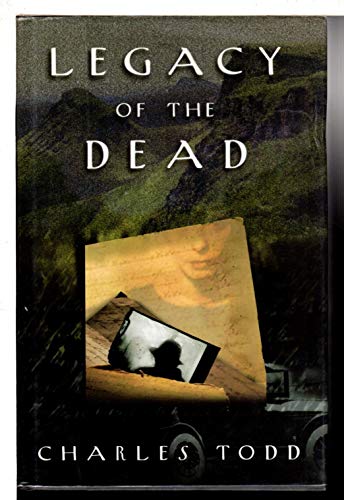
Synopsis
In Ian Rutledge, Charles Todd has created a classic literary figure. A survivor of World War I, Rutledge is a man walking on the edge of insanity, finding both relief and more madness in his work as a Scotland Yard investigator. Now this series, praised by The New York Times Book Review for "challenging plot, complex characters, and subtle psychological insights [wrapped] in thick layers of atmosphere," takes Rutledge to the one place that most threatens the balance of his mind: his past.
Legacy Of The Dead
Rutledge's superior dispatches him to Durham to question the mother of a missing young woman. The weathered remains found on a windswept Scottish mountainside may be those of Eleanor Gray, but the imperious Lady Maude Gray will have to be handled delicately. This is not the only ground that Rutledge must tread carefully. The case will more than likely lead him on to Scotland, where many of Rutledge's ghosts rest uneasily. Scotland was the homeland of many of the young soldiers Rutledge led into battle--and, for far too many of them, to their deaths. And of Corporal Hamish MacLeod, the Highlander he shot for breaking on the battlefield. It is Hamish's voice, caustic and accusing, that haunts his waking moments and assesses his every action. Rutledge knows that in the Scottish countryside he will hear echoes of that condemning voice everywhere he turns. But he cannot know what else he will encounter as he follows the trail of Eleanor Gray's last movements. In the village of Duncarrick he will find a young mother who has been destroyed by a malicious campaign of gossip carried by anonymous letters. Now Fiona MacDonald stands accused of murdering the woman on that rugged mountain--and of taking the child of her victim to raise as her own. Rutledge owes this woman a terrible debt, driving him on a harrowing journey to find the truth--leading him back through the fires of his past, and into secrets that still have the power to kill. Legacy of the Dead is a breathtaking, riveting mystery set in a fascinating landscape at the wary dawn of a new age. In Scotland, Charles Todd captures a land where war and bloodshed are part of the earth, the walls, and living memory. And where a man like Ian Rutledge is all too much at home.
"synopsis" may belong to another edition of this title.
About the Author
Charles Todd is the author of A Test of Wills, Wings of Fire, and Search the Dark. He lives on the East Coast, where he is at work on the next novel in the Inspector Ian Rutledge series, Watchers of Time.
From the Back Cover
Praise for Charles Todd's
Search The Dark
"Todd works...volatile elements into a remarkable village mystery...driven by characters of great psychological complexity."
-- The New York Times Book Review
"Todd's Ian Rutledge mysteries are among the most intelligent and affecting being written these days."
-- The Washington Post Book World
Wings Of Fire
"[Todd wraps] his challenging plot, complex characters, and subtle psychological insights in thick layers of atmosphere."
-- The New York Times Book Review
"Fine writing. A spectacular conclusion that rejuvenates the cliché 'It was a dark and stormy night.' "
-- The Washington Post Book World
"A strong mystery, filled with fine characterizations [and] a superb eye for Cornwall...Wise and wily."
-- The Boston Globe
A Test Of Wills
A New York Times Notable Book of the Year "Todd gives us a superb characterization of a man whose wounds have made him into a stranger in his own land, and a disturbing portrait of a country intolerant of all strangers."
-- The New York Times Book Review
"Todd depicts the outer and inner worlds of his characters with authority and sympathy as he closes in on his surprising--and convincing--conclusion."
-- Publishers Weekly (starred review)
"The emotional and physical carnage in World War I is used to remarkable effect."
-- Chicago Tribune
From the Inside Flap
dge, Charles Todd has created a classic literary figure. A survivor of World War I, Rutledge is a man walking on the edge of insanity, finding both relief and more madness in his work as a Scotland Yard investigator. Now this series, praised by The New York Times Book Review for "challenging plot, complex characters, and subtle psychological insights [wrapped] in thick layers of atmosphere," takes Rutledge to the one place that most threatens the balance of his mind: his past.
Legacy Of The Dead
Rutledge's superior dispatches him to Durham to question the mother of a missing young woman. The weathered remains found on a windswept Scottish mountainside may be those of Eleanor Gray, but the imperious Lady Maude Gray will have to be handled delicately. This is not the only ground that Rutledge must tread carefully. The case will more than likely lead him on to Scotland, where many of Rutledge's ghosts rest uneasily. Scotland was the homeland of
Reviews
The muddy, bloody horrors of WWI continue to haunt Insp. Ian Rutledge, back at work at Scotland Yard, but just barely. Still guilt-stricken over his wartime murder of Corp. Hamish MacLeod, who "cracked" during the Somme offensive of 1916, Rutledge hears Hamish's voice in his head as a steady, moralizing conversationalist. Now Rutledge has been dispatched to Scotland to identify the probable remains of Eleanor Gray, an aristocratic suffragette inexplicably estranged from her mother, the imperious Lady Maude. Local police theorize that Eleanor was murdered on the Highlands by beautiful, young Fiona MacDonald, who's been raising Eleanor's newborn son as her own. Unconvinced of a link between the two women, Rutledge visits Fiona in jail and immediately recognizes her as Hamish's beloved fianc?e. But Fiona won't exonerate herself, refusing to identify the boy's real parents. Following the Edgar-nominated A Test of Wills (1996), this fourth installment in the series focuses narrowly on the question: is there a link between Fiona and Eleanor? Since the answer is never in doubt, there's not much to absorb suspense addicts, as Rutledge slogs through Scotland trying to break the apparently deadlocked circumstantial case. The resolution, implicating too many peripheral characters, is particularly unsatisfying. But readers will continue to be captivated by Todd's portrait of the dangerously unraveling detective, and his equally incisive evocation of the grieving postwar world. Agent, Jane Chelius. (Oct.)
Copyright 2000 Reed Business Information, Inc.
It's a little hard to believe that a successful series could develop from such a quirky premise, but here's the third novel about Scotland Yard Inspector Ian Rutledge and his unusual sidekick, Hamish MacLeod. It's late 1919, and Rutledge is assigned to find the truth behind some recently unearthed human remains. He winds up investigating a young woman accused of murder and uncovering some secrets he would prefer remain hidden. So far this is pretty standard stuff. But readers who have yet to meet Rutledge are in for a surprise: his sidekick, MacLeod, was a corporal in World War I; during the Battle of the Somme, Rutledge was forced to have MacLeod executed for cowardice. MacLeod exists now only as a voice in Rutledge's head--not a ghost but more than a fantasy figure. MacLeod is as real as any flesh-and-blood man, at least to Rutledge, whose inner turmoil, whose haunting (if you will), is what makes this series so immensely intriguing. This is a fine, unique, and moving mystery that will appeal to readers looking for something a little out of the ordinary. David Pitt
Copyright © American Library Association. All rights reserved
A sensitive approach, literate prose, and provocative situations mark Todd's latest addition to his Ian Rutledge series. Although recovered enough from World War I shell shock to function ably in his job with Scotland Yard, Ian still carries with him an internal voice of guilt named Hamish, a soldier he ordered shot for cowardice. When Ian investigates a possible murder in Scotland, the main suspect turns out to be the dead Hamish's intended, who seems destined for the gallows but will not betray a confidence. Very forceful emotional scenes ensue as Ian ferrets out the truth. A special treat for series and historical fans.
Copyright 2000 Reed Business Information, Inc.
Excerpt. © Reprinted by permission. All rights reserved.
1916
Glasgow
The two women sat huddled together in the small carriage, looking around them in dismay, staring at the filthy, closed-in street, the drunken old man sprawled in one of the doorways, the tall tenements ugly and bleak and perilously ill-kept. There was no grace here, only an air of despondency and gloom and poverty.
"It's a horrible place!" one said at last. She was the elder, but not by much. They were both young and very frightened.
"Are you quite sure this is the street we want? I can't believe--" Her companion, the reins lying in her lap, let the words die.
In answer, the passenger dug in her purse for the tattered piece of paper, pulled it out, and read it again. Her lips were trembling, and she felt cold, sick. "Look for yourself. Oh--" The paper slipped from her fingers, and she caught it just before it tumbled into the fetid running gutter beneath the wheel.
It was the street and the house they had searched over an hour to find.
There was silence, only the rain and the whistle of a train somewhere in the distance making any sound at all. The horse waited patiently.
"You'll remember, won't you?" the older woman went on breathlessly. "I'm Mrs. Cook. And you're Sarah. My mother had a housekeeper called Mrs. Cook. And a sewing woman called Sarah. That makes it easier for me--" She stared at the house. "It's a cursed place, dreadful."
"I only have to remember who you are. And I've called you that all day. Mrs. Cook. Don't fret so--you'll make yourself ill!"
"Yes." She smoothed the rug across her knees, felt its dampness.
The horse blew, shifting uncomfortably in the rain.
Finally the older woman squeezed her companion's hand and said, "We must go in, Sarah. We're expected. It must be nearly time."
They climbed stiffly out of the carriage, two respectable young women looking as out of place here as they felt. The stench of bad sewers and boiled cabbage, overlaid with coal smoke and dirty streets, heavy in the dampness, seemed to wrap itself around them. A miasma of the city.
They made their way up to the door, stepping over old newsprint and brown sacking that had been turned to the consistency of porridge by the downpour. Lifting the latch, they could just see down a dark, awful tunnel that was only a rubbish-littered hallway but seemed like the final path to hell.
The door they were after was the second on the left, a barely discernible Number Three on a grimy card marking it. Someone shouted "Come!" to their tentative knock, and they found themselves in a bare, high-ceilinged room with a half dozen broken-down chairs and no windows. It was cold with damp, smelled of cigars and stale beer, and to their fastidious eyes hadn't been cleaned in years.
They could hear someone crying in the next room beyond a second door.
The older woman caught her friend's hand and said, "F--Sarah--I'm going to be sick!"
"No, it's only fright. Here, sit down." She quickly found the best chair and brought it forward, then took another one for herself. It wobbled, one leg uneven.
A nondescript paint, peeled from the walls and ceiling, gave the floor a dappled look, and the old brown carpet in the center seemed to be woven of all the hopelessness that had been brought here.
The older of the two began to tremble. "I'm not frightened--I'm terrified!"
"It will be all right--wait and see." It was a comforting lie, and they both recognized it for what it was.
They sat there for a time, not speaking, their hands gripped together, their faces blanched with the thought of what must lie ahead. The crying went on and on, and overhead there was the sound of furniture being shifted, first this way, then that, an endless screech that seemed half human, half demon. Somewhere in the hallway a man's voice shouted, and they both jumped.
Watching the inner door, they could feel the minutes drag into the half hour. "Sarah" found herself wishing it would open, then dreading that it would. They'd been here a very long time--why had no one come out to speak to them? They had been expected at two sharp--
If only the crying would stop--
Suddenly the older woman stood up. "No, I can't do it!" Her voice was thick, unnaturally loud to her own ears.
"You must! He'll kill you if you don't!"
"I'd rather kill myself. Oh, God, I can't carry the memory of this place around with me for the rest of my life, I can't--! It was a mistake, I want to go home! Sarah--take me home, for the love of heaven, take me home!"
Her friend, compassion in her eyes, said, "You're sure? It's not to be done again? I can't borrow the carriage again without questions being asked."
"No, just take me home!" She was shaking in earnest, cold with dread, cold with fear, cold with the decision she knew she dared not make. Her friend put an arm around her shoulders, and in the hallway, she was sick, leaning there for several minutes in such pain that she seemed to collapse in on herself, frail and helpless. Weak to the point of fainting, her breath a sob, she pressed her forehead against the drab, dirty paint, grateful for its coolness.
They could hear voices behind the other doors, barely muffled--children crying, a man swearing, a woman singing something mournful and off-key. A cat meowing impatiently, pans banging, and thumps, as if somewhere someone were beating a carpet. But mercifully no one came out into the hall. Still--they might--at any moment--
"Can you walk as far as the carriage?" her companion asked softly.
"I must try--" The older woman straightened herself with an effort and pressed a handkerchief to her lips. "I wish I'd never come here--I wish I'd never heard of this place, much less seen it! If I died, how would I have faced him, with this place on my soul!"
"He would understand. He would. It's what made him special, poor man."
"Yes." They linked arms for comfort and walked unsteadily back to the outside door. It swung open as they reached it, and a man smelling strongly of sweat and too much beer grinned knowingly at them for an instant, eyes raking both of them. The tenants here must be aware of what went on in Number Three. "Sarah" felt herself flush with embarrassment. But the man held the door wide and let them pass unmolested.
It was all the older woman could do to climb back into the carriage. Once there, she slumped to the side, clinging to one of the braces that held the top in place. Her companion gently wrapped the damp blanket around her and looked pityingly at her.
What were they to do? What were they to do?
"About this title" may belong to another edition of this title.
Other Popular Editions of the Same Title

Search results for Legacy of the Dead

Stock Image
Legacy of the Dead (Inspector Ian Rutledge Mysteries)
Seller: Your Online Bookstore, Houston, TX, U.S.A.
Seller rating 5 out of 5 stars

Hardcover. Condition: Fair. Seller Inventory # 0553801686-4-19971924
Stock Image
Legacy of the Dead
Published by
Random House Publishing Group, 2000
ISBN 10: 0553801686
ISBN 13: 9780553801682
Used
Hardcover
Seller: Better World Books, Mishawaka, IN, U.S.A.
Seller rating 5 out of 5 stars
Condition: Good. First Printing. Former library copy. Pages intact with minimal writing/highlighting. The binding may be loose and creased. Dust jackets/supplements are not included. Includes library markings. Stock photo provided. Product includes identifying sticker. Better World Books: Buy Books. Do Good. Seller Inventory # GRP71640780
Stock Image
Legacy of the Dead (Inspector Ian Rutledge Mysteries)
Seller: HPB-Emerald, Dallas, TX, U.S.A.
Seller rating 5 out of 5 stars
Hardcover. Condition: Very Good. Connecting readers with great books since 1972! Used books may not include companion materials, and may have some shelf wear or limited writing. We ship orders daily and Customer Service is our top priority! Seller Inventory # S_461171059
Stock Image
Legacy of the Dead (Inspector Ian Rutledge Mysteries)
Seller: HPB-Diamond, Dallas, TX, U.S.A.
Seller rating 5 out of 5 stars
Hardcover. Condition: Very Good. Connecting readers with great books since 1972! Used books may not include companion materials, and may have some shelf wear or limited writing. We ship orders daily and Customer Service is our top priority! Seller Inventory # S_457606695
Stock Image
Legacy of the Dead (Inspector Ian Rutledge Mysteries)
Seller: Half Price Books Inc., Dallas, TX, U.S.A.
Seller rating 5 out of 5 stars
Hardcover. Condition: Very Good. Connecting readers with great books since 1972! Used books may not include companion materials, and may have some shelf wear or limited writing. We ship orders daily and Customer Service is our top priority! Seller Inventory # S_463323522
Stock Image
Legacy of the Dead (Inspector Ian Rutledge Mysteries)
Seller: Idaho Youth Ranch Books, Boise, ID, U.S.A.
Seller rating 5 out of 5 stars
Condition: Good. A copy that has been read, but remains in clean condition. All pages are intact, and the cover is intact (including dust cover, if applicable). The spine may show signs of wear. Pages can include limited notes and highlighting, and the copy can include "From the library of" labels or limited small stickers. Book may have a remainder mark or be a price cutter. Seller Inventory # D-05-02-01-0794
Stock Image
Legacy of the Dead: An Inspector Ian Rutledge Mystery
Seller: WorldofBooks, Goring-By-Sea, WS, United Kingdom
Seller rating 5 out of 5 stars
Paperback. Condition: Good. The book has been read but remains in clean condition. All pages are intact and the cover is intact. Some minor wear to the spine. Seller Inventory # GOR007556909
Buy Used
US$ 4.88
US$ 7.45 shipping
Ships from United Kingdom to U.S.A.
Ships from United Kingdom to U.S.A.
Quantity: 1 available
Stock Image
Legacy of the Dead: An Inspector Ian Rutledge Mystery
Seller: WorldofBooks, Goring-By-Sea, WS, United Kingdom
Seller rating 5 out of 5 stars
Paperback. Condition: Very Good. The book has been read, but is in excellent condition. Pages are intact and not marred by notes or highlighting. The spine remains undamaged. Seller Inventory # GOR002815452
Buy Used
US$ 4.88
US$ 7.45 shipping
Ships from United Kingdom to U.S.A.
Ships from United Kingdom to U.S.A.
Quantity: 1 available
Stock Image
Legacy of the Dead
Published by
Bantam Books October 2000, 2000
ISBN 10: 0553801686
ISBN 13: 9780553801682
Used
Hardcover
Seller: Isle of Books, Bozeman, MT, U.S.A.
Seller rating 4 out of 5 stars

Hardcover. Condition: Very Good. Seller Inventory # 605347
Stock Image
Legacy of the Dead: An Inspector Ian Rutledge Mystery
Published by
Bantam Dell Pub Group, 2000
ISBN 10: 0553801686
ISBN 13: 9780553801682
Used
Hardcover
First Edition
Seller: Black Cat Books, Shelter Island, NY, U.S.A.
Seller rating 5 out of 5 stars
Hardcover. Condition: Very Good. Dust Jacket Condition: Very Good. 1st Edition. 1st edition. Hardbound in unclipped dust jacket. Seller Inventory # 95035