
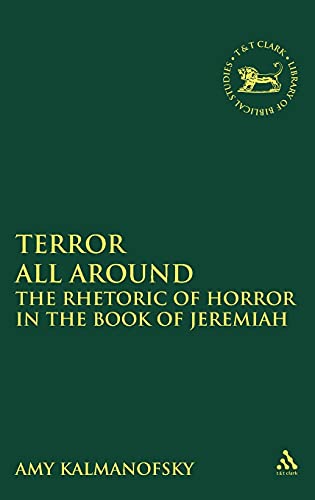
Terror All Around: The Rhetoric of Horror in the Book of Jeremiah (The Library of Hebrew Bible/Old Testament Studies, 390) - Hardcover
Synopsis
Among the many strategies of persuasive speech, biblical prophets often employ a rhetoric of horror. Prophets use verbal threats and graphic images of destruction to terrify their audience. Contemporary horror theory provides insight into the rhetoric of horror employed by the prophets. In this book, Amy Kalmanofsky applies horror theory to the book of Jeremiah and considers the nature of biblical horror and the objects that provoke horror, as well as the ways texts like Jeremiah work to elicit horror from their audience.
Kalmanofsky begins by analyzing the emotional response of horror as reflected in characters' reactions to terrifying entities in the book of Jeremiah. Horror, she concludes, is a composite emotion consisting of fear in response to a threatening entity and a corresponding response of shame either directed toward one's self or felt on behalf of another. Having considered the nature of horror, she turns to the objects that elicit horror and consider their ontological qualities and the nature of the threat they pose. There are two central monstrous figures in the book of Jeremiah-aggressor God and defeated Israel. Both of these monsters refuse to be integrated into and threaten to disintegrate the expected order of the universe. She then presents a close, rhetorical reading of Jeremiah 6 and consider the way this text works to horrify its audience. The book concludes by considering fear's place within religious experience and the theological implications of a rhetoric that portrays God and Israel as monsters.
"synopsis" may belong to another edition of this title.
About the Authors
Andrew Mein is Director of Research at the Queen's Foundation for Ecumenical Theological Education, UK
Claudia V. Camp is Professor of Religion at Texas Christian University, USA and was on the steering committee of the Seminar. She is currently co-general editor of the LHBOTS series, as well as the author or editor of 4 books and numerous articles.
"About this title" may belong to another edition of this title.
Search results for Terror All Around: The Rhetoric of Horror in the Book...

Stock Image
Terror All Around : Horror, Monsters, and Theology in the Book of Jeremiah
Seller: GreatBookPrices, Columbia, MD, U.S.A.
Seller rating 5 out of 5 stars

Condition: New. Seller Inventory # 5967446-n
Stock Image
Terror All Around
Published by
Bloomsbury Publishing (UK), 2008
ISBN 10: 0567026566
ISBN 13: 9780567026569
New
Hardcover
Seller: PBShop.store US, Wood Dale, IL, U.S.A.
Seller rating 5 out of 5 stars
HRD. Condition: New. New Book. Shipped from UK. THIS BOOK IS PRINTED ON DEMAND. Established seller since 2000. Seller Inventory # L1-9780567026569
Stock Image
Terror All Around
Published by
Bloomsbury Publishing (UK), 2008
ISBN 10: 0567026566
ISBN 13: 9780567026569
New
Hardcover
Seller: PBShop.store UK, Fairford, GLOS, United Kingdom
Seller rating 5 out of 5 stars
HRD. Condition: New. New Book. Delivered from our UK warehouse in 4 to 14 business days. THIS BOOK IS PRINTED ON DEMAND. Established seller since 2000. Seller Inventory # L1-9780567026569
Buy New
US$ 176.26
US$ 6.62 shipping
Ships from United Kingdom to U.S.A.
Ships from United Kingdom to U.S.A.
Quantity: Over 20 available
Seller Image
Terror All Around : Horror, Monsters, and Theology in the Book of Jeremiah
Seller: GreatBookPrices, Columbia, MD, U.S.A.
Seller rating 5 out of 5 stars
Condition: As New. Unread book in perfect condition. Seller Inventory # 5967446
Stock Image
Terror All Around: The Rhetoric of Horror in the Book of Jeremiah (The Library of Hebrew Bible/Old Testament Studies, 390)
Seller: Ria Christie Collections, Uxbridge, United Kingdom
Seller rating 5 out of 5 stars
Condition: New. In English. Seller Inventory # ria9780567026569_new
Buy New
US$ 173.33
US$ 15.80 shipping
Ships from United Kingdom to U.S.A.
Ships from United Kingdom to U.S.A.
Quantity: Over 20 available
Stock Image
Terror All Around : Horror, Monsters, and Theology in the Book of Jeremiah
Seller: GreatBookPricesUK, Woodford Green, United Kingdom
Seller rating 5 out of 5 stars
Condition: New. Seller Inventory # 5967446-n
Buy New
US$ 173.32
US$ 19.78 shipping
Ships from United Kingdom to U.S.A.
Ships from United Kingdom to U.S.A.
Quantity: Over 20 available
Seller Image
Terror All Around
Published by
Bloomsbury Publishing PLC, GB, 2008
ISBN 10: 0567026566
ISBN 13: 9780567026569
New
Hardcover
Seller: Rarewaves.com USA, London, LONDO, United Kingdom
Seller rating 5 out of 5 stars
Hardback. Condition: New. Among the many strategies of persuasive speech, biblical prophets often employ a rhetoric of horror. Prophets use verbal threats and graphic images of destruction to terrify their audience. Contemporary horror theory provides insight into the rhetoric of horror employed by the prophets. In this book, Amy Kalmanofsky applies horror theory to the book of Jeremiah and considers the nature of biblical horror and the objects that provoke horror, as well as the ways texts like Jeremiah work to elicit horror from their audience.Kalmanofsky begins by analyzing the emotional response of horror as reflected in characters' reactions to terrifying entities in the book of Jeremiah. Horror, she concludes, is a composite emotion consisting of fear in response to a threatening entity and a corresponding response of shame either directed toward one's self or felt on behalf of another. Having considered the nature of horror, she turns to the objects that elicit horror and consider their ontological qualities and the nature of the threat they pose. There are two central monstrous figures in the book of Jeremiah-aggressor God and defeated Israel. Both of these monsters refuse to be integrated into and threaten to disintegrate the expected order of the universe. She then presents a close, rhetorical reading of Jeremiah 6 and consider the way this text works to horrify its audience. The book concludes by considering fear's place within religious experience and the theological implications of a rhetoric that portrays God and Israel as monsters. Seller Inventory # LU-9780567026569
Buy New
US$ 210.14
Free Shipping
Ships from United Kingdom to U.S.A.
Ships from United Kingdom to U.S.A.
Quantity: Over 20 available
Seller Image
Terror All Around: Horror, Monsters, and Theology in the Book of Jeremiah: The Rhetoric of Horror in the Book of Jeremiah. Vol. 390
Seller: Libro Co. Italia Srl, San Casciano Val di Pesa, FI, Italy
Seller rating 4 out of 5 stars

Cartonato. Condition: fine. English Text.London, 2008; hardback, pp. 164, cm 15,6x23,4. Libro. Seller Inventory # 3857248
Buy Used
US$ 186.77
US$ 23.86 shipping
Ships from Italy to U.S.A.
Ships from Italy to U.S.A.
Quantity: 1 available
Stock Image
Terror All Around: The Rhetoric of Horror in the Book of Jeremiah (Library of Hebrew Bible/Old Testament Studies): v. 390
Seller: Kennys Bookshop and Art Galleries Ltd., Galway, GY, Ireland
Seller rating 5 out of 5 stars
Condition: New. Seller Inventory # V9780567026569
Buy New
US$ 199.17
US$ 11.93 shipping
Ships from Ireland to U.S.A.
Ships from Ireland to U.S.A.
Quantity: Over 20 available
Seller Image
Terror All Around : Horror, Monsters, and Theology in the Book of Jeremiah
Seller: GreatBookPricesUK, Woodford Green, United Kingdom
Seller rating 5 out of 5 stars
Condition: As New. Unread book in perfect condition. Seller Inventory # 5967446
Buy Used
US$ 191.93
US$ 19.78 shipping
Ships from United Kingdom to U.S.A.
Ships from United Kingdom to U.S.A.
Quantity: Over 20 available