
Items related to The Canon: The Beautiful Basics of Science
Synopsis
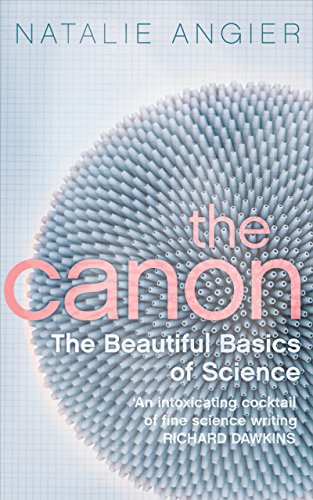
In this exuberant book, the best-selling author Natalie Angier distills the scientific canon to the absolute essentials, delivering an entertaining and inspiring one-stop science education. Angier interviewed a host of scientists, posing the simple question “What do you wish everyone knew about your field?” The Canon provides their answers, taking readers on a joyride through the fascinating fundamentals of the incredible world around us and revealing how they are relevant to us every day. Angier proves a rabble-rousing, wisecracking, deeply committed tour guide in her irresistible exploration of the scientific process and the basic concepts of physics, chemistry, evolutionary biology, cellular and molecular biology, geology, and astronomy. Even science-phobes will find her passion infectious as she strives "to make the invisible visible, the distant neighborly, the ineffable affable."
"synopsis" may belong to another edition of this title.
About the Author
NATALIE ANGIER writes about biology for the New York Times, where she has won a Pulitzer Prize, the American Association for the Advancement of Science journalism award, and other honors. She is the author of The Beauty of the Beastly, Natural Obsessions, and Woman, named one of the best books of the year by the Los Angeles Times, Chicago Tribune, People, National Public Radio, Village Voice, and Publishers Weekly, among others.
A New York Times bestseller and National Book Award finalist, Woman is “a text so necessary and abundant and true that all efforts of its kind, for decades before and after it, will be measured by it” (Los Angeles Times Book Review). Angier lives with her husband and daughter outside of Washington, D.C.
A New York Times bestseller and National Book Award finalist, Woman is “a text so necessary and abundant and true that all efforts of its kind, for decades before and after it, will be measured by it” (Los Angeles Times Book Review). Angier lives with her husband and daughter outside of Washington, D.C.
From the Back Cover
With the singular intelligence and exuberance that made Woman an international sensation, Natalie Angier takes us on a whirligig tour of the major scientific disciplines: physics, chemistry, biology, geology, and astronomy. She draws on conversations with hundreds of the world's top scientists and on her own work as a Pulitzer Prize-winning writer for the New York Times to create a thoroughly entertaining guide to scientific literacy.
The Canon is vital listening for anyone who wants to understand the great issues of our time—from stem cells and bird flu to evolution and global warming. And it's for every parent who has ever panicked when a child asked how the earth was formed or what electricity is. Angier's sparkling prose and memorable metaphors bring the science to life, reigniting our own childhood delight in discovering how the world works.
The Canon is vital listening for anyone who wants to understand the great issues of our time—from stem cells and bird flu to evolution and global warming. And it's for every parent who has ever panicked when a child asked how the earth was formed or what electricity is. Angier's sparkling prose and memorable metaphors bring the science to life, reigniting our own childhood delight in discovering how the world works.
Reviews
Pulitzer Prize-winner Natalie Angier (Woman: An Intimate Geography), a science journalist at the New York Times, was writing an article on whale genetics when her editor suggested that she define the term mammal for her readers and confirm that mammals are animals. That was the last straw for Angier, who nevertheless writes with respect for The Canon's intended audience. She incorporates imaginative metaphors, concise analogies, and jokes into her writing, which result in clear and accessible explanations of complex ideas. A few critics were annoyed by the scientific "sugarcoating" and the dizzying pace of the book, but most were impressed by Angier's lucid prose and clever word play.
Copyright © 2004 Phillips & Nelson Media, Inc.
Science is underappreciated and undervalued in a world that thrives on it. Pulitzer Prize–winning science reporter Angier sets out to bring the basics of hard science (biology, chemistry, physics, etc.) into listeners' everyday lives. Rather than returning to the doldrums of a high school science class, she shows listeners where and how science is happening in everything we do. Through her discussions with scientists and her use of analogies, she makes the complex accessible. Doukas delivers her performance in an energetic, soft and welcoming voice. She emphasizes and paces so as not to overload her listeners as well as to bring home Angier's points. Doukas's tone hints of excitement but also sympathy for those listeners who may appreciate science but who have a bit of angst for learning about it. With over 13 hours of listening, though, this audiobook is best processed in small chunks. Angier covers a lot in each chapter, but trying to grasp it all may take repeated listening.
Copyright © Reed Business Information, a division of Reed Elsevier Inc. All rights reserved.
Popular indifference toward science regularly motivates writers to attempt mass-market enlightenment. Travel writer Bill Bryson's Short History of Nearly Everything (2003) was a best-selling smash, and Angier, better credentialed in science writing and the author of the blockbuster Woman: An Intimate Geography (1999), now makes her bid. In contrast with Bryson's fact- and history-heavy approach, Angier's way of reaching the sciencephobic relies on love of language. Angier deploys extravagantly cascading metaphors, puns, and tangents to plant awareness of central scientific concepts for those who may be vague on what causes the seasons. Covering physics, chemistry, geology, astronomy, and evolutionary and cell biology, Angier induces from scientists in each discipline a zeal comparable to her own for figural explanations of science. Scientific thinking, though, radically differs from our subjective experience of the natural world in a way that Angier creatively illustrates in explaining theory, probability, and scale. Some readers may find Angier's wordplay excessively indulgent, but her core audience will delight in her ecstatic exuberance for all things scientific. Gilbert Taylor
Copyright © American Library Association. All rights reserved
The title tells it all. Starting with the basics of scientific thinking, probability, and statistical measurement, Angier sets us up for a wild joyride through the central scientific discoveries of the last two centuries in physics, chemistry, geology, biology, and astronomy. It is a lively, enjoyable tour meant especially for science phobes but is also a useful refresher course. Narrator Nike Doukas dances with obvious delight over some of Angiers more playful analogies. Her voice sparkles with precision and youthful vitality. She immediately takes charge of the text and seems to understand intuitively the more difficult concepts, as well as the authors offbeat, anything-but-didactic tone. If youre struggling with the transition from James Bond to the ionic bond, this is the book for you. P.E.F. © AudioFile 2007, Portland, Maine-- Copyright © AudioFile, Portland, Maine
Excerpt. © Reprinted by permission. All rights reserved.
From "THE CANON" Maybe you’re one of those people who hasn’t clicked with science since that dreadful year of high school when you flunked physics because you showed up for the final exam an hour late, in your pajamas, and carrying an insect collection. Or maybe you fulfilled your college science requirements by taking courses like the Evolutionary Psychology of Internet Dating, and you regret that you still can’t tell the difference between a proton, a photon, and a moron. Or maybe you’re just curiouser and curiouser and you don’t know where to start. You think that the beginning might be a reasonable place, but whose beginning? Not the kiddie beginning, not the contemptuous or embarrassing or didactic digit-wagging beginning, but the beginning as an adult. The beginning as a relationship between equals, you and science. And before you raise your hands defensively, and cry, Whoa, that’s not a fair competition, me versus science, let me say, It’s not you against science, but you with science, you the taxpayer who supports science whether you realize it or not, you the person who does science more often than you’d suspect. Every time you try to isolate a problem with the vacuum cleaner, for example—machine heats up; machine stops running; holy hairball, when was the last time you changed the bag in this thing, anyway? Or when you know that if you don’t stir the hollandaise sauce constantly at a hot but not boiling temperature you’ll end up with a mass too lumpy to pour over your asparagus. You do science, you support science, you’re baking the cake, you may as well lick the spoon.
"About this title" may belong to another edition of this title.
Search results for The Canon: The Beautiful Basics of Science

Stock Image
The Canon: The Beautiful Basics of Science
Seller: More Than Words, Waltham, MA, U.S.A.
Seller rating 5 out of 5 stars

Condition: Good. A sound copy with only light wear. Overall a solid copy at a great price! Seller Inventory # BOS-Q-13e-01655
Stock Image
The Canon: The Beautiful Basics of Science
Seller: AwesomeBooks, Wallingford, United Kingdom
Seller rating 5 out of 5 stars
Hardcover. Condition: Very Good. The Canon: The Beautiful Basics of Science This book is in very good condition and will be shipped within 24 hours of ordering. The cover may have some limited signs of wear but the pages are clean, intact and the spine remains undamaged. This book has clearly been well maintained and looked after thus far. Money back guarantee if you are not satisfied. See all our books here, order more than 1 book and get discounted shipping. Seller Inventory # 7719-9780571239719
Buy Used
US$ 4.16
US$ 2.60 shipping
Ships from United Kingdom to U.S.A.
Ships from United Kingdom to U.S.A.
Quantity: 2 available
Stock Image
The Canon: A Whirligig Tour of the Beautiful Basics of Science
Seller: Hawking Books, Edgewood, TX, U.S.A.
Seller rating 4 out of 5 stars

Condition: Acceptable. Missing dust jacket; otherwise in excellent condition. Acceptable Condition. Five star seller - Buy with confidence! Seller Inventory # X0571239714X4
Stock Image
The Canon : The Beautiful Basics of Science
Seller: Better World Books, Mishawaka, IN, U.S.A.
Seller rating 5 out of 5 stars
Condition: Good. Former library copy. Pages intact with minimal writing/highlighting. The binding may be loose and creased. Dust jackets/supplements are not included. Includes library markings. Stock photo provided. Product includes identifying sticker. Better World Books: Buy Books. Do Good. Seller Inventory # GRP16996083
Stock Image
The Canon : The Beautiful Basics of Science
Seller: Better World Books, Mishawaka, IN, U.S.A.
Seller rating 5 out of 5 stars
Condition: Very Good. Pages intact with possible writing/highlighting. Binding strong with minor wear. Dust jackets/supplements may not be included. Stock photo provided. Product includes identifying sticker. Better World Books: Buy Books. Do Good. Seller Inventory # 17281604-6
Stock Image
The Canon: The Beautiful Basics of Science
Seller: ThriftBooks-Atlanta, AUSTELL, GA, U.S.A.
Seller rating 5 out of 5 stars
Hardcover. Condition: Very Good. No Jacket. May have limited writing in cover pages. Pages are unmarked. ~ ThriftBooks: Read More, Spend Less. Seller Inventory # G0571239714I4N00
Stock Image
The Canon: The Beautiful Basics of Science
Seller: Bahamut Media, Reading, United Kingdom
Seller rating 5 out of 5 stars
Hardcover. Condition: Very Good. This book is in very good condition and will be shipped within 24 hours of ordering. The cover may have some limited signs of wear but the pages are clean, intact and the spine remains undamaged. This book has clearly been well maintained and looked after thus far. Money back guarantee if you are not satisfied. See all our books here, order more than 1 book and get discounted shipping. Seller Inventory # 6545-9780571239719
Buy Used
US$ 4.58
US$ 3.26 shipping
Ships from United Kingdom to U.S.A.
Ships from United Kingdom to U.S.A.
Quantity: 2 available
Stock Image
The Canon: The Beautiful Basics of Science
Published by
Faber & Faber, United Kingdom, London, 2008
ISBN 10: 0571239714
ISBN 13: 9780571239719
Used
Paperback
Seller: WorldofBooks, Goring-By-Sea, WS, United Kingdom
Seller rating 4 out of 5 stars
Paperback. Condition: Very Good. Unless we are brilliant at science in our teenage years, many of us put off childish things - science museums, an interest in palaeontology - in favour of art galleries, museums and concert halls. A cultured person, Natalie Angier argues, should know about the classic ideas of physics and evolutionary biology as well as the classic works of Beethoven and Picasso. Drawing on conversations with hundreds of the world's leading scientists, Angier takes us on a vivid, good-humoured and informative tour of this neglected canon. An entertaining guide to scientific literacy for anyone who wants to understand the great issues of our age - from stem cell research to bird flu and global warming - this is a joyride through the great subjects that explain the machinery of this place we call home. The book has been read, but is in excellent condition. Pages are intact and not marred by notes or highlighting. The spine remains undamaged. Seller Inventory # GOR001485865
Buy Used
US$ 4.34
US$ 7.33 shipping
Ships from United Kingdom to U.S.A.
Ships from United Kingdom to U.S.A.
Quantity: 4 available
Stock Image
The Canon : The Beautiful Basics of Science
Seller: Better World Books Ltd, Dunfermline, United Kingdom
Seller rating 5 out of 5 stars
Condition: Very Good. Former library copy. Pages intact with possible writing/highlighting. Binding strong with minor wear. Dust jackets/supplements may not be included. Includes library markings. Stock photo provided. Product includes identifying sticker. Better World Books: Buy Books. Do Good. Seller Inventory # 45528394-20
Buy Used
US$ 6.18
US$ 6.54 shipping
Ships from United Kingdom to U.S.A.
Ships from United Kingdom to U.S.A.
Quantity: 1 available
Stock Image
The Canon : The Beautiful Basics of Science
Seller: Better World Books Ltd, Dunfermline, United Kingdom
Seller rating 5 out of 5 stars
Condition: Good. Pages intact with minimal writing/highlighting. The binding may be loose and creased. Dust jackets/supplements are not included. Stock photo provided. Product includes identifying sticker. Better World Books: Buy Books. Do Good. Seller Inventory # GRP14065453
Buy Used
US$ 6.18
US$ 6.54 shipping
Ships from United Kingdom to U.S.A.
Ships from United Kingdom to U.S.A.
Quantity: 1 available