
Items related to What A Truly Cool World
Synopsis
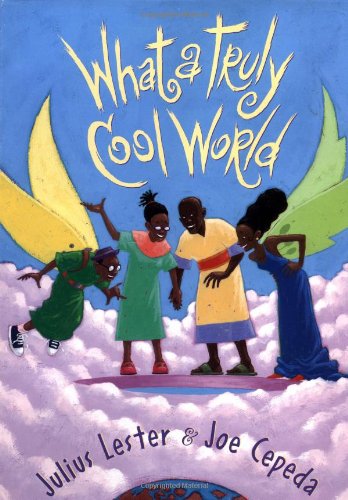
Discovering that making a world takes a lot of work, God calls on his secretary Bruce and the angel Shaniqua to help him create bushes, grass, flowers, and butterflies. By the award-winning author of How Many Spots Does a Leopard Have!
"synopsis" may belong to another edition of this title.
About the Author
JOE CEPEDA has illustrated many books for children, including What a Truly Cool World by Julius Lester and Nappy Hair by Carolivia Herron. He lives in Whittier, California. DARCY PATTISON is the author of The River Dragon, illustrated by Jean and Mou-Sien Tseng, as well as the fantasy novel The Wayfinder. She teaches writing at the University of Arkansas at Little Rock and reviews children's books for the Arkansas Democrat-Gazette. She lives in North Little Rock, Arkansas.
Reviews
PreSchool-Grade 2-Lester and Cepeda depict a down-to-earth God to whom children can relate in this remarkable book. Pleased with his creation of the world, He is about to call it an early night. Then Shaniqua, "the angel in charge of everybody's business," bustles in with the observation that the green, brown, and blue planet looks kind of boring. God agrees, and a series of amazingly creative acts results in the making of flowers and butterflies. With the help of Bruce, God's personal assistant, and Shaniqua's helpful suggestions, the world becomes more colorful and beautiful, as does Heaven. Children will feel completely at home in the "great beyond" with its overstuffed chairs, vacuum cleaners, and framed photographs on the walls. Heaven's inhabitants are also very much like the people they know. (Everybody has at least one Shaniqua in the neighborhood.) The vibrant oil paintings are cartoonlike in style, with a quiet humor that reflects the playful text. The main characters are African American but there is great diversity among the "Hallelujah Angelic Choir." As in Patricia McKissack's Mirandy and Brother Wind (Knopf, 1988), the dialogue is in a casual dialect, making it seem even more approachable. Perhaps the most intriguing aspect of all is the way that God and the Heavenly community cooperate to get the job of Creation finished as perfectly as possible. While this is not your average Bible story, it is one that is not to be missed. It's unique, inspired, and truly cool.
Torrie Hodgson, Burlington Public Library,
Copyright 1999 Reed Business Information, Inc.
"I allow my imagination free play here," writes Lester in his introduction to this fresh interpretation of "How God Made the Butterflies," a creation tale he retold more traditionally in 1969 in Black Folktales. An African-American deity looks down with satisfaction on the world he has just created, seated in a lounge chair in his computer- equipped, heavenly digs. Enter Shaniqua, "the angel in charge of everybody's business," who announces: "I don't want to hurt your feelings or nothing like that, but what you made looks kind of boring." In an attempt to make his world less drab, God snips off the tops of trees to create grass and bushes and sings into being flowers of many colors. But the blooms are lonely. Since God is too hoarse, Shaniqua takes over to supply companions for the flowers, and her song causes the angels, stars and planets to cry tears of various hues, which turn into tiny, colorful butterflies. The banter between Lester's characters more than makes up for a few leaps in logic. Cepeda's (Gracias, the Thanksgiving Turkey) oil paintings, with their vivid palette and hip particulars (Shaniqua sports a beehive 'do, electric-blue evening dress, pointy-toed orange shoes and luminous green wings), bring a funky dimension to this playfully outlandish depiction of how the world came to be. Ages 4-7.
Copyright 1999 Reed Business Information, Inc.
Lester (Black Cowboy, Wild Horses, p. 661, etc.) has conceived a creation story that proves even God needs to have a little fun. When Shaniqua, ``the angel in charge of everybody's business,'' points out to God that the newly created earth is kind of drab, God trims the trees, and the clippings become bushes and grass. Shaniqua is still not impressed, though, so God goes to the edge of heaven, opens His mouth, and out comes music. The notes are in shapes and colors that turn into flowers. The flowers whisper that they are lonely; Shaniqua learns to sing so beautifully that she brings tears into the world, and from those tears come butterflies. The language is winning: God's secretary, Bruce, greets his boss with ``Yo! What's up, Deity?'' Cepeda's oil paintings carry the warmth and familiarity of the text: Bruce wears glasses, strap-on wings, and has taped messages to the side of the computer that indexes the Library of Everything That Is Going to Be; heaven's interiors resemble comfortable homes (God's chair is a bright red recliner). A truly cool book about howperhapsthings came to be. (Picture book. 3-9) -- Copyright ©1998, Kirkus Associates, LP. All rights reserved.
"About this title" may belong to another edition of this title.
Search results for What A Truly Cool World

Stock Image
How Butterflies Came to be
Seller: World of Books (was SecondSale), Montgomery, IL, U.S.A.
Seller rating 5 out of 5 stars

Hardback. Condition: Fair. Cepeda, Joe (illustrator). Seller Inventory # 00102765020
Seller Image
What A Truly Cool World
Seller: 3Brothers Bookstore, Egg harbor township, NJ, U.S.A.
Seller rating 5 out of 5 stars
Condition: very_good. Cover may have light wear, pages in very good condition and binding is sturdy; may have other light shelf wear or creases. May have notes or highlighting. Seller Inventory # EVV.0590864688.VG
Seller Image
What A Truly Cool World
Seller: Greenworld Books, Arlington, TX, U.S.A.
Seller rating 5 out of 5 stars
Condition: very_good. Fast Free Shipping â" Very Good condition book with a firm cover and clean pages. Shows normal use and some light wear or limited notes markings. A solid, nice copy to enjoy. Seller Inventory # GWV.0590864688.VG
Stock Image
What A Truly Cool World
Published by
Scholastic Press (edition ), 1999
ISBN 10: 0590864688
ISBN 13: 9780590864688
Used
Hardcover
Seller: BooksRun, Philadelphia, PA, U.S.A.
Seller rating 5 out of 5 stars
Hardcover. Condition: Very Good. With dust jacket. It's a well-cared-for item that has seen limited use. The item may show minor signs of wear. All the text is legible, with all pages included. It may have slight markings and/or highlighting. Seller Inventory # 0590864688-11-6-29
Stock Image
What A Truly Cool World
Seller: More Than Words, Waltham, MA, U.S.A.
Seller rating 5 out of 5 stars
Condition: Good. . . All orders guaranteed and ship within 24 hours. Before placing your order for please contact us for confirmation on the book's binding. Check out our other listings to add to your order for discounted shipping. Seller Inventory # WAL-H-3a-003129
Stock Image
How Butterflies Came to be
Seller: World of Books Inc, Montgomery, IL, U.S.A.
Seller rating 4 out of 5 stars

Hardback. Condition: Fair. Cepeda, Joe (illustrator). Seller Inventory # CIN0590864688A
Stock Image
What A Truly Cool World
Seller: ThriftBooks-Dallas, Dallas, TX, U.S.A.
Seller rating 5 out of 5 stars
Hardcover. Condition: Very Good. No Jacket. May have limited writing in cover pages. Pages are unmarked. ~ ThriftBooks: Read More, Spend Less. Seller Inventory # G0590864688I4N00
Stock Image
What A Truly Cool World
Seller: ThriftBooks-Atlanta, AUSTELL, GA, U.S.A.
Seller rating 5 out of 5 stars
Hardcover. Condition: As New. No Jacket. Pages are clean and are not marred by notes or folds of any kind. ~ ThriftBooks: Read More, Spend Less. Seller Inventory # G0590864688I2N00
Stock Image
What A Truly Cool World
Seller: ThriftBooks-Atlanta, AUSTELL, GA, U.S.A.
Seller rating 5 out of 5 stars
Hardcover. Condition: Very Good. No Jacket. May have limited writing in cover pages. Pages are unmarked. ~ ThriftBooks: Read More, Spend Less. Seller Inventory # G0590864688I4N00
Stock Image
What a Truly Cool World
Published by
Scholastic, Incorporated, 1999
ISBN 10: 0590864688
ISBN 13: 9780590864688
Used
Hardcover
Seller: Better World Books, Mishawaka, IN, U.S.A.
Seller rating 5 out of 5 stars
Condition: Very Good. Former library copy. Pages intact with possible writing/highlighting. Binding strong with minor wear. Dust jackets/supplements may not be included. Includes library markings. Stock photo provided. Product includes identifying sticker. Better World Books: Buy Books. Do Good. Seller Inventory # 4886440-6