
Items related to The Knife Man
Synopsis
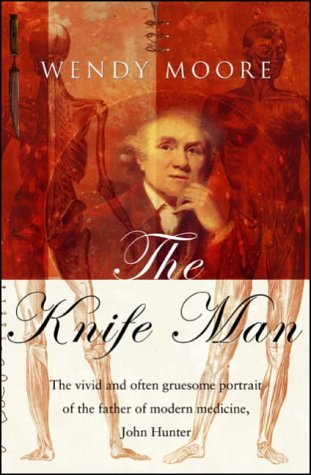
The vivid, often gruesome portrait of the 18th century pioneering surgeon and father of modern medicine, John Hunter.
In the gothic horror story, Dr Jekyll and Mr Hyde, the house of the genial doctor turned fiend is reputedly based on the home of the 18th century surgeon and anatomist John Hunter. The choice was understandable, for Hunter combined an altruistic determination to advance scientific knowledge with dark dealings that brought him into daily contact with the sinister Georgian underworld. In 18th century London, Hunter was a man both acclaimed and feared.
John Hunter revolutionized surgical practice through his groundbreaking experiments. Driven by an insatiable curiosity, he dissected thousands of human bodies, using the knowledge he gained to improve medical care for countless patients, including some very illustrious people, Joshua Reynolds and Lord Byron among them. He was appointed Surgeon Extraordinary to King George III.
In The Knife Man, Wendy Moore unveils a world characterized by hangings at the Tyburn Tree, by gruesome expeditions to dank churchyards, and by countless human dissections in attic rooms – large sums were paid to body-snatchers for stolen corpses which were delivered to Hunter’s back door.
Meticulously researched, it is also a fascinating portrait of a scientist determined to haul surgery out of the realm of superstition and into the dawn of modern medicine.
"synopsis" may belong to another edition of this title.
About the Author
Wendy Moore is a writer and journalist, specializing in health and medical topics. She has a diploma in the History of Medicine from the Society of Apothecaries. The Knife Man is her first book.
Excerpt. © Reprinted by permission. All rights reserved.
CHAPTER 1
The Coach Driver’s Knee
St. George’s Hospital, Hyde Park Corner, London December 1785
The patient faced an agonizing choice. Above the cries and moans of fellow sufferers on the fetid ward, he listened as the surgeon outlined the dilemma. If the large swelling at the back of his knee was left to continue growing, it would soon burst, leading to certain and painful death. If, on the other hand, the leg was amputated above the knee, there was a slim chance he would survive the crude operation–provided he did not die of shock on the operating table, or bleed to death soon after, or succumb to infection on the filthy ward days later–but he would be permanently disabled.
For the forty-five-year-old hackney coach driver, both options were unthinkable. Since he had first noticed the swelling in the hollow behind his knee three years ago, the lump had grown steadily, until it was the size of an orange.(1) It throbbed continuously and was now so painful, he could barely walk. Extended on the hospital bed before him, his leg and foot were hideously swollen, while his skin had turned an unsightly mottled brown. Once the coachman had gained admittance to St. George’s, having persuaded the governors he was a deserving recipient of their charity, the surgeon on duty had lost no time in making a diagnosis. He had seen popliteal aneurysms at exactly the same spot on numerous occasions and knew the prognosis all too well.
It was a common-enough problem in the cabdriver’s line of work. Aneurysms could happen to anyone, anywhere in the body, but they appeared to occur with particular frequency among coach drivers, and others in equestrian occupations in Georgian London, in the popliteal artery behind the knee. The condition, in which a section of artery that has been injured or otherwise weakened begins to bulge to form a blood-filled sac, may well have been triggered by the wearing of high leather riding boots, which rubbed the back of the knee.(2) As the aneurysm swelled, it not only became extremely painful but made walking exceedingly difficult. Whatever the cause, the outcome was often an early death–if not from the condition itself, then from the treatment generally meted out. To lose his leg, even supposing the coach driver survived such a drastic procedure in an era long before anesthesia or antiseptics, would mean never being able to work again. But to carry on working, navigating his horse-drawn carriage over London’s rutted and congested roads, would be equally impossible if the lump was left to grow. Either way, the cabbie feared destitution and the workhouse.
But there was a third choice, the surgeon at his bedside now confided on that early December day, for a coachman sufficiently willing or desperate. In his slow Scottish lilt, redolent of his humble farming origins, the surgeon laid out his scheme for a daring new operation. Surrounded by the poxed, maimed, and diseased bodies of London’s poorest wretches, huddled in their beds on the drafty ward, the cabbie resolved to put his life in the hands of John Hunter.
Without a doubt, John Hunter’s reputation was well known to the coach driver long before he limped through the portal of St. George’s, for he was generally acknowledged as one of the best-skilled surgeons in London, if not Europe, and was a favorite among the well-heeled and the unshod alike. As well as working for no recompense patching up the poor in St. George’s, he was in constant demand from the fee-paying patients who thronged each morning to his fashionable home in Leicester Square or called him out for consultations in the elegant drawing rooms of their West End villas. For all his blunt manners, coarse speech, and disdain for fashion–he currently sported an unkempt beard and tied his tawny-colored hair behind his head in preference to wearing the customary wig– Hunter was firmly established in Georgian high society. He visited court as surgeon extraordinary to George III, dined with the society artist Sir Joshua Reynolds, and debated science with his close friend, the well-connected naturalist Sir Joseph Banks.
Now aged fifty-seven, with seventeen years’ service at St. George’s under his belt, Hunter was renowned for his pioneering and controversial operations. Only two months before the coach driver’s admission, he had skillfully cut away from the neck of a thirty-seven-year-old man a massive benign tumor weighing more than eight pounds and roughly the size of an extra head. The relieved patient had walked away with only a long, neat scar as souvenir of his ordeal.(3) Hunter was popular with the medical students, too. The coachman had watched the eager pupils trooping devotedly after their teacher on his ward rounds, for more students flocked to Hunter’s side than to all the other surgeons at St. George’s put together.(4) Aspiring young surgeons traveled not only from the far reaches of the British Isles but even from across the Atlantic to “walk the wards” at Hunter’s side and hear their hero expound on his radical views in the private lectures he held at his home each winter.
But the cabbie would have heard darker stories, too, whispered on the wards, insinuated in newspapers, and muttered in coffeehouses and cockpits, for Hunter was as much feared and despised as admired in eighteenth-century London. Although his pupils idolized their master, and patients often had cause to thank the bluff but honest surgeon, Hunter’s fiery temper and maverick views had earned him powerful enemies within the four walls of St. George’s, and beyond. While aristocrats bowed to his medical advice, and denizens of the Royal Society–the engine room of eighteenth-century progress–hung on his every pronouncement, Hunter was isolated at St. George’s. To his fellow surgeons, he was at best a laughingstock and at worst a reckless fool. And he had quarreled, too, with several of the city’s other leading practitioners, not least his own elder brother.
To the students, the explanation for this was straightforward: Hunter was simply so far ahead of his contemporaries that he stood alone. But his rivals at St. George’s had other opinions. They decried Hunter’s novel approach and controversial methods, preferring to bleed, blister, and purge their patients to early graves–in strict accordance with classical teaching–than to question conventional modes of practice. They even encouraged Hunter’s most vociferous enemy, a mediocre house surgeon named Jessé Foot, who worked in a neighboring hospital, and whom Hunter had upset by criticizing a surgical appliance the young upstart had invented. In Foot’s jaundiced view, Hunter was “a very inferior, dangerous, and irregular practical surgeon” who was embroiled in “continual war” at St. George’s.(5)
But there were stranger stories still about the rebellious surgeon.
Hunter was known to keep rare and exotic wild beasts–including a lion, a jackal, a dingo, and two leopards–at his country home in the tranquil village of Earls Court, a few miles west of London. In this rural retreat, the surgeon performed countless experiments on animals both dead and alive. Innumerable research papers, presented to his friends in the Royal Society, detailed his bizarre trials, such as grafting a cockerel’s testicle into the belly of a hen–an early step toward transplanting body parts in humans–as well as the freezing of fish and rabbits’ ears in a forlorn attempt to invent a scheme for human immortality. At this prototype research center, Hunter dissected great carcasses, including whales washed up on the banks of the Thames, apes sent back from explorations into unmapped territories, and elephants donated by Queen Charlotte. It was here, too, that he experimented on living animals, tying down squealing pigs, sheep, and dogs for lengthy dissections in order to explore how healthy organs function and to test ways to improve surgery. Although by now they had become inured to the sight of rare beasts grazing the lawns, Hunter’s curious neighbors still gaped on occasions when the surgeon set out from Earls Court driving a cart pulled by three Asian buffalo, headed for the West End. Arriving at his Leicester Square town house, a drawbridge could be swiftly lowered– and just as swiftly raised–to allow mysterious cargoes to trundle in and out.(6)
The enterprising surgeon did not confine his zeal for research to the animal kingdom, however, for Hunter had built up his surgical expertise through an unrivaled knowledge of human anatomy. Since arriving in London almost four decades earlier, Hunter had dissected human bodies in unprecedented numbers. By his own admission, he had carved up “some thousands” during his lengthy career.(7) It was through this relentless firsthand exploration of the human body, rather than by reading the works of the ancient Greeks and Romans or passively watching over the shoulders of other practitioners, that Hunter had become such a skilled operator. Although other surgeons of the day had become adept at certain procedures through trial and error, many operations performed in London’s charity hospitals were still risky gambles, due to ignorance of anatomy and physiology. Whenever Hunter cut, probed, sliced, and sawed, he knew precisely what lay beneath. He possessed a better knowledge than any other surgeon in town of the exact whereabouts, functions, and habits of every organ, muscle, blood vessel, and tissue, healthy or diseased, that he was likely to encounter.
Yet while many of Hunter’s patients, rich and poor, were grateful for their surgeon’s int...
"About this title" may belong to another edition of this title.
Search results for The Knife Man

Stock Image
The Knife Man. The Extraordinary Life and Times of John Hunter, Father of Modern Surgery
Seller: WorldofBooks, Goring-By-Sea, WS, United Kingdom
Seller rating 5 out of 5 stars

Hardback. Condition: Very Good. The book has been read, but is in excellent condition. Pages are intact and not marred by notes or highlighting. The spine remains undamaged. Seller Inventory # GOR001771480
Buy Used
US$ 4.44
US$ 7.57 shipping
Ships from United Kingdom to U.S.A.
Ships from United Kingdom to U.S.A.
Quantity: 2 available
Stock Image
The Knife Man. The Extraordinary Life and Times of John Hunter, Father of Modern Surgery
Seller: AwesomeBooks, Wallingford, United Kingdom
Seller rating 5 out of 5 stars
Hardcover. Condition: Very Good. The Knife Man. The Extraordinary Life and Times of John Hunter, Father of Modern Surgery This book is in very good condition and will be shipped within 24 hours of ordering. The cover may have some limited signs of wear but the pages are clean, intact and the spine remains undamaged. This book has clearly been well maintained and looked after thus far. Money back guarantee if you are not satisfied. See all our books here, order more than 1 book and get discounted shipping. Seller Inventory # 7719-9780593052099
Buy Used
US$ 6.64
US$ 5.57 shipping
Ships from United Kingdom to U.S.A.
Ships from United Kingdom to U.S.A.
Quantity: 2 available
Stock Image
The Knife Man. The Extraordinary Life and Times of John Hunter, Father of Modern Surgery
Seller: Bahamut Media, Reading, United Kingdom
Seller rating 5 out of 5 stars
Hardcover. Condition: Very Good. This book is in very good condition and will be shipped within 24 hours of ordering. The cover may have some limited signs of wear but the pages are clean, intact and the spine remains undamaged. This book has clearly been well maintained and looked after thus far. Money back guarantee if you are not satisfied. See all our books here, order more than 1 book and get discounted shipping. Seller Inventory # 6545-9780593052099
Buy Used
US$ 6.95
US$ 9.44 shipping
Ships from United Kingdom to U.S.A.
Ships from United Kingdom to U.S.A.
Quantity: 2 available
Stock Image
The Knife Man. The Extraordinary Life and Times of John Hunter, Father of Modern Surgery
Seller: Sell Books, Elland, YORKS, United Kingdom
Seller rating 5 out of 5 stars
hardcover. Condition: Very Good. Most of our very good books have only minor imperfections such as shelf wear consistent with a new book that's sat on a bookshop shelf for a year or two. Occasionally we may miss other minor imperfections as we have to grade books at speed. Our books are dispatched from a Yorkshire former cotton mill. We list via barcode/ISBN so please note that the images are stock images and may not be the exact copy you receive, furthermore the details about edition and year might not be accurate as many publishers reuse the same ISBN for multiple editions and as we simply scan a barcode or enter an ISBN we do not check the validity of the edition data when listing. If you're looking for an exact edition please don't order (at least not without checking with us first, although we don't always have time to check). We aim to dispatch prompty, the service used will depend on order value and book size. We can ship to most countries, see our shipping policies. Payment is via Abe only. Seller Inventory # mon0000086753
Buy Used
US$ 3.31
US$ 16.43 shipping
Ships from United Kingdom to U.S.A.
Ships from United Kingdom to U.S.A.
Quantity: 1 available
Seller Image
The Knife Man. The Extraordinary Life and Times of John Hunter, Father of Modern Surgery
Published by
Bantam Press, 2005
ISBN 10: 0593052099
ISBN 13: 9780593052099
Used
Hardcover
First Edition
Seller: BoundlessBookstore, Wallingford, United Kingdom
Seller rating 5 out of 5 stars
Hardcover. Condition: Good. 1st edition, 1st printing. VG condition book with dust jacket. DJ is clean, has fresh colours and has little wear to edges. Book has clean and bright contents. Seller Inventory # 9999-999108537953
Buy Used
US$ 13.93
US$ 9.44 shipping
Ships from United Kingdom to U.S.A.
Ships from United Kingdom to U.S.A.
Quantity: 1 available
Stock Image
The Knife Man
Published by
Bantam Press (edition Edition Unstated), 2005
ISBN 10: 0593052099
ISBN 13: 9780593052099
Used
Hardcover
Seller: BooksRun, Philadelphia, PA, U.S.A.
Seller rating 5 out of 5 stars
Hardcover. Condition: Very Good. Edition Unstated. With dust jacket. It's a well-cared-for item that has seen limited use. The item may show minor signs of wear. All the text is legible, with all pages included. It may have slight markings and/or highlighting. Seller Inventory # 0593052099-11-1-29
Stock Image
The Knife Man
Seller: ThriftBooks-Dallas, Dallas, TX, U.S.A.
Seller rating 5 out of 5 stars
Hardcover. Condition: Fair. No Jacket. Readable copy. Pages may have considerable notes/highlighting. ~ ThriftBooks: Read More, Spend Less. Seller Inventory # G0593052099I5N00
Seller Image
The Knife Man : the extraordinary life and times of John Hunter, father of modern surgery
Published by
Bantam Press, 2005
ISBN 10: 0593052099
ISBN 13: 9780593052099
Used
Hardcover
First Edition
Seller: Chapter 1, Johannesburg, GAU, South Africa
Seller rating 5 out of 5 stars
hardcover. Condition: Very Good. Dust Jacket Condition: Very Good. First Edition. shelf wear on the jacket. a bit foxed and marked. one book plate. soundly bound and presentable. heavy, may require extra postage. [SK]. Our orders are shipped using tracked courier delivery services. Seller Inventory # d5dt
Buy Used
US$ 9.00
US$ 28.98 shipping
Ships from South Africa to U.S.A.
Ships from South Africa to U.S.A.
Quantity: 1 available
Seller Image
The Knife Man. The Extraordinary Life and Times of John Hunter, Father of Modern Surgery
Seller: Chapter Two Books, Ammanford, United Kingdom
Seller rating 5 out of 5 stars
hardcover. Condition: Very Good. Seller Inventory # mon0001640741
Buy Used
US$ 13.92
US$ 24.33 shipping
Ships from United Kingdom to U.S.A.
Ships from United Kingdom to U.S.A.
Quantity: 1 available
Stock Image
The Knife Man - The Extraordinary Life and Times of John Hunter, Father of Modern Surgery
Seller: Best Books, St. Leonards on sea, United Kingdom
Seller rating 5 out of 5 stars
Hardcover. Condition: Very Good. Dust Jacket Condition: Very Good. dj has a little rubbing on corner tips and light creasing on spine ends. Medical. Seller Inventory # 025535
Buy Used
US$ 11.15
US$ 27.19 shipping
Ships from United Kingdom to U.S.A.
Ships from United Kingdom to U.S.A.
Quantity: 1 available