
Items related to God of the Rodeo: The Search for Hope, Faith, and a...
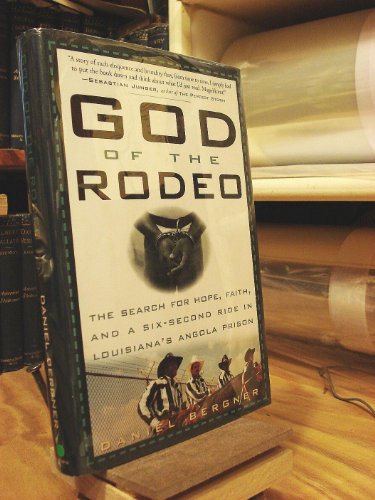
God of the Rodeo: The Search for Hope, Faith, and a Six-Second Ride in Louisiana's Angola Prison - Hardcover
Synopsis
Never before had Daniel Bergner seen a spectacle as bizarre as the one he had come to watch that Sunday in October. Murderers, rapists, and armed robbers were competing in the annual rodeo at Angola, the grim maximum-security penitentiary in Louisiana. The convicts, sentenced to life without parole, were thrown, trampled, and gored by bucking bulls and broncos before thousands of cheering spectators. But amid the brutality of this gladiatorial spectacle Bergner caught surprising glimpses of exaltation, hints of triumphant skill.
The incongruity of seeing hope where one would expect only hopelessness, self-control in men who were there because they'd had none, sparked an urgent quest in him. Having gained unlimited and unmonitored access, Bergner spent an unflinching year inside the harsh world of Angola. He forged relationships with seven prisoners who left an indelible impression on him. There's Johnny Brooks, seemingly a latter-day Stepin Fetchit, who, while washing the warden's car, longs to be a cowboy and to marry a woman he meets on the rodeo grounds. Then there's Danny Fabre, locked up for viciously beating a woman to death, now struggling to bring his reading skills up to a sixth-grade level. And Terry Hawkins, haunted nightly by the ghost of his victim, a ghost he tries in vain to exorcise in a prison church that echoes with the cries of convicts talking in tongues.
Looming front and center is Warden Burl Cain, the larger-than-life ruler of Angola who quotes both Jesus and Attila the Hun, declares himself a prophet, and declaims that redemption is possible for even the most depraved criminal. Cain welcomes Bergner in, and so begins a journey that takes the author deep into a forgotten world and forces him to question his most closely held beliefs. The climax of his story is as unexpected as it is wrenching.
Rendered in luminous prose, God of the Rodeo is an exploration of the human spirit, yielding in the process a searing portrait of a place that will be impossible to forget and a group of men, guilty of unimaginable crimes, desperately seeking a moment of grace.
"synopsis" may belong to another edition of this title.
About the Author
Daniel Bergner is a journalist and author of the novel Moments of Favor. He lives with his wife and two children in New York City.
From the Back Cover
"A story of such eloquence and brutality that, from time to time, I simply had to put the book down and think about what I had just read. Magnificent!"
--Sebastian Junger, author of The Perfect Storm
"A fascinating descent into the hell of one of America's most notorious prisons, God of the Rodeo offers a surprising and humane portrait of the men trapped in a horror beyond imagining."
--John Berendt, author of Midnight in the Garden of Good and Evil
"For most of us the story ends when a defendant is sentenced to prison. But as Daniel Bergner demonstrates so compellingly prison itself may be the most astonishing story of all. A horrific, macabre--yet strangely ennobling--tale of life on the other side."
--Jeffrey Toobin, staff writer, The New Yorker, legal analyst, ABC News, and author of The Run of His Life: The People v. O.J. Simpson
"An unusually stirring and transcendent work about a former slave plantation in Louisiana that is now one of the nation's most isolated prisons. Important, timely, and disturbing."
--Jonathan Kozol, author of Amazing Grace: The Lives of Children and the Conscience of a Nation
"Daniel Bergner uncovers a bizarre secret world inside Louisiana's notorious Angola prison, where unskilled prisoners perform as gladiators in public rodeos. He offers a stunning glimpse into an otherworld brimming with human passion and ambition, and does so with insight, eloquence, and compassion."
--Melissa Fay Greene, author of Praying for Sheetrock and The Temple Bombing
"A first-rate piece of investigative reporting that's written and constructed like a novel, God of the Rodeo brings us inside a place that seems almost unimaginable in present-day America."
--Nicholas Lemann, author of The Promised Land and Out of the Forties
"Daniel Bergner's account of what really goes on in hellholes like Louisiana's Angola prison should shock the nation's conscience."
--Tom Wicker, former New York Times columnist and author of A Time to Die: The Attica Prison Revolt
From the Inside Flap
had Daniel Bergner seen a spectacle as bizarre as the one he had come to watch that Sunday in October. Murderers, rapists, and armed robbers were competing in the annual rodeo at Angola, the grim maximum-security penitentiary in Louisiana. The convicts, sentenced to life without parole, were thrown, trampled, and gored by bucking bulls and broncos before thousands of cheering spectators. But amid the brutality of this gladiatorial spectacle Bergner caught surprising glimpses of exaltation, hints of triumphant skill.<br><br>The incongruity of seeing hope where one would expect only hopelessness, self-control in men who were there because they'd had none, sparked an urgent quest in him. Having gained unlimited and unmonitored access, Bergner spent an unflinching year inside the harsh world of Angola. He forged relationships with seven prisoners who left an indelible impression on him. There's Johnny Brooks, seemingly a latter-day Stepin Fetchit, who, while washing the warden's car, longs to be a
Reviews
Bergner (Moments of Favor) offers a fascinating portrait of the inmates of a maximum security penitentiary (Angola) in a state (Louisiana) where a life sentence means 'til you die. Providing the frame and the protagonists is Angola's annual fall rodeo, where inmates compete in such events as "Guts & Glory," trying to grab a $100 chip from between the horns of an angry bull. Wondering why these men would submit themselves to such harm for little glory and less money, Bergner decided to follow six of them from one year's rodeo to the next. With a comfortable sympathy for warden Burt Cain and his program of faith and rehabilitation, Bergner spent his first five months freely interviewing guards and inmates. But in January, Cain suddenly demanded first editorial veto, then a cut of the royalties. Refusing both, Bergner lost entrance to the prison and while a lawsuit reinstated his access, the interruption (of interviews and narrative) opened Bergner's eyes to the warden's despotic paternalism (his new programs included shoe-shine detail and car-wash detail) and inspired greater confidence from inmates. Whether by dumb luck or design, Bergner's half-dozen subjects turned out to be inspired ones. A couple of them seemed simply criminals doing time; the others were looking for something transcendent, whether through God, family or rodeo. Bergner brilliantly balances the pathos of this life (e.g., the fear of being buried in a flimsy state-issued coffin) with the violent facts of the crimes. Had Bergner been a less scrupulous journalist and glossed over the rupture in the center of his account, it might have made a better narrative. But it would not have been so honest.
Copyright 1998 Reed Business Information, Inc.
Angola, La., is this nations version of Devils Island, a swamp-bound expanse of territory larger than Manhattan. The place, writes novelist Bergner (Moments of Favor, 1991), is also strangely beautiful, a tropical wonderland of magnolia, oak, cypress, and crab applehardly the common version of hell. Yet hell it is. Bergner writes of men who, for entertainment and revenge, fling feces at one another, cut each other with homemade knives, kill, and maim. Considered the toughest prison in a state with a good claim to the toughest sentencing laws in the nation, Angola was a place where many entered and few left, where guards behaved with studied brutality. The Supreme Court, Bergner writes, found that Angolas wardens so regularly violated the constitutional rights of the inmates that it ordered federal oversight of the prison, including the replacement of the old wardens with a new breed more attuned to modern theories of penology. One of those newcomers, Burl Cain, especially fascinates Bergner. A no-nonsense lawgiver, Cain believes in redemption and rehabilitation, and one of his innovations was the creation of a prison rodeo that draws onlookers from miles around to see the residents of Angola compete against sharp-horned bulls for a small cash purse. This rodeo provides Bergner with a useful framing device for his narrative, but it is also an object lesson in empty symbolismfor the dangerous rodeo offers small rewards and costs its participants dearly. We owe the prisoners little, Bergner writes, for in the main they have brought their fates on themselves. Yet even he argues that we owe them more than a perverse rodeo as a vehicle for self-improvement and a way to make themselves known. Although no classic of criminology or of muckraking journalism, Bergners book is, all the same, an interesting glimpse at the underside of American life. -- Copyright ©1998, Kirkus Associates, LP. All rights reserved.
Rodeos are not usually associated with maximum-security prisons, yet every October for 35 years, Angola Prison in Louisiana has staged a full-scale rodeo viewed by thousands of spectators. Journalist Bergner wrote an article about the rodeo for Harper's magazine, then expanded the material into this volume, which traces a year in the lives of six convict rodeo riders. The text suffers at times from disorganization and from padding, but nevertheless it gives a vivid picture of this bizarre event. Bergner describes how the inmates willingly participate in the rodeo because they have been convinced by prison authorities that it amounts to absolution of their sins. The Louisiana public, many still heavily racist, come to watch the convicts "thrown every which way." It has all the earmarks of a Roman circus. The most fascinating of all is the modern-day Caesar, Warden Burl Cain, who is noted for both his evangelism and his skulduggery. Since this is not a typical prison story, it may appeal to the general reader.?Frances O. Sandiford, Green Haven Correctional Facility Lib., Stormville, NY
Copyright 1998 Reed Business Information, Inc.
Angola State Penitentiary in Louisiana is one of the toughest in the nation, but every October over four consecutive weekends, the inmates have a brief opportunity to excel in the prison rodeo. Bergner, a journalist and novelist, gained extraordinary access to the inmates, the warden, and the penal bureaucracy in this unique portrait of an institution whose ultimate function seems little understood even by those closest to it. Should a prison simply incarcerate, or should it strive to rehabilitate? Burl Cain, warden at Angola, quotes Jesus Christ and Attila the Hun and has been surrounded by scandal throughout his tenure, including an incident associated with Bergner and this book. Even more critical to Bergner's portrait of prison life are the six inmates whose lives he examines closely. Most will not leave Angola, but one has. He turned his life around after experiencing a revelation while preparing a "feces cocktail" to throw at a cellmate. He realized he was wasting a life: his own. He's out now and drives a truck. The other inmates are left behind, left with Octobers and rodeos but little realistic hope. The autumn rodeo was the catalyst for this book, but it is not the focus. The rodeo is a symbol of hope for these men, and if not hope, a way to mark time and a break in their dreadful routine. Bergner does the near impossible: he creates empathy for the prisoners yet never allows the reader to lose sight of the reasons for their incarceration. Some people should not live in society, but we can't turn our back on their innate--if deeply flawed--humanity. A very powerful and beautifully written book. Wes Lukowsky
Excerpt. © Reprinted by permission. All rights reserved.
Chapter One
When he had finished work--building fence or penning cattle or castrating bull calves with a knife supplied by his boss on the prison farm--Johnny Brooks lingered in the saddle shed. The small cinder-block building is near the heart of Angola, Louisiana's maximum-security state penitentiary. Alone there, Brooks placed his saddle on a wooden rack in the middle of the room, leapt into it, and imagined himself riding in the inmate rodeo coming up in October. He prepared himself. The afternoon he first showed me what he did, the shed's corrugated metal door was half shut. The air in the unlit room had a dusky, textured quality, almost like the weave of a fabric. He floated on it, the fabric. To vault himself into the saddle, which rested at chest height, he did not use a stirrup. Nor, it seemed, did he bend his knees. He merely flicked his ankles to rise well above the leather, and for an instant he was frozen there, suspended above it, legs spread in perfect symmetry and spine impeccably upright.
That morning, in early September, I had watched him train a colt in a tight, fenced ring. Brooks stood at the center and taught the young quarter horse to cut, to switch directions fast, on command, so that eventually it could work the cattle. "Get around there," he demanded. "Get around; get around." And warned, "Better behave yourself." The colt kept half an eye on Brooks always. Brooks's voice was quiet, but the horse had no desire to feel the whip he carried. And though floggings were a thing long past at Angola, Brooks maintained his own sidelong glance on his boss, one of the freemen who ran the range crew, leaning against the fence. The sleeves of Brooks's T-shirt looked taut as rubber bands around his muscles, which were thick as tree roots. His boss was short, heavy, more like a softening stump. "Give me handle," he said, and Brooks answered, "Yassuh," and "Yassuh" was much of what I heard him say during the first weeks I knew him, whether in response to me or to prison employees. He kept his shoulders stooped. His head hung slightly. Often his eyes were lowered. He had, at times, an unrestrained, affecting smile that included his eyes, though he was missing three bottom teeth and the upper ones didn't look so healthy. He was a caricature, an illusion from another era, humble black servant, Stepin Fetchit.
"Yassuh," he replied after finishing with the colt, when another of the freemen called, "Mr. Jimmy wants his truck washed." He jogged over, caught the keys that were tossed his way, and hustled off to soap, scrub, rinse, and dry.
But later, inside the saddle shed, his shoulders were straight and his speech gained authority. The air seemed not only textured but, like the air over all of Angola's vast grounds, laden, palpably heavier than the atmosphere outside the gates. Five thousand men were incarcerated there. Eighty-five percent had killed or raped or robbed with violence. About eight in ten were sentenced either to life without parole or to so many years they might as well have been. (Louisiana had good claim to the toughest sentencing laws in the nation. It was one of only three states where all lifers were natural lifers--the governor's clemency offered the only way out. Other states with a natural life sentence used it sparingly.) Brooks, here for beating a woman to death during a robbery twenty-two years ago, was no longer floating above his saddle. He sat on the brown leather. Yet his new posture and voice, and his eyes that were suddenly direct and animated, defied more than his submissiveness; they defied Angola's excess gravity.
In the previous year's rodeo a gold-tinted bull had knocked him unconscious. Hurtling, the 1,600 pound animal snapped Brooks's neck back then forward, slamming his head into the knobby rock of muscle between the bull's shoulders. Now Brooks envisioned drawing the same bull, reminded himself to stay out of its "territory," not to let his weight fall too far back. Or he would lose all control and the whiplashing would start.
He schooled himself, in the hush of the room, to slice the air with the elbow of his free arm, the way the pros on TV did, for balance against the bull's spin. He taught himself to spur constantly against that spin, a plea--as much as a command--for an end to centrifugal force. The bull rope would be tied around his right hand. He imagined how hard he wanted the rope pulled by the inmate helping him in the chute. "It should feel like the tire of a truck pinning me there, Mr. Dan, he said. When I get done it should feel like my hand been inside a vise."
To fix his eyes only on the bull's left shoulder, never on its head--he trained himself about that, too. The head was a temptation but would trick you; the animal always went where the shoulder did. And he tried to anticipate the sensation when the chute gate opened and the bull exploded. Fear would blacken his mind, make him deaf to every sound. There would be no conscious control from then on. There would be only the reactions he tried to drill into himself here, daydreaming.
Besides last year's injury, Brooks had, after his first ride in his first rodeo more than a decade ago, been kicked in the back by the bull that threw him. He had then watched another convict thrown immediately in front of the chute. The bull found the man on the ground and shook him between its horns, cracking his spine--the man was left a quadriplegic, living in the Department of Corrections' version of a nursing home. A few years later, Brooks had broken his arm, and the year before last the flesh just below his eye had been sliced open by a bulls horn. Rodeo anywhere is a dangerous sport, bull riding its most extreme event. The prison staff who oversaw Brooks on the range crew, and who organized Angola's rodeo, were quick to remind me of this. Brooks's medical history would be about the gentlest on the pro tour. But many pros enter two rodeos in a weekend, ride several bulls every week, hundreds in a year. Each year Brooks mounted exactly four. His odds were not gentle at all.
They were not meant to be. The inmate rodeo, a thirty-two-year-old tradition that year, 1996, was held every Sunday in October and was billed by the prison as "The Wildest Show in the South." The public was invited through Angola's gates, lured by write-ups in the fun section of the local paper promising untrained convicts "thrown every which way." The men could not practice. Many, unlike Brooks and a few others who worked with horses as part of their prison jobs, had never so much as ridden a pony at a childhood street fair. They were not given the protective vests the pros wear to save themselves from shattered ribs and punctured lungs when the bronco kicks or the bull stomps down. Broken shoulders or wrists or ribs occurred daily. One past rider, petrified on his horse in a slapstick event called "Buddy Pick-Up," had died of a heart attack. Hours before the rodeo started, to be sure of getting in, the fans would line their cars along the shoulder of the road leading to Angola; there was rarely enough room for everyone in the prisons old 5,000-seat arena. Weeks before, the convicts signed up to compete in the spectacle--and signed a release absolving the prison of all liability--then begged their way into the featured events.
And yes, Brooks knew what the public came for. "Some of them, sure," he said when I asked about rooting for broken bodies. But not all. "And if you give them something good..." He spoke more of technique, of the bull's "pivot point," of a "suicide tie" for his right hand, of locking his right elbow, of watching J. W. Hart and Tuff Hedeman and Ted Nuce on ESPN, "studying them tight, tight." Then he talked again of the spectators, who cheered loudly for the best performances. He had heard it. He knew they did. And he recalled the day a rodeo clown--hired from the pro circuit to draw the bulls away from fallen riders--hugged him, lifted him off his feet in congratulations after a beautifully executed ride. "He liked what I done," Brooks remembered, his eyes completely at odds with the understatement of his words, "and he just picked me up like this."
"About this title" may belong to another edition of this title.
Search results for God of the Rodeo: The Search for Hope, Faith, and a...

Stock Image
God of the Rodeo: The Search for Hope, Faith, and a Six-Second Ride in Louisiana's Angola Prison
Seller: HPB-Diamond, Dallas, TX, U.S.A.
Seller rating 5 out of 5 stars

hardcover. Condition: Very Good. Connecting readers with great books since 1972! Used books may not include companion materials, and may have some shelf wear or limited writing. We ship orders daily and Customer Service is our top priority! Seller Inventory # S_471807754
Stock Image
God of the Rodeo: The Search for Hope, Faith, and a Six-Second Ride in Louisiana's Angola Prison
Published by
Crown Publishing Group (NY), 1998
ISBN 10: 0609601059
ISBN 13: 9780609601051
Used
Hardcover
Seller: World of Books (was SecondSale), Montgomery, IL, U.S.A.
Seller rating 5 out of 5 stars
Hardback. Condition: Good. Never before had Daniel Bergner seen a spectacle as bizarre as the one he had come to watch that Sunday in October. Murderers, rapists, and armed robbers were competing in the annual rodeo at Angola, the grim maximum-security penitentiary in Louisiana. The convicts, sentenced to life without parole, were thrown, trampled, and gored by bucking bulls and broncos before thousands of cheering spectators. But amid the brutality of this gladiatorial spectacle Bergner caught surprising glimpses of exaltation, hints of triumphant skill. The incongruity of seeing hope where one would expect only hopelessness, self-control in men who were there because they'd had none, sparked an urgent quest in him. Having gained unlimited and unmonitored access, Bergner spent an unflinching year inside the harsh world of Angola. He forged relationships with seven prisoners who left an indelible impression on him. There's Johnny Brooks, seemingly a latter-day Stepin Fetchit, who, while washing the warden's car, longs to be a cowboy and to marry a woman he meets on the rodeo grounds. Then there's Danny Fabre, locked up for viciously beating a woman to death, now struggling to bring his reading skills up to a sixth-grade level. And Terry Hawkins, haunted nightly by the ghost of his victim, a ghost he tries in vain to exorcise in a prison church that echoes with the cries of convicts talking in tongues. Looming front and center is Warden Burl Cain, the larger-than-life ruler of Angola who quotes both Jesus and Attila the Hun, declares himself a prophet, and declaims that redemption is possible for even the most depraved criminal. Cain welcomes Bergner in, and so begins a journey that takes the author deep into a forgotten world and forces him to question his most closely held beliefs. The climax of his story is as unexpected as it is wrenching. Rendered in luminous prose, God of the Rodeo is an exploration of the human spirit, yielding in the process a searing portrait of a place that will be impossible to forget and a group of men, guilty of unimaginable crimes, desperately seeking a moment of grace. From the Hardcover edition. Seller Inventory # 00105271635
Stock Image
God of the Rodeo: The Search for Hope, Faith, and a Six-Second Ride in Louisiana's Angola Prison
Published by
Crown Publishing Group (NY), 1998
ISBN 10: 0609601059
ISBN 13: 9780609601051
Used
Hardcover
Seller: World of Books (was SecondSale), Montgomery, IL, U.S.A.
Seller rating 5 out of 5 stars
Hardback. Condition: Very Good. Never before had Daniel Bergner seen a spectacle as bizarre as the one he had come to watch that Sunday in October. Murderers, rapists, and armed robbers were competing in the annual rodeo at Angola, the grim maximum-security penitentiary in Louisiana. The convicts, sentenced to life without parole, were thrown, trampled, and gored by bucking bulls and broncos before thousands of cheering spectators. But amid the brutality of this gladiatorial spectacle Bergner caught surprising glimpses of exaltation, hints of triumphant skill. The incongruity of seeing hope where one would expect only hopelessness, self-control in men who were there because they'd had none, sparked an urgent quest in him. Having gained unlimited and unmonitored access, Bergner spent an unflinching year inside the harsh world of Angola. He forged relationships with seven prisoners who left an indelible impression on him. There's Johnny Brooks, seemingly a latter-day Stepin Fetchit, who, while washing the warden's car, longs to be a cowboy and to marry a woman he meets on the rodeo grounds. Then there's Danny Fabre, locked up for viciously beating a woman to death, now struggling to bring his reading skills up to a sixth-grade level. And Terry Hawkins, haunted nightly by the ghost of his victim, a ghost he tries in vain to exorcise in a prison church that echoes with the cries of convicts talking in tongues. Looming front and center is Warden Burl Cain, the larger-than-life ruler of Angola who quotes both Jesus and Attila the Hun, declares himself a prophet, and declaims that redemption is possible for even the most depraved criminal. Cain welcomes Bergner in, and so begins a journey that takes the author deep into a forgotten world and forces him to question his most closely held beliefs. The climax of his story is as unexpected as it is wrenching. Rendered in luminous prose, God of the Rodeo is an exploration of the human spirit, yielding in the process a searing portrait of a place that will be impossible to forget and a group of men, guilty of unimaginable crimes, desperately seeking a moment of grace. From the Hardcover edition. Seller Inventory # CIN0609601059VG
Stock Image
God of the Rodeo: The Search for Hope, Faith, and a Six-Second Ride in Louisiana's Angola Prison
Seller: ThriftBooks-Dallas, Dallas, TX, U.S.A.
Seller rating 5 out of 5 stars
Hardcover. Condition: Very Good. No Jacket. May have limited writing in cover pages. Pages are unmarked. ~ ThriftBooks: Read More, Spend Less. Seller Inventory # G0609601059I4N00
Stock Image
God of the Rodeo: The Search for Hope, Faith, and a Six-Second Ride in Louisiana's Angola Prison
Seller: ThriftBooks-Atlanta, AUSTELL, GA, U.S.A.
Seller rating 5 out of 5 stars
Hardcover. Condition: Very Good. No Jacket. May have limited writing in cover pages. Pages are unmarked. ~ ThriftBooks: Read More, Spend Less. Seller Inventory # G0609601059I4N00
Stock Image
God of the Rodeo: The Search for Hope, Faith, and a Six-Second Ride in Louisiana's Angola Prison
Seller: ThriftBooks-Dallas, Dallas, TX, U.S.A.
Seller rating 5 out of 5 stars
Hardcover. Condition: Very Good. No Jacket. Missing dust jacket; May have limited writing in cover pages. Pages are unmarked. ~ ThriftBooks: Read More, Spend Less. Seller Inventory # G0609601059I4N01
Stock Image
God of the Rodeo: The Search for Hope, Faith, and a Six-Second Ride in Louisiana's Angola Prison
Seller: ThriftBooks-Reno, Reno, NV, U.S.A.
Seller rating 5 out of 5 stars
Hardcover. Condition: Very Good. No Jacket. May have limited writing in cover pages. Pages are unmarked. ~ ThriftBooks: Read More, Spend Less. Seller Inventory # G0609601059I4N00
Stock Image
God of the Rodeo: The Search for Hope, Faith, and a Six-Second Ride in Louisiana's Angola Prison
Seller: ThriftBooks-Atlanta, AUSTELL, GA, U.S.A.
Seller rating 5 out of 5 stars
Hardcover. Condition: Good. No Jacket. Pages can have notes/highlighting. Spine may show signs of wear. ~ ThriftBooks: Read More, Spend Less. Seller Inventory # G0609601059I3N00
Stock Image
God of the Rodeo: The Search for Hope, Faith, and a Six-Second Ride in Louisiana's Angola Prison
Seller: ThriftBooks-Atlanta, AUSTELL, GA, U.S.A.
Seller rating 5 out of 5 stars
Hardcover. Condition: Very Good. No Jacket. Missing dust jacket; May have limited writing in cover pages. Pages are unmarked. ~ ThriftBooks: Read More, Spend Less. Seller Inventory # G0609601059I4N01
Stock Image
God of the Rodeo: The Search for Hope, Faith, and a Six-Second Ride in Louisiana's Angola Prison
Seller: Half Price Books Inc., Dallas, TX, U.S.A.
Seller rating 5 out of 5 stars
hardcover. Condition: Very Good. Connecting readers with great books since 1972! Used books may not include companion materials, and may have some shelf wear or limited writing. We ship orders daily and Customer Service is our top priority! Seller Inventory # S_474773820